
You are weighing a role change, an external job search, and a difficult workplace conversation. You are also unsure what a career coach would actually do. Career coaching is a client-led process that helps you examine career decisions, define useful goals, compare options, and choose practical next steps.
The process gives a career question a clear focus, while the coach asks questions, listens for patterns, reflects what they hear, and helps you review evidence. You decide what it means, which trade-offs you will accept, and what you will do next. You can see those responsibilities in practice under What Does a Career Coach Do?
TL;DR
Career coaching is a structured working relationship centered on a career question chosen by the client. The coach and client agree on the focus and scope, then examine the current situation, relevant evidence, assumptions, options, and possible actions. A career coach asks, listens, reflects, and may challenge an assumption with permission. The client interprets the discussion, chooses a direction, and completes any action. Later conversations review what happened and what the client wants to revise. Coaching can address decisions about direction, a current role, a job search, a transition, or a workplace conversation. It does not transfer responsibility for applications, decisions, communication, or follow-through to the coach.
What Is Career Coaching?
Career coaching is a structured, client-led working relationship for examining career questions. It brings goals, evidence, options, and actions into one agreed scope. The client sets the question and remains the author of each decision.
The work may begin with uncertainty rather than a finished goal. For example, a client might know that their current role no longer fits but remain unsure whether to change teams, employers, or fields. The coach helps make the question specific enough to examine without deciding which answer is right.
1. A Client-Led Working Relationship
The coach asks open questions, listens closely, and reflects patterns or tensions in what the client says. They may invite the client to test an assumption, compare evidence, or consider another view. A challenge is an invitation to think, not an instruction to agree.
The client decides what information matters and how to interpret it. They choose whether an option fits their priorities, consent to an action, and revise that action when new information appears. This division of responsibility keeps the work focused without treating the coach as the source of a correct career answer.
2. Who Career Coaching Can Support
Career coaching can be considered by working adults at many career stages when the question fits an agreed coaching scope. Someone might be entering leadership, returning after time away, considering a different role, preparing for a transition, or deciding how to address a concern in their present workplace.
The relevant starting point is a career question that the client wants to examine. Suitability depends on that question, the provider’s stated role, and the support required. If the need changes, both people can pause and agree whether coaching remains the appropriate form of support.
What Does a Career Coach Do?
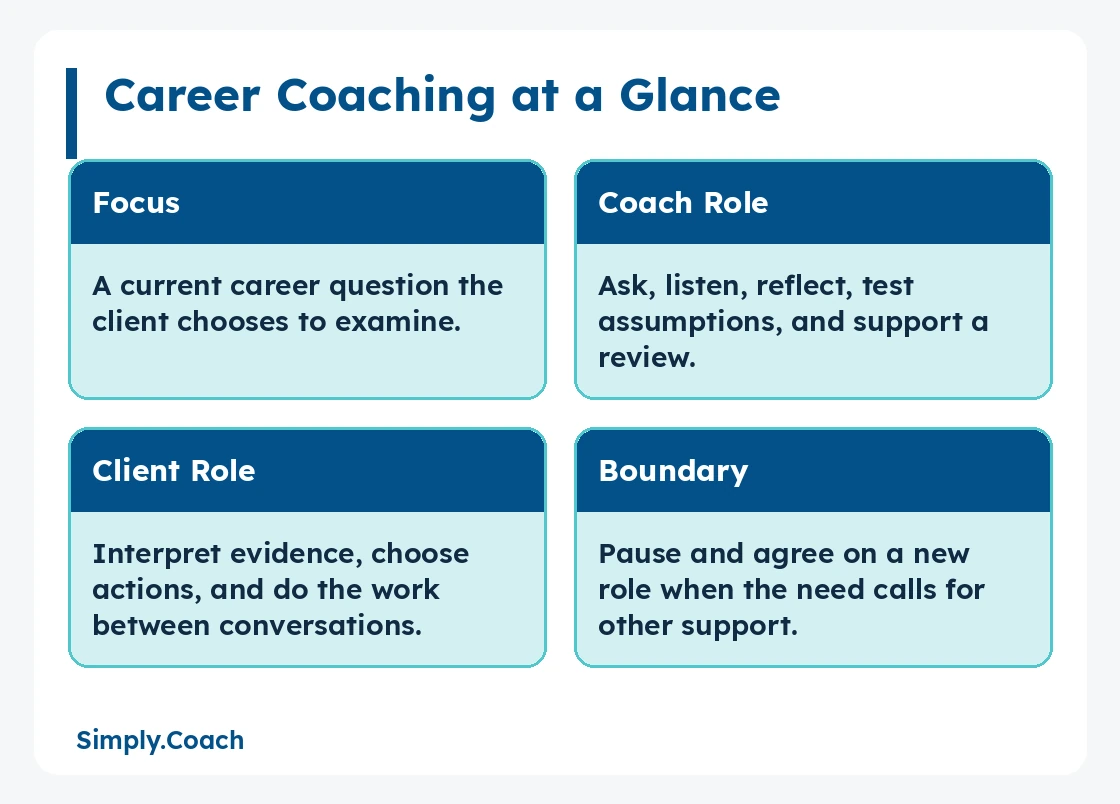
A career coach makes the work observable by agreeing on a question, keeping attention on it, and helping the client examine what informs it. The role is active but bounded. The coach structures the conversation, while the client supplies context and owns the choices.
1. Set the Focus With the Client
The coach first asks what the client wants to think about and what would make the conversation useful. Together, they turn a broad concern into a workable focus. They also agree on the scope, their respective roles, and how they will recognize when the focus needs to change.
A client may say they need a new career, yet that statement can hold several questions. The immediate issue could be dissatisfaction with a task, uncertainty about a promotion, or interest in another field. The coach reflects these possibilities and asks which one the client wants to examine first.
2. Examine Evidence and Options
The coach asks what the client knows, what they are assuming, and what remains unclear. They listen for repeated themes and reflect them without presenting an interpretation as fact. With the client’s permission, they can question a conclusion or ask what evidence would change it.
Options become easier to compare when their trade-offs are explicit. The coach may help the client name the criteria that matter, such as the work involved, timing, responsibilities, or uncertainty. The client decides how much weight each criterion receives and which options remain open.
3. Turn Choices Into Reviewable Actions
When the client chooses a direction, the coach asks what action would provide useful information or move the decision forward. The action might be gathering facts, preparing for a conversation, or drafting questions for someone with relevant knowledge. The client decides whether to accept it and when to act.
The coach records the agreed action and returns to it at a review point. Review is not a pass or fail judgment. It asks what happened, what the client learned, and whether the next action should continue, change, or stop.
| Coaching area | What the coach does | What the client owns |
|---|---|---|
| Focus | Agrees on the question and scope | Chooses the question to examine |
| Evidence | Asks and reflects what emerges | Interprets what the evidence means |
| Options | Invites comparisons and assumption checks | Weighs trade-offs and keeps or rejects options |
| Action | Records the action the client accepts | Chooses and completes the action |
| Review | Asks what happened and what changed | Decides what to continue or revise |
How Does Career Coaching Work?
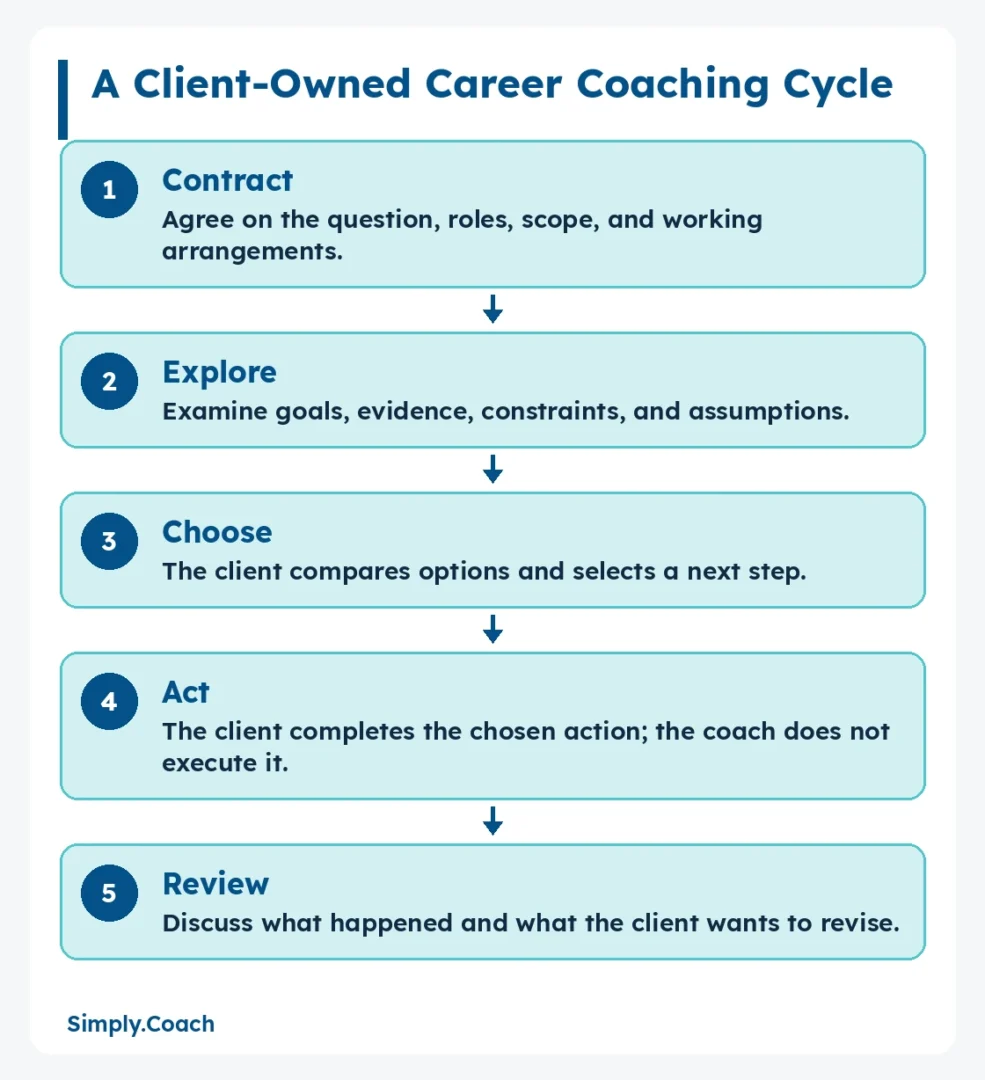
Career coaching usually follows a repeatable cycle rather than a fixed script. The coach and client contract the relationship, explore the current question, choose a next step, and review what the client learns. The cycle can repeat as the question becomes clearer or the situation changes.
1. Contract the Relationship
Contracting makes the working arrangement explicit. The coach and client agree on the question, scope, roles, confidentiality arrangements, contact, records, and review points. They clarify what coaching includes and what would require a different role or another form of support.
The agreement can be revisited. If a client asks for direct advice or a finished deliverable, the coach names that change before proceeding. The client can then decide whether to add a separately defined service or keep the engagement within coaching.
2. Explore the Current Career Question
The client describes the situation in their own terms. The coach asks questions that separate observations from assumptions and helps organize the evidence already available. They may reflect a gap, conflict, or pattern and check whether the client recognizes it.
Exploration can reveal that the original question needs revision. A request for career guidance about changing employers may become a decision about duties, location, or a workplace conversation. The client chooses whether to restate the focus before comparing possible paths.
3. Choose and Review the Next Step
The client chooses an action that fits the decision and the information they need. The coach can ask how specific it is, what consent or preparation it requires, and when the client wants to review it. The action remains the client’s commitment.
At the next review, both examine what happened rather than forcing the original plan to continue. New evidence may support the choice, weaken it, or create another option. The client decides what the learning changes and chooses the next step, if any.
4. Career Coaching Strategies
This page explains the high-level cycle, while detailed career coaching strategies and techniques belong to the family lead. That distinction keeps the focus here on what the relationship is and how client ownership works.
Career Coaching and Related Forms of Support
Career coaching, counseling, mentoring, advising, consulting, recruiting, and specialist services answer different needs. Their activities may overlap, and providers may use the terms differently. Any overlap should be made explicit through a clear scope and an agreed change of role.
The useful question is not whether one label is always better. It is whether the provider’s role matches the client’s present need and whether both understand who will decide, advise, or deliver work.
1. Career Counseling
No single past-versus-present distinction explains every coaching and counseling service. A provider should describe the questions they address, the work they offer, and the limits of the agreement. The client can then compare that scope with the support they are seeking.
If a need falls outside the coaching agreement, the coach should pause, name the boundary, and discuss another qualified form of support. The coach should not quietly expand their role or imply competence that has not been agreed.
2. Mentoring and Advising
A mentor may share experience from a field, organization, or role. An adviser may recommend a course of action based on stated expertise. Career coaching services can sit beside either role, but the speaker should say when they move from asking and reflecting to sharing an opinion or recommendation.
Clear labels let the client decide how to treat the input. Advice remains information for the client to assess, not a transfer of responsibility for the final career decision.
3. Consulting and Specialist Services
A consultant or specialist may analyze a defined problem or produce a deliverable. Recruiters represent a hiring process, while resume writers and other specialists may complete agreed work for a client. Those roles differ from a coaching conversation in which the client does the work and chooses the answer.
One provider may offer more than one service. They should name each role, explain its scope, and obtain agreement before changing roles. This prevents a recommendation or deliverable from being presented as though it emerged from client-led coaching.
Questions Career Coaching Can Help a Client Examine
Career questions become workable when they are bounded and connected to evidence the client can consider. The examples below describe topics for examination, not results that coaching produces.
- Career direction: What evidence supports a change, and which assumptions about a possible field still need testing?
- Current role: Which parts of the role fit the client’s priorities, and what trade-offs would come with seeking different duties or compensation?
- Job search or transition: What criteria will the client use to compare options, and what information is missing before they decide?
- Workplace decisions: What conversation does the client want to prepare for, what do they want to communicate, and which responses are outside their control?
- Next-step commitment: What action does the client choose, what could they learn from it, and when do they want to review what happened?
These questions can change as the client learns more. A compensation discussion, role-development decision, external application, or concern about work may supply the context. The coach keeps the inquiry clear, while the client decides what conclusion and action fit.
What the Client Still Owns
The client owns interpretation, decisions, consent, actions, communication, and follow-through. A coach can reflect what they hear and ask the client to consider another view. The client decides whether that view matters and whether to act on it.
The coach does not choose a career, submit applications, attend workplace conversations, or guarantee another person’s response. They also do not decide that a particular salary, role, employer, or field is the right result. Those judgments remain with the client.
If an engagement includes advice, resume work, research, or another deliverable, the provider should label and contract that role separately. The client needs to know when the provider is coaching, when they are recommending, and when they are completing work.
Records and review points can maintain continuity across conversations. Notes can preserve the agreed focus, and action records can show what the client chose to try. They do not guarantee that an action will be completed or that a particular career result will follow.
Conclusion
Career coaching gives a working adult a structured space to examine a career question. The coach agrees on the focus, asks, listens, reflects, and helps organize evidence and options. The client decides what the discussion means and what happens next.
That division of responsibility applies from the first agreement through each review. A clear scope also shows when the need has changed and another role or form of support should be discussed. Throughout the process, the career decision and its consequences remain the client’s own.
Key Takeaways
The central points define the working relationship and preserve the client’s decisions, actions, and responsibilities throughout it.
- Client-led process: Career coaching starts with a question the client chooses and keeps the meaning, direction, and final decision with that client.
- Observable coach role: The coach agrees on focus, asks, listens, reflects patterns, invites assumption checks, and records actions selected by the client.
- Reviewable sequence: Coaching uses checkpoints for scope, exploration, choice, action, and review, so each conversation can build on what the client learned.
- Explicit boundaries: Coaching, counseling, mentoring, advising, consulting, recruiting, and specialist work should be distinguished through a clear and agreed scope.
- Neutral questions: Career direction, a current role, a job search, a transition, or a workplace decision can be examined without promising a result.
- Client ownership: The client interprets evidence, gives consent, communicates, completes actions, and decides what to continue, revise, or stop.
Keep the practical side of an engagement organized with Simply.Coach coaching and mentoring software. Use it to manage scheduling and sessions, maintain notes and goal records, assign client-chosen actions and reminders, share forms and resources, and give each client a dedicated workspace.
Frequently Asked Questions (FAQs)
What is career coaching?
Career coaching is a client-led process for examining career questions, goals, evidence, options, and next steps. The coach asks, listens, reflects, and helps structure the conversation. The client interprets what emerges, chooses a direction, and remains responsible for each decision and action.
What does a career coach actually do?
A career coach agrees on the focus, asks open questions, reflects patterns, tests assumptions, and helps a client compare options. The coach may record goals and review points, but does not choose a career, guarantee an outcome, or complete the client's work.
How does career coaching work?
The coach and client first agree on the question, scope, roles, and working arrangements. They examine the current situation and available evidence, compare options, and identify a client-chosen next step. Later conversations review what happened and what the client wants to adjust.
What should I expect from career coaching?
Expect focused conversations about a career question you choose, along with reflection, open questions, and agreed records or actions. A coach may challenge an assumption or invite another view, but you decide what the discussion means and what you will do between conversations.
What is the purpose of career coaching?
The purpose is to give a client a structured space to examine a career decision without transferring ownership of it. The process can make evidence, assumptions, options, and trade-offs easier to discuss, while the client chooses the goal and the next action.
Is career coaching the same as career counseling?
No single distinction fits every provider or jurisdiction. Career coaching usually works within an agreed coaching scope around current career questions and client-chosen actions. Counseling or another qualified service may be more appropriate when the need falls outside that agreement. Ask each provider to explain their scope.
Can a career coach do the work for you?
No. A coach can help you examine evidence, prepare for a decision, compare options, and review an action you chose. You remain responsible for applications, conversations, decisions, and follow-through. Any advising, consulting, or done-for-you service should be named and agreed separately.