
Feeling stuck at work can resemble walking hard on a treadmill incline while the view never changes. Career coaching can help you clarify goals, examine options, plan next steps, and review progress, but it cannot choose your path or guarantee a job. The benefits of career coaching are possible uses of structured support, not promised results.
You might bring a career choice, transition, job search, or practice need to a coach. A coach can ask questions, review evidence, and help you record actions, but you decide what matters and what to try. The section “When career coaching may be worth considering” gives you a practical fit check before you commit time or money.
TL;DR
Career coaching may help you frame a question, examine work evidence, compare options, practice a conversation, and review an action you selected. Its value depends on the need, scope, coach background, working fit, and your willingness to do the work. A coach may offer an external perspective, but you own every decision and consequence. Coaching cannot promise a job, promotion, pay change, confidence, or relief from a mental-health condition. It is not a substitute for therapy, licensed care, training, mentoring, or specialist advice when those options fit better. Before committing, agree on boundaries, process, records, time, and cost, then decide whether the support matches your priorities.
Benefits of career coaching
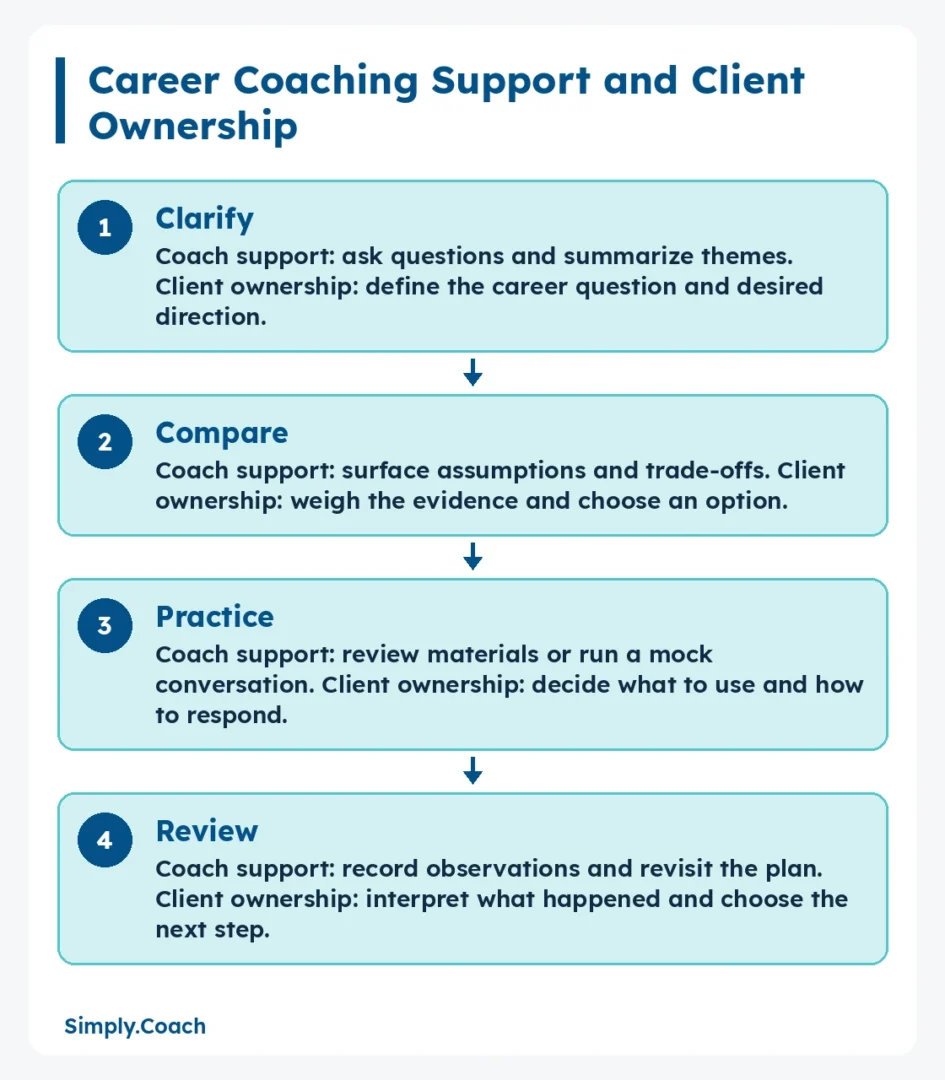
Career coaching can give you a structured place to examine work questions and prepare client-selected actions. Its possible benefits come from what you explore, practice, record, and review.
a. Understand professional value
A coach may help you collect work examples, feedback, and documented contributions. You decide which evidence reflects your skills and how to describe it. A simple record might pair each contribution with its context, your action, and the observation that followed.
b. Establish a personalized, executable career plan
A coach can help you turn a broad concern into options that you can compare. You define the direction, trade-offs, steps, and review date. Your record might list one action, its deadline, and the evidence you will examine later.
c. Identify skill needs, practice abilities & examine confidence
Coaching can help you compare a role requirement with evidence from your current work. You choose a skill to practice and decide how to record the attempt. Afterward, you may report feeling more or less confident, but that observation does not prove a career outcome.
d. Work through difficult career choices
A coach may help you name options, assumptions, risks, and trade-offs. You weigh that information, choose the option, and accept its consequences. A decision record can show what you knew, what remained uncertain, and why the choice fit your priorities at that time.
e. Prepare for career transitions
During a possible transition, a coach may help you examine role evidence and notice possible skill gaps. You choose whether to test an assumption through a conversation, short course, project, or limited work sample. Record what you learned before deciding on a larger move.
f. Assume accountability for professional growth
Accountability starts with an action you choose, not a task imposed by a coach. You set its timing and define what evidence would show completion. The coach can record that agreement and review what happened, while you decide the next step.
g. Reflect on motivation, work anxiety & stress
A coaching session may give you space to describe a setback and structure the next career decision. You decide whether a small action feels useful. Coaching is not treatment for anxiety, stress, or another mental-health condition; persistent or acute distress may require an appropriately qualified health professional.
h. Get frank, constructive feedback
A coach can offer an external perspective, but no perspective is free from bias. You can agree on the type of feedback you want and ask for specific examples. You interpret the feedback and record what, if anything, you will use.
i. Use tools and resources, build a personal brand
A coach may review how your resume, cover letter, and professional profile present your work evidence. You choose the examples and wording that accurately represent you. A review record might note unclear claims, missing context, and edits you want to test, without predicting a recruiter’s response.
Tools for Success
Our repository of online coaching tools will help you help your clients fast-track their goals!

j. Prepare for the job interview
A coach may run a mock interview and ask you to connect answers with work examples. You decide which examples to use and how to respond. After practice, record which answers felt clear, what needs more evidence, and what you want to rehearse again.

What career coaching won’t do
Career coaching has clear boundaries and cannot take over your choices, work, timing, or results. These limits should be agreed before the work begins.
a. Drop that dream job in your lap
A coach cannot place a job in your hands or guarantee that an employer will choose you. The coach may review your evidence or preparation, but you decide what to send and where to apply. Hiring decisions remain with employers.
b. Do the work for you
A career coach may work with you but will not do the work for you. You choose each action, decide when to attempt it, and own the consequences. A review can document completion or a changed plan without treating compliance as the goal.
c. Be your therapist/life counselor
Titles and scopes vary, so agree on the coach’s role before you begin. Coaching is not a substitute for licensed mental-health care. A coach should state their competence and refer you when your needs fall outside it.
d. Agree with you all the time
Useful coaching does not require constant agreement. With your consent, a coach may question an assumption, ask for evidence, or point out a gap in the plan. You decide how to interpret the challenge and whether to change course.
e. Deliver instantaneous professional turnaround
Timing and outcomes vary, and coaching cannot promise an immediate professional change. A review may reveal a completed action, a revised assumption, or a decision to pause. Those observations describe what happened; they do not prove that coaching caused a wider career result.
When career coaching may be worth considering
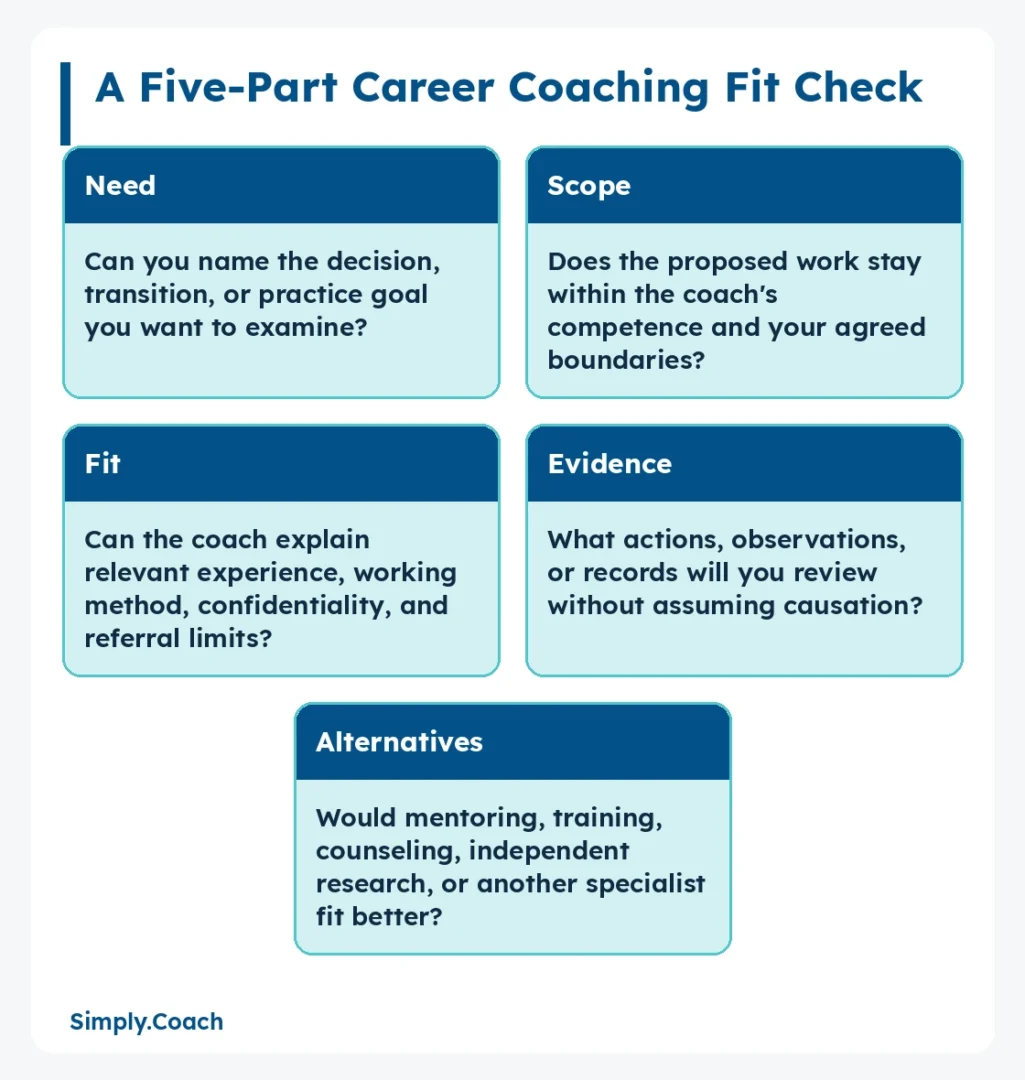
Career coaching may be worth considering when the issue is concrete enough to discuss and structured support seems relevant. Start by separating the need from a hoped-for result. For example, comparing two roles creates a clearer scope than seeking a better career in general.
Check whether the coach’s background relates to your situation, what stays private, where the engagement stops, and when another professional would be suggested. Reading about effective career coaching techniques can help you form questions about the approach used during sessions. Notice whether you can disagree, request examples, and keep each decision in your own hands.
- Need and scope: State the issue in one sentence, then agree on boundaries for the engagement.
- Background and fit: Look for past work connected to your situation. Pay attention to whether questions feel respectful and leave room to disagree.
- Process and evidence: Clarify how sessions connect and how you will assess an action afterward. Decide which notes or observations matter.
- Time and budget: Compare the expected commitment with your other priorities. Include preparation time, session time, and the full cost you are considering.
- Available alternatives: List other ways to get support, then judge each option against the same need.
Conclusion
The benefits of career coaching lie in structured examination, practice, and review rather than promised outcomes. A coach may help you clarify a question and compare evidence, but you choose the direction and do the work.
The limits matter just as much. Coaching cannot guarantee employment, make decisions for you, or replace licensed mental-health care.
A clear need, agreed scope, relevant background, workable relationship, and realistic trade-offs can help you judge fit. If those conditions are missing, another form of support may suit the question better.
Key Takeaways
Use these points to keep possible support, personal responsibility, and coaching’s limits clear when you assess your options.
- Structured support: Coaching may help you clarify a question, compare options, prepare actions, and review what you observe afterward.
- Client ownership: You define the goal, choose each action, interpret the evidence, and remain responsible for every career decision.
- Bounded benefits: Work examples, decision records, document reviews, and practice conversations are possible uses, not proof of career results.
- Clear limits: A coach cannot guarantee a job, complete your work, choose your path, or replace licensed mental-health care.
- Fit before commitment: Compare the need, scope, relevant background, working relationship, process, time, cost, and available alternatives.
- Evidence over promises: Agree on what you will review, then describe observations without claiming that coaching caused a wider outcome.
If you are a career coach who needs one place to manage client work, consider whether Simply.Coach fits your process. Explore its coaching and mentoring software, compare the available functions with your requirements, and decide whether the system matches the way you organize client work.
Frequently Asked Questions (FAQs)
How can one benefit from career coaching?
Career coaching can help you clarify a career question, examine your skills and work evidence, compare options, and plan actions you choose. It may also provide structured review and interview practice. These are possible uses of the process, not guarantees of a job, promotion, salary change, or greater confidence.
Why is career coaching important?
Career coaching can provide a structured space to examine a decision that feels difficult to handle alone. A coach may ask questions, reflect patterns, and help you review evidence. You remain responsible for defining the goal, choosing an action, and deciding whether coaching fits your needs.
What is the impact of career coaching?
Impact should be defined with the client before the work begins. Review client-selected actions, decision records, completed practice, and later observations against that starting point. Report what changed and what evidence was reviewed without claiming that coaching caused a job, performance, wellbeing, or financial result.
Does career coaching work?
Career coaching may be useful when you have a defined question, agree on the scope, and are willing to examine evidence and act on your own choices. Its value varies by need, coach fit, process, and context. No coach can guarantee a particular career or hiring outcome.
Is career coaching worth it?
It may be worth considering when the question matters, the scope is clear, and the coach's background and working method fit your need. Compare the expected time and cost with alternatives such as mentoring, training, counseling, or independent research. Decide using your priorities, not a promised result.
How much does it cost to have a job coach?
Fees vary by provider, location, experience, format, session length, and package scope. This local research pack does not support a reliable price range. Ask what is included, how cancellation works, what records you receive, and whether the proposed scope matches the career question you want to address.
Can ChatGPT be a career coach?
AI can help organize questions, draft options, or simulate practice, but it cannot verify every fact, understand your full context, or assume professional responsibility. Protect confidential information and check important advice. For high-stakes career, legal, financial, or mental-health concerns, use an appropriately qualified human professional.