
In 2025, the U.S. coaching industry is valued at approximately $5.34 billion, with projections indicating it will reach $10.1 billion by 2032. Despite this significant growth, many coaches face challenges in attracting the right clients, managing multiple programs efficiently, and clearly showcasing the results they deliver. If you find yourself overwhelmed by administrative tasks and struggling to differentiate your services, you’re not alone.
Specializing in a specific coaching niche is a proven strategy to overcome these challenges. By focusing on areas such as business coaching, relationship coaching, or health and wellness, you can position yourself as an expert, attract clients who are ready to invest in your services, and create structured programs that deliver measurable results. This approach not only helps in client acquisition but also streamlines your workflow, allowing you to serve your clients more effectively.
In this blog, we’ll explore 15 types of coaches and delve into how each one successfully attracts and retains clients within their niche. You’ll gain insights into the strategies that work best for client acquisition, learn how to position yourself effectively, and discover actionable steps to grow your coaching practice.
Key Takeaways
- The coaching industry in the U.S. is rapidly growing, creating opportunities across multiple niches.
- Choosing the right coaching type helps you attract ideal clients, build credibility, and increase revenue.
- Life, business, career, executive, relationship, financial, health & wellness, mindset, leadership, and other specialized coaching niches each have unique roles and client needs.
- Understanding your strengths, passions, and market demand is essential for selecting a profitable and fulfilling niche.
- Testing your niche with pilot programs or workshops ensures alignment with client expectations.
- Align your niche with personal and business goals to create a scalable, purpose-driven coaching practice.
Why Understanding Different Types of Coaches Matters
Choosing a clear coaching niche is one of the most strategic decisions you will make in your coaching career. When you define what kind of coach you are and who you serve best, you transform your practice from a general service to a focused solution. Your niche determines how effectively you attract clients, how much you can charge, and how sustainable your growth will be.
1. Builds your expertise and credibility
When you specialize, you move from being a coach who helps everyone to being the go-to professional for solving a specific problem. This focus allows you to develop deeper insights, create structured frameworks, and offer results that generalist coaches cannot consistently deliver.
Think of it this way: a leadership coach who focuses exclusively on first-time managers can design tailored programs for managing teams, giving feedback, and improving communication. This precision builds authority, and clients start to associate your name with reliable results in that area.
Certifications, case studies, and testimonials all reinforce that authority. The more specialized your outcomes, the easier it is for clients to trust your expertise and refer others facing the same challenge.
Know more: Steps to Getting a Professional Coaching Certification
2. Strengthens your brand positioning
Defining your niche also helps you build a brand that speaks directly to your ideal client. Every aspect of your marketing, from the tone on your website to the visuals on social media, can align with the emotional and professional journey of your audience.
For example, if you are a relationship coach helping individuals recover after a breakup, your messaging can reflect empathy, healing, and personal rediscovery. When potential clients read your content, they immediately recognize themselves in your words.
Your personal story becomes a powerful part of your brand. Coaches who have experienced the same struggles as their clients naturally build stronger emotional connections and trust faster.
Also read: 8 Tips for Powerful Personal Branding for Coaches
3. Increases your earning potential
Clients are willing to pay more when they know you specialize in their exact problem. Niche coaches consistently command higher fees than generalists because their expertise feels more valuable and targeted.
An executive coach who focuses solely on healthcare leaders can charge significantly more than a general leadership coach simply because they understand the industry’s language, challenges, and metrics for success.
With specialization, referrals also come naturally. Clients who achieve measurable results in a focused area tend to recommend you to peers in similar situations. Over time, you can even turn your approach into a signature framework or digital program, allowing you to scale your practice beyond one-on-one sessions.
Also read: Maximize Your Earning Potential: How to Make Money as a Life Coach
4. Helps you deliver measurable value
When you coach within a defined niche, your results become easier to measure and communicate. You are not just promising improvement or growth; you are showing specific transformations.
A financial coach can track debt reduction percentages, while a fitness coach can measure weight loss or muscle gain. These tangible outcomes make your services more marketable and credible.
You also gain confidence through repetition. Working with similar clients allows you to refine your methods, predict outcomes more accurately, and deliver a consistently strong experience that keeps clients coming back.
When you understand the different types of coaches, you gain clarity on where you fit in this expanding industry. You stop trying to appeal to everyone and start attracting the clients who truly value your expertise. That is when your business stops feeling like a hustle and starts running like a scalable, client-focused practice.
Read more: Benefits of Choosing a Coaching Niche
15 Types of Coaches and How They Attract Clients
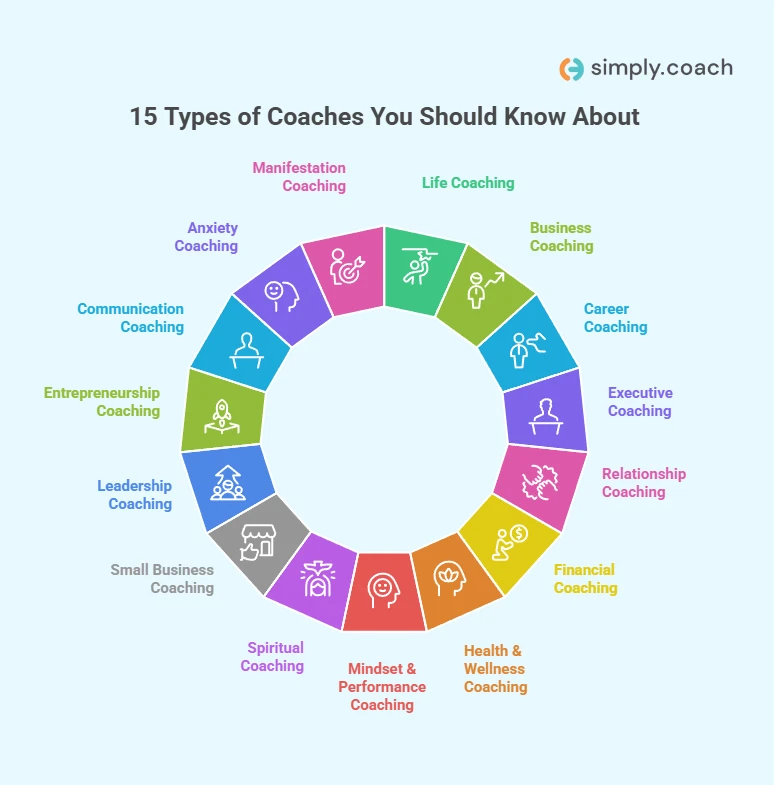
Each coaching niche demands a unique approach to visibility, credibility, and client conversion. Understanding how different types of coaches position themselves, market their expertise, and deliver measurable results helps you identify proven strategies that you can adapt to grow your own practice.
1. Life Coach
Life coaching focuses on helping individuals achieve personal growth, improve their mindset, and create meaningful life goals. As a life coach, you work with clients who want to overcome limiting beliefs, develop confidence, and make actionable changes that enhance their overall well-being. You help people gain clarity, direction, and motivation to lead a more fulfilling life.
What you do:
- Guide clients in identifying their strengths, values, and priorities.
- Help clients set actionable personal goals and track progress.
- Support mindset shifts to overcome obstacles and limiting beliefs.
- Provide tools and strategies to build positive habits and maintain long-term personal growth.
If you’re looking for a rewarding niche, life coaching is a strong choice, offering ample opportunities to attract clients who are ready to invest in themselves and their growth. You will need empathy, patience, and excellent communication skills, but you won’t struggle to make a meaningful impact as a life coach.
Pro Tip: If you’re serious about building a successful life coaching practice, explore Simply.Coach’s Life Coaching Track. It helps you understand the profession deeply, get certified, launch your business, and attract clients with confidence, all while mastering the tools and tech that simplify your growth journey.
2. Business Coach
Business coaching helps entrepreneurs, business owners, and leaders grow their companies while improving team performance. You work with clients to identify operational gaps, optimize processes, and implement strategies that drive measurable results. You guide leaders in making data-driven decisions and scaling their business efficiently.
What you do:
- Analyze business models, workflows, and leadership practices to uncover growth opportunities.
- Develop tailored strategies to increase profitability, efficiency, and competitiveness.
- Mentor leaders on decision-making, team management, and long-term strategic planning.
- Implement scalable systems, automate processes, and optimize resource allocation.
- Refine offerings, marketing approaches, and pricing strategies to maximize revenue growth.
Businesses constantly seek coaches who can help them solve operational challenges and drive growth. With proven strategies and measurable results, you position yourself as a trusted partner for companies ready to scale.
Try This: The Business Coaching Track by Simply.Coach offers a complete roadmap to becoming a professional business coach. Learn to position your services, get certified, start your practice, and scale with the right technology to manage clients efficiently.
3. Career Coach
Career coaching focuses on helping professionals navigate career transitions, achieve promotions, or pivot into new industries. You help clients identify their strengths, define career objectives, and create actionable plans to reach their professional goals. You support clients in gaining clarity, confidence, and positioning themselves effectively in competitive job markets.
What you do:
- Assess skills, strengths, and career goals to create personalized development plans.
- Guide clients in resume building, interview preparation, and professional branding.
- Provide step-by-step strategies for career transitions, promotions, or skill enhancement.
- Advise on job search techniques, networking, and leveraging online platforms effectively.
- Support decision-making and problem-solving in workplace challenges to maintain career momentum.
Professionals who achieve measurable progress through strategic guidance and actionable steps see tangible career growth. By consistently delivering results, you build a reputation that attracts high-value clients ready to invest in their future.
Next Step: If you’re aiming to build or expand your career coaching practice, the Career Coaching Track from Simply.Coach can guide you. It covers everything from certification and client acquisition to using tech tools that streamline your coaching business.
4. Executive Coach
Executive coaching focuses on helping senior leaders, C-suite executives, and high-potential managers unlock their full potential and drive organizational success. You work with clients to refine leadership strategies, enhance decision-making, and strengthen influence across teams and stakeholders. Your guidance ensures leaders not only achieve business goals but also foster sustainable organizational growth.
What you do:
- Analyze leadership effectiveness, strategic thinking, and team dynamics to identify areas for improvement.
- Coach executives on influencing organizational culture, driving change, and improving employee engagement.
- Develop actionable plans for enhancing decision-making, conflict resolution, and stakeholder management.
- Support clients in achieving measurable business outcomes while maintaining personal productivity and resilience.
- Create frameworks that help leaders replicate success, scale influence, and leave a lasting impact in their organization.
High-performing executives look for coaches who can deliver measurable impact. By combining strategic insights with actionable guidance, you help leaders accelerate business results while strengthening their personal and professional growth.
5. Relationship Coach
Relationship coaching focuses on helping individuals and couples navigate complex emotional landscapes, strengthen connections, and create lasting fulfillment. You work with clients to identify challenges, improve communication, and build healthier, more resilient relationships. Your approach emphasizes practical solutions that create visible, measurable improvement in clients’ personal and professional lives.
What you do:
- Help clients uncover patterns and behaviors that negatively affect relationships.
- Guide individuals and couples in developing communication skills, emotional intelligence, and conflict resolution strategies.
- Provide personalized action plans for building trust, intimacy, and mutual understanding.
- Coach clients on maintaining healthy boundaries, improving self-awareness, and fostering emotional growth.
- Offer tools to measure progress and create sustainable, long-term improvements in relational satisfaction.
People seek relationship coaches who deliver tangible, transformative results. By providing structured guidance and actionable strategies, you enable clients to experience deeper connection, emotional fulfillment, and stronger partnerships, positioning yourself as a trusted advisor in personal and relational growth.
6. Financial Coach
Managing money can feel overwhelming for many professionals and small business owners. As a financial coach, you step in to turn confusion into clarity, helping clients make confident financial decisions and build sustainable wealth. Your guidance transforms financial habits into measurable outcomes like reduced debt, smarter investments, and better cash flow management.
What you do:
- Analyze income, expenses, and spending patterns to create personalized financial strategies.
- Guide clients in debt reduction, budgeting, and long-term savings planning.
- Advise small business owners on pricing, profitability, and growth strategies.
- Help clients plan for retirement, investments, and financial milestones.
- Provide tracking tools to measure financial progress and outcomes.
By delivering actionable strategies and measurable results, you position yourself as a trusted financial partner who turns uncertainty into tangible financial growth.
7. Health & Wellness Coach
Health and well-being is more than exercise or dieting, it’s about creating sustainable lifestyle changes that improve energy, focus, and vitality. You work with clients to identify patterns that affect health and implement practical solutions that lead to lasting results. Your role combines accountability, education, and behavioral strategies to create measurable improvements in overall wellness.
What you do:
- Assess lifestyle habits, nutrition, and fitness levels to create customized plans.
- Develop actionable routines for exercise, nutrition, stress management, and sleep.
- Offer behavioral strategies to maintain motivation and consistency.
- Monitor progress using health metrics and wellness milestones.
- Address emotional and psychological factors that influence health outcomes.
By helping clients integrate actionable wellness strategies into daily life, you enable them to achieve sustainable health improvements while establishing yourself as a credible, results-driven guide.
Recommended Resource: Simply.Coach’s Health Coaching Track
Which equips you with a step-by-step path to becoming a certified coach. It helps you start your wellness business, attract clients, and use digital tools to enhance client accountability and progress tracking.

8. Mindset & Performance Coach
High achievers know that success starts in the mind. As a mindset coach, you guide clients in breaking mental barriers, developing resilience, and maintaining peak performance under pressure. Your coaching transforms thought patterns, productivity habits, and emotional regulation into measurable progress toward personal and professional goals.
What you do:
- Evaluate mindset, productivity habits, and performance obstacles.
- Help clients set performance-oriented goals with clear action plans.
- Provide tools to build mental resilience, focus, and emotional regulation.
- Address limiting beliefs, procrastination, and self-doubt that block progress.
- Track measurable outcomes like goal achievement, productivity, and behavioral shifts.
By equipping clients with strategies that improve mental clarity, confidence, and performance, you help them achieve peak results and become high-performing individuals in every area of their lives.
9. Spiritual/Faith-Based Coach
For many clients, personal and professional challenges intersect with their spiritual or faith journey. You guide clients in aligning their beliefs, values, and actions to live a purposeful and balanced life. Beyond traditional coaching, your work helps clients find clarity, inner peace, and direction that resonates with their spiritual framework.
What you do:
- Help clients explore and clarify their values, beliefs, and life purpose.
- Guide individuals in making decisions aligned with their spiritual or faith principles.
- Offer reflective practices, meditation, or faith-based exercises to foster clarity and emotional resilience.
- Support clients in navigating personal or professional challenges without compromising their core beliefs.
- Encourage integration of spiritual practices into everyday decision-making and relationships.
Specializing in spiritual or faith-based coaching allows you to create deeply transformative experiences for clients, building a practice rooted in trust, purpose, and meaningful impact while attracting clients seeking alignment and fulfillment.
10. Small Business Coach
Small businessowners often face unique challenges, from managing tight budgets to scaling operations. You step in as a practical strategist, helping entrepreneurs navigate these hurdles while optimizing growth. Your expertise enables clients to make informed decisions, increase revenue, and build operational efficiency, turning their business vision into reality.
What you do:
- Evaluate business operations, financial health, and market positioning to identify growth opportunities.
- Provide tailored strategies for marketing, customer acquisition, and retention.
- Guide owners in streamlining workflows, delegating tasks, and implementing scalable systems.
- Offer insights on revenue optimization, cost management, and sustainable growth strategies.
- Mentor clients on leadership and team development to strengthen business foundations.
Choosing to specialize in small business coaching positions you as a trusted growth partner for entrepreneurs, helping you build a steady client base while enabling business owners to scale efficiently and increase profitability.
11. Leadership Coach
Effective leadership goes beyond titles, it’s about influence, vision, and driving team performance. You work with leaders at all levels to strengthen their ability to inspire, make strategic decisions, and foster high-performing teams. Your coaching creates measurable improvement in leadership effectiveness, team alignment, and organizational impact.
What you do:
- Assess leadership strengths, communication styles, and decision-making capabilities.
- Guide clients in developing strategic vision and aligning teams with organizational goals.
- Provide tools to handle conflict, motivate teams, and navigate change effectively.
- Coach on emotional intelligence, presence, and stakeholder management for sustained influence.
- Help leaders implement frameworks that improve accountability, performance, and team cohesion.
By specializing in leadership coaching, you gain the opportunity to work with high-impact clients, elevate organizational performance, and establish a reputation as a go-to expert in developing influential and results-driven leaders.
Elevate your leadership coaching practice with Simply.Coach’s Leadership Coaching Track.
It’s designed to help you refine your expertise, gain certification, build a thriving coaching business, and leverage technology to deliver measurable results.
12. Entrepreneurship Coach
Turning an idea into a successful business requires more than ambition. You guide founders and startup owners through the complexities of launching, scaling, and sustaining their ventures. Your expertise helps clients avoid costly mistakes, validate strategies, and build businesses that are both profitable and sustainable.
What you do:
- Evaluate business ideas and market opportunities to identify high-potential ventures.
- Develop actionable plans for product development, customer acquisition, and revenue growth.
- Provide guidance on funding strategies, investor pitches, and financial planning.
- Mentor clients on building scalable systems, operational processes, and team structures.
- Hold clients accountable for milestones and strategic decisions to ensure progress.
Entrepreneurship coaching is in high demand as startups and small businesses continually seek guidance to scale efficiently, giving you ample opportunity to work with motivated clients and build a thriving practice..
13. Communication & Public Speaking Coach
The ability to speak clearly and persuasively can make or break professional success. You help clients overcome fear, develop compelling messaging, and engage any audience confidently. Your coaching ensures that clients not only communicate effectively but also influence and inspire others in their personal and professional spheres.
What you do:
- Train clients in speech structure, storytelling, and audience engagement techniques.
- Provide guidance on non-verbal communication, tone, and body language.
- Help clients overcome public speaking anxiety and build confidence in high-pressure situations.
- Offer strategies for persuasive presentations, pitches, and professional interactions.
- Track measurable outcomes such as audience engagement, clarity, and communication impact.
Demand for communication and public speaking coaching is growing rapidly among professionals and executives who want to influence, lead, and advance their careers, providing you with a steady flow of clients seeking measurable results.
14. Anxiety Disorder Coach
Anxiety can disrupt every aspect of a client’s life, from work to relationships. As an anxiety disorder coach you guide clients in identifying triggers, developing coping strategies, and regaining control over their mental and emotional well-being. Your work creates tangible improvements in confidence, focus, and daily functioning.
What you do:
- Assess patterns and severity of anxiety to create customized coaching strategies.
- Teach practical techniques such as mindfulness, breathing exercises, and cognitive restructuring.
- Provide ongoing support and accountability to ensure consistent practice.
- Guide clients in navigating social, personal, and professional anxiety challenges.
- Measure progress through reduced anxiety episodes, improved focus, and emotional stability.
With rising awareness around mental health, anxiety coaching has become increasingly sought-after, offering you the chance to support clients who need guidance and create a meaningful, in-demand practice.
15. Manifestation Coach
Turning desires into reality requires clear intention and aligned action. You help clients clarify their goals, eliminate limiting beliefs, and implement structured practices that produce measurable results. Your coaching ensures clients transform their vision into achievable outcomes rather than leaving success to chance.
What you do:
- Guide clients in defining clear goals and desired outcomes.
- Teach techniques such as visualization, affirmations, and intentional action plans.
- Support clients in overcoming self-doubt, limiting beliefs, and blocks to success.
- Develop accountability systems and structured routines to track progress.
- Measure results through tangible achievements in career, finances, relationships, or personal growth.
Manifestation coaching is gaining popularity among individuals and professionals looking for structured approaches to achieving personal and career goals, giving you access to a motivated client base eager for results-driven coaching.
How to Choose the Right Coaching Type for Your Practice
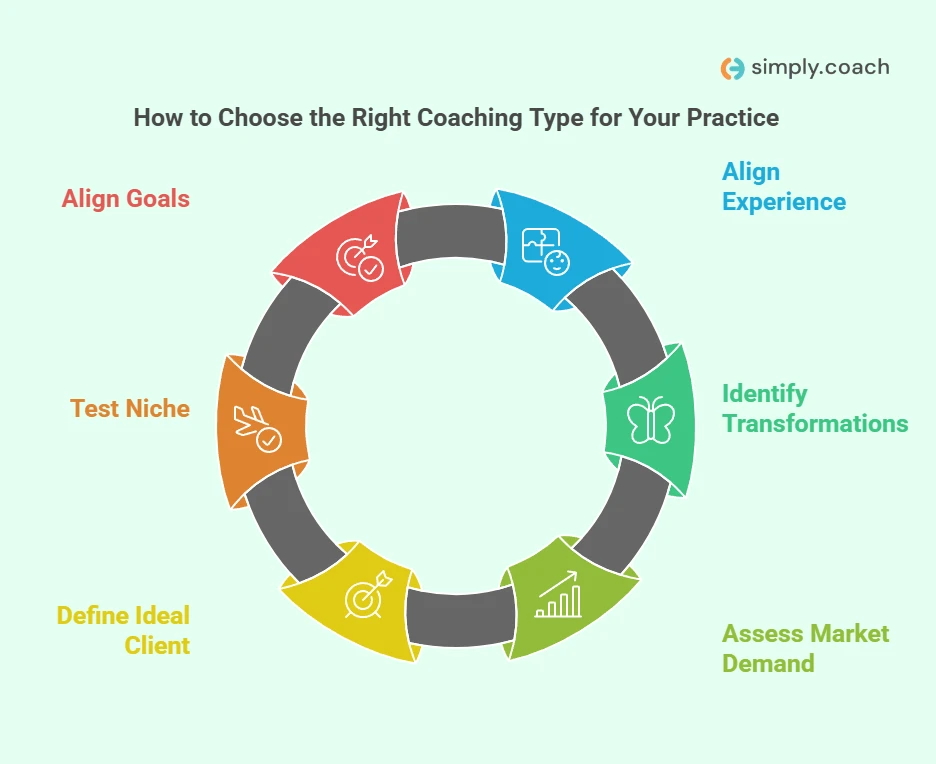
Selecting the right coaching niche is pivotal for establishing a successful coaching practice. It enables you to position your services effectively, build authority, and attract clients who resonate with your expertise.
1. Align your experience with a coaching niche
Reflect on your professional background and identify areas where you’ve delivered tangible results. For instance, if you have experience in leadership roles, leadership coaching might be a natural fit. Similarly, a background in finance could lend itself well to financial coaching.
2. Identify the transformations you’re passionate about
Consider the outcomes that inspire you. If you’re motivated by helping individuals overcome personal challenges, life coaching could be your niche. If you’re driven to assist professionals in career advancement, career coaching might be more suitable.
3. Assess market demand and industry trends
The coaching industry is experiencing significant growth. According to the 2025 ICF Global Coaching Study, the number of coach practitioners has increased by 15% since 2023, reaching a record 122,974 globally. Additionally, the industry is projected to reach $6.41 billion by 2026, with a 9.6% annual growth rate. Understanding these trends can help you select a niche with strong demand.
4. Define your ideal client’s needs
Clarity on your target audience allows you to tailor your coaching services to meet their specific needs. For example, if your ideal clients are executives, executive coaching would be appropriate. Understanding their challenges ensures your coaching services are relevant and impactful.
5. Test your niche before fully committing
Pilot your coaching services through workshops or free sessions to gauge interest and gather feedback. This approach allows you to refine your offerings based on real client responses, ensuring your niche aligns with market needs.
6. Align your niche with personal and business goals
Ensure that your chosen niche aligns with your lifestyle and long-term objectives. If you prefer flexible working hours, consider niches that allow for remote coaching. Aligning your niche with your goals ensures long-term satisfaction and success.
By thoughtfully selecting a coaching niche that aligns with your expertise and market demand, you can build a coaching practice that is both fulfilling and profitable.
Also read: 100 Life Coaching Niches to Grow a Profitable Coaching Business in 2025
Conclusion
Choosing the right coaching type is a strategic step that defines your practice, your impact, and your ability to attract the clients you want. Understanding the different coaching niches, assessing your strengths, aligning with client demand, and clearly defining the transformations you offer allows you to stand out in a crowded market. By investing the time to select a niche that aligns with both your expertise and passion, you create a coaching practice that is focused, credible, and poised for long-term growth.
Simply.Coachis an all-in-one coaching software designed to streamline your business operations and client management. From goal tracking and session scheduling to automated reminders and client workspaces, Simply.Coach simplifies every aspect of your practice. It empowers you to deliver a seamless, professional experience while focusing on what matters most, creating real transformation for your clients.
FAQs
1. How long does it take to establish a coaching niche?
Establishing a niche typically takes 3 to 6 months of testing, refining your services, and building credibility with your target clients. Consistent delivery and client feedback accelerate the process.
2. Can I combine multiple coaching niches in my practice?
Yes, you can integrate complementary niches, such as business and leadership coaching. Combining niches works best when your services solve interconnected client problems.
3. Do I need certifications for every coaching niche?
Certifications are recommended for credibility, especially in regulated or specialized areas like financial or health coaching. They boost trust and client acquisition, but experience and results matter equally.
4. How do I price my coaching services in a niche?
Pricing should reflect your expertise, client demand, and transformation outcomes. Start with market research, then adjust based on results, testimonials, and program depth.
5. How can I test if my chosen niche will succeed?
Run small pilot programs, free workshops, or online challenges. Collect feedback, track engagement, and refine your messaging before fully committing to the niche.
6. How important is a personal story in choosing a niche?
A personal story builds trust and relatability. Clients often choose coaches who have overcome similar challenges, so integrating your journey can strengthen your niche positioning.
7. Can I switch niches after starting my coaching business?
Yes, niches can evolve based on client demand, expertise, and personal growth. Gradual transitions with targeted marketing help retain credibility and attract new clients.