
Remote coaching is no longer just an alternative, it is quickly becoming the default. If you are still relying heavily on in-person sessions, you are likely feeling the limits: restricted client reach, rigid schedules, and a cap on how much you can actually scale.
The shift toward remote coaching changes how you deliver, price, and grow your practice. Today, you are not just trying to run sessions, you are trying to reduce scheduling gaps, work across time zones, and create more consistent client progress between sessions.
At the same time, your clients expect flexibility, faster access, and ongoing support. This is where traditional coaching models start to fall short.
Updated for 2026, this guide breaks down why remote coaching is growing at this pace and what is actually driving it beneath the surface. Instead of repeating obvious benefits, you will see how client behavior, delivery models, and coaching economics are shifting.
At a Glance
- Remote coaching is growing because it removes structural limits like location, fixed schedules, and session-only delivery
- Client expectations have shifted toward continuous support, faster feedback, and flexible access
- Coaching is moving from session-based delivery to outcome-driven, structured models
- Remote coaching improves time efficiency by reducing gaps, cancellations, and transition overhead
- Access to a global client base allows for better-fit clients and stronger positioning
- Progress becomes more consistent when coaching extends beyond sessions into ongoing engagement
- Simply.Coach helps coaches deliver remote coaching more effectively by centralizing client progress, communication, scheduling, and between-session support
What is Remote Coaching, and Why is it No Longer Optional in 2026?
Remote coaching means delivering your coaching services without meeting clients in person. This includes video calls, messaging, shared workspaces, and structured follow-ups between sessions. The definition is simple, but the way you deliver remote coaching has changed significantly.
If you treat remote coaching as a replacement for in-person sessions, you limit its value. In practice, it works as a more continuous system where you support clients beyond scheduled calls. This changes how your coaching is experienced and how progress is created.
Your clients are no longer paying only for scheduled sessions. They are paying for access, consistency, and ongoing support that helps them move forward between sessions.
How Remote Coaching Works in Practice Today
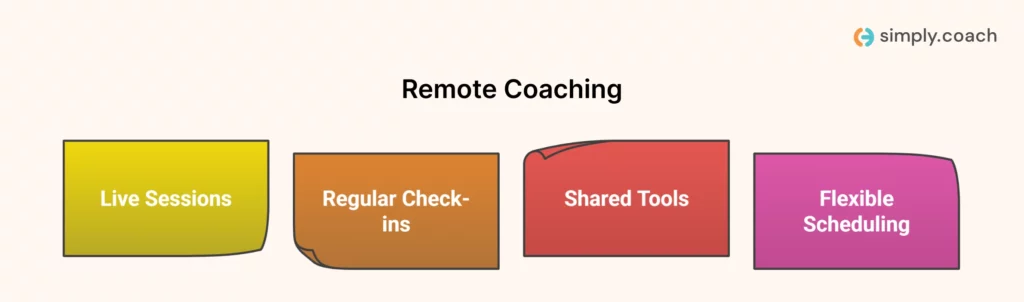
Your remote coaching setup typically combines different layers of interaction. Each layer supports a different part of the client journey.
In most cases, this includes:
- Live sessions for deeper conversations and decision-making
- Check-ins or messages between sessions to maintain momentum
- Shared tools or workspaces to track goals, actions, and progress
- Flexible scheduling that works across time zones
This structure allows your coaching to continue outside the session. As a result, progress does not depend entirely on weekly calls.
Also Read:Best Group Coaching Platforms & Frameworks for L&D Professionals in 2026
Why Remote Coaching Is Growing?
Remote coaching is growing because it improves accessibility, flexibility, and results for both coaches and clients. Here are the Key Reasons Behind the Growth
- Continuous support instead of fixed sessions: Clients get help when they need it, not just during scheduled calls, which improves consistency and accountability.
- Higher time efficiency for coaches: No travel or idle gaps between sessions allows you to serve more clients without increasing working hours.
- Global reach and better client fit: You can work with clients beyond your local area, improving alignment, retention, and pricing potential.
- Faster progress and real-time feedback: Support during real-life situations helps clients take action and course-correct immediately.
Why This Matters for Your Coaching Practice
Remote coaching shifts your model from session-based delivery to outcome-driven coaching. Instead of selling time, you focus on consistent progress, better engagement, and long-term results.
Also Read: Essential Coaching Tools for Leadership Development Programs
Remote Coaching vs In-Person Coaching: Major Differences
The conversation is often framed as remote vs in-person, as if one replaces the other. In reality, the difference is not just location. It is how your coaching is structured, delivered, and experienced by clients.
If you only compare formats, you miss the bigger shift. The real difference shows up in how time is used, how clients engage, and how outcomes are created.
Here are some key differences at a glance:
| Area | Remote Coaching | In-Person Coaching |
| Time structure | Flexible scheduling with minimal transition time; can work across time zones | Fixed schedules with travel or transition gaps; limited to local availability |
| Client engagement | Continuous interaction through sessions, check-ins, and async support | Engagement centered around scheduled sessions; limited between-session interaction |
| Progress rhythm | Ongoing, with faster feedback loops and real-time adjustments | Cyclical, often tied to weekly or periodic sessions |
| Accessibility | Global client access; no location constraints | Limited to local or nearby clients |
| Practice scalability | Easier to scale through programs, async support, and flexible formats | Scaling requires more hours, space, or additional staff |
| Delivery format | Combines live sessions with messaging, tools, and structured follow-ups | Primarily session-based, with limited supporting layers |
| Client expectations | Focus on access, responsiveness, and ongoing support | Focus on scheduled time and in-session interaction |
| Cost structure | Lower overhead; no physical space required | Higher overhead due to rent, utilities, and location-based costs |
These differences are not minor, they directly affect how you deliver your work and how your clients experience it. Remote coaching gives you more flexibility and control, while in-person coaching offers a more contained, session-focused experience.
The right choice depends on how you want to structure your coaching and what kind of experience you want to create for your clients.
Also read: 10 Best Billing Software for Life Coaches in 2026: Streamline Payments & Invoicing
Common Mistakes Coaches Make With Remote Coaching in 2026
As remote coaching grows, many coaches adopt it quickly without changing how they deliver their work. The result is a model that looks modern but still operates like traditional coaching.
The issue is not remote coaching. It is how it is implemented. Key mistakes to avoid:
- Treating remote coaching like in-person sessions on Zoom: A common mistake is moving sessions online without redesigning the coaching experience. When everything still depends on weekly calls, clients lose momentum between sessions and progress slows down.
- Overloading clients with too much communication: Some coaches assume remote coaching means constant availability. Too many messages, unclear expectations for responses, and no boundaries can overwhelm clients rather than support them.
- Not building enough structure or accountability: Remote coaching needs clear goals, milestones, and next steps. Without structure, clients may not know what to focus on, making it harder to track progress and maintain engagement.
- Not having proper systems in place: When sessions, notes, follow-ups, and progress tracking are spread across disconnected tools, delivery becomes messy and inconsistent. A simple system helps you stay organised and gives clients a smoother experience.
Remote coaching works best when it is designed intentionally. Most mistakes happen when coaches either copy the in-person model too closely or add flexibility without enough structure.
Strategies to Build a High-Performing Remote Coaching Practice
Understanding why remote coaching is growing is one thing. Making it work effectively in your own practice requires a more deliberate approach. The difference between coaches who succeed remotely and those who struggle usually comes down to structure, not skill.
These strategies focus on how you design your remote coaching so it delivers consistent results without becoming chaotic.
Design Your Coaching Around Outcomes, Not Sessions
If you continue to think in terms of “sessions per week,” your remote model will feel limited. The shift is to define what the client is working toward and structure your coaching around that.
In practice, this means:
- Defining clear goals and milestones upfront
- Structuring your engagement around progress, not calendar slots
- Using sessions as checkpoints, not the only delivery method
This creates a more focused experience where every interaction ties back to a specific outcome.
Build a Between-Session System that Supports Momentum
Most of your client’s progress happens outside the session. If that time is unstructured, progress becomes inconsistent.
A stronger approach is to design what happens between sessions:
- What actions the client is responsible for
- When and how you check in
- How feedback is delivered
This turns the space between sessions into an active part of your coaching, rather than a gap.
Standardize Your Delivery Without Making it Rigid
As your client base grows, relying on memory or ad hoc delivery becomes unsustainable. At the same time, over-structuring can make your coaching feel impersonal.
The balance is to standardize the core elements:
- A repeatable flow for sessions
- A consistent way to track goals and actions
- Defined checkpoints in your coaching journey
This gives you consistency while still allowing flexibility for each client.
Set Clear Communication Boundaries Early
Remote coaching increases access, but without boundaries, it can quickly become overwhelming for both you and your clients.
Instead of reacting to every message, define:
- When clients can expect responses
- What type of communication is appropriate between sessions
- How urgent situations are handled
This creates clarity and keeps your coaching structured rather than reactive.
Use Asynchronous Support Intentionally
Asynchronous coaching is one of the biggest advantages of remote delivery, but it needs to be used with purpose.
Rather than constant back-and-forth, focus on:
- Timely feedback at key moments
- Short, actionable responses
- Reinforcing decisions and next steps
Used well, this increases impact without increasing your workload unnecessarily.
Track Progress in A Way Clients Can See
Progress that is not visible often feels like no progress at all. In remote coaching, this becomes even more important because you are not physically present.
A more effective setup includes:
- Clear tracking of goals and actions
- Regular reviews of progress
- Visible milestones that clients can refer back to
This strengthens accountability and helps clients stay engaged over time.
Start Simple, Then Refine Based on Real Usage
Many coaches try to build a perfect remote system from the start. This often leads to overcomplication and friction.
A better approach is:
- Start with a simple structure
- Observe how clients engage with it
- Adjust based on what actually works
Over time, your system becomes more effective because it is shaped by real usage, not assumptions.
Remote coaching works best when it is intentionally designed. These strategies help you move from running sessions online to building a structured, scalable coaching practice.
The most effective remote coaching practices are built on clear structure, consistent delivery, and intentional support between sessions.
How Simply.Coach Helps You Build a Structured Remote Coaching Practice
As you move toward remote coaching, the challenge is not running sessions, it is managing everything around them. Client communication, progress tracking, scheduling, and follow-ups often end up spread across different tools. This creates gaps in delivery, makes it harder to stay consistent, and reduces visibility into how your clients are actually progressing.
Simply.Coach brings these elements into one structured system so your remote coaching model works the way it is meant to. Instead of relying on scattered tools or manual tracking, you can organize your delivery in a way that supports continuous engagement and consistent outcomes.
Where Simply.Coach supports your remote coaching delivery:
- Client workspaces (keep all client work in one place) → Track goals, session notes, and action steps centrally, so you always have a clear view of client progress across sessions and between them
- Programs and journeys (structure your remote coaching model) → Turn your coaching into repeatable programs that extend beyond sessions, making it easier to deliver consistently and support clients continuously
- Scheduling + timezone conversion (support global clients) → Manage sessions across locations without coordination friction, making it easier to work with clients beyond your local market
- Action plans and nudges (maintain momentum between sessions) → Guide clients on what to focus on between sessions, improving follow-through and keeping progress consistent
- Reports and progress tracking (measure outcomes, not just sessions) → Track engagement and progress in a structured way, so you can see how your coaching is working and where to improve
- Centralized system (reduce operational complexity) → Bring scheduling, communication, and delivery into one place, so your remote coaching setup stays organized as you grow
What This Changes in How You Deliver Remote Coaching
When your remote coaching is structured:
- your delivery extends beyond sessions into continuous support
- client engagement becomes more consistent
- you gain visibility into progress and outcomes
- your practice becomes easier to scale without adding complexity
Simply.Coach does not change how you coach. It helps you run remote coaching in a way that stays consistent, structured, and easier to manage as your practice grows.
Conclusion
Remote coaching is thriving because it aligns with how coaching is actually used today. Clients expect ongoing support, faster feedback, and flexibility, while you need a model that allows you to use your time better and grow without being limited by location.
As your practice evolves, the focus shifts from where coaching happens to how it is structured. A well-designed remote coaching model helps you reduce inefficiencies, improve engagement, and create more consistent outcomes across your clients.
Simply.Coach supports this by helping you structure your delivery, track client progress, and manage your coaching beyond sessions, so your practice stays organized as it scales.
See how Simply.Coach fits your practice.
FAQs
1. Is remote coaching as effective as in-person coaching?
Effectiveness depends more on how coaching is structured than where it happens. Remote coaching can be equally or more effective when it includes consistent follow-ups, clear action tracking, and support between sessions, which are often limited in traditional formats.
2. What tools do coaches need to run remote coaching successfully?
Most coaches use a combination of video platforms, messaging tools, scheduling systems, and progress tracking tools. The challenge is not access to tools, but organizing them into a system that supports consistent delivery and client engagement.
3. How do you keep clients engaged in remote coaching?
Engagement improves when coaching extends beyond sessions. Regular check-ins, clear action plans, and visibility into progress help clients stay accountable and involved, rather than relying only on scheduled calls.
4. Can remote coaching work for all coaching niches?
Remote coaching works well for most niches, especially where progress depends on decision-making, accountability, or skill-building. Some highly experiential or physical coaching formats may still benefit from in-person elements.
5. How do coaches handle time zones in remote coaching?
Time zone differences are managed through flexible scheduling and planning session blocks strategically. Many coaches use this to their advantage by spreading sessions across different time slots instead of being limited to local working hours.
6. Do clients prefer remote coaching over in-person sessions?
Many clients now prefer remote coaching because it fits into their schedule more easily and allows for faster access to support. Preference often depends on convenience, flexibility, and how the coaching is delivered.
7. How do you price remote coaching services?
Pricing is shifting away from per-session models toward packages or programs that reflect outcomes and ongoing support. Remote coaching makes it easier to bundle services and price based on value rather than time alone.