
Students today are navigating more academic and emotional challenges than ever before. Yet, in many U.S. schools, one counselor is responsible for over 430 students, far above the recommended ratio of 250 students per counselor set by the American School Counselor Association. That gap shows just how overloaded but essential your role as a guidance counselor has become.
If you are already working as a counselor or planning to become one, your impact can be life-changing. The right traits, such as empathy, patience, and strong communication, help students succeed, stay grounded, and feel supported. In this guide, we will explore the essential qualities of a guidance counselor that you should possess that will eventually define your success.
Understanding the Role of Guidance Counselors
As a guidance counselor, your role extends far beyond scheduling classes or filling out college forms. On any given day, you’re supporting students through academic struggles, helping them navigate personal issues, and guiding them toward future careers. You’re a consistent presence in a student’s life when stability may be lacking elsewhere.
You also serve as a key connector, bridging communication between students, parents, teachers, and school administrators. Whether it’s coordinating interventions, addressing behavioral concerns, or planning long-term academic goals, your input shapes how each student is supported by the larger system.
In recent years, the role has grown even more complex. You’re expected to respond to mental health concerns, help students manage anxiety and depression, and stay updated on college admissions, financial aid, and shifting educational policies.
You need more than just certifications, you need the right mindset, support, and the qualities of guidance counselor that can stand up to real-world challenges.
Read: Steps to Becoming a School Counselor
Traits vs Skills: What’s the Difference?
To be effective in your role as a guidance counselor, it’s important to understand the difference between traits and skills, as a blend of both is essential for success. Here’s a quick comparison:
| Traits | Skills |
| Inherent qualities you naturally possess (e.g., empathy, patience, emotional stability) | Learned abilities that are developed over time (e.g., active listening, goal setting, conflict resolution) |
| Shaped by your personality and how you connect with students on a human level | Acquired through training and experience |
| Constant over time, though can be refined | Can be sharpened with tools, practice, and feedback |
| Primarily affect how you relate to others and create trust | Help you manage tasks, guide students, and resolve issues effectively |
Both traits and skills matter. A counselor with strong emotional intelligence but poor organizational skills may struggle to manage caseloads or track progress. Likewise, someone who knows every college requirement by heart but lacks empathy won’t build the trust students need.
Top 15 Essential Traits of an Effective Guidance Counselor
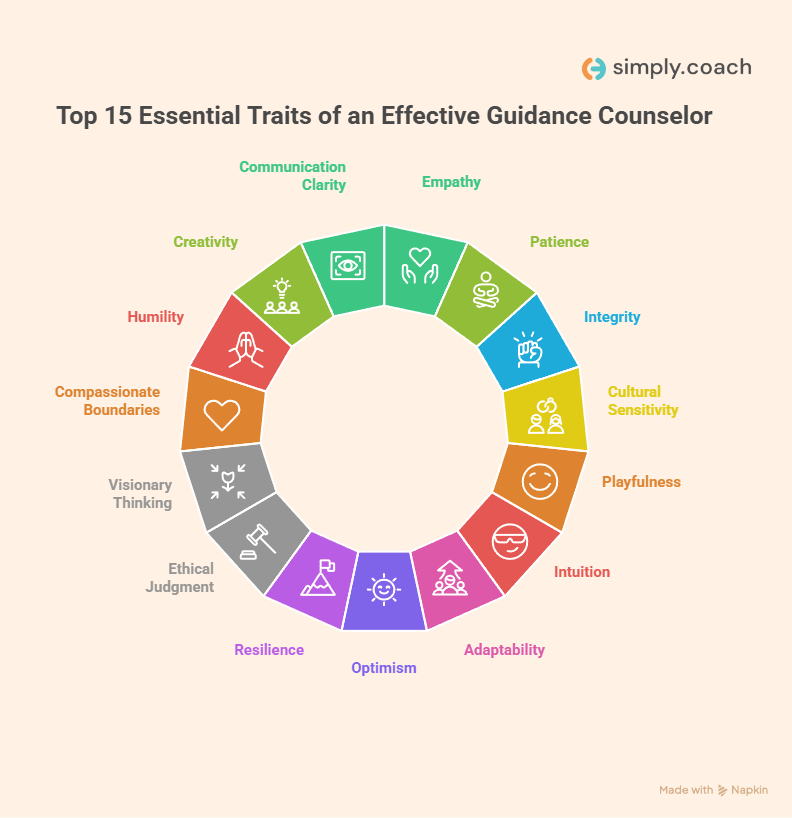
Behind every successful student, there’s often a school counselor who listens, guides, and shows up consistently. You aren’t just a professional with credentials, but an individual who embodies qualities that students remember for life. Here are some unique traits that will define excellence in your role as a guidance counselor.
1. Empathy
A student walks into your office after failing a test, not because they didn’t study, but because they didn’t sleep. Empathy allows you to understand what’s beneath the surface. It’s about listening without fixing and validating without judgment. As a guidance counselor, empathy creates the trust that students rely on to open up.
2. Patience
Progress with students is rarely linear. One day, a student seems ready to apply for college; the next, they’re doubting their worth entirely. Patience allows you to meet your clients where they are, consistently and calmly, without frustration or pressure. It also helps you when working with parents, teachers, and systems that don’t always move quickly.
3. Integrity
Confidentiality, honest communication, and doing the right thing even when no one is watching define true integrity. It builds your reputation as someone both students and staff can trust and rely on. For instance, when mediating a student conflict or handling a disciplinary issue, your fairness and transparency help resolve the matter in a way everyone can accept.
4. Cultural sensitivity
Students come from diverse backgrounds, with unique values, identities, and challenges. A great counselor acknowledges that and adapts without assumptions. Whether you are helping a first-generation college applicant or supporting a student navigating gender identity, cultural sensitivity is crucial to inclusive, respectful support.
Also read: 8 Effective Strategies for Culturally Responsive Counseling to Enhance Client Engagement
5. Playfulness
Sometimes, a little humor can break the ice and make a big difference in how a student approaches a difficult conversation. Your playful attitude can help ease tension, create a safe space, and show students that vulnerability doesn’t always have to be serious. It’s a subtle yet impactful trait that fosters openness and connection.
6. Intuition
Great counselors often rely on their gut feelings to understand what’s going on with a student. Intuition allows you to notice patterns in behavior, sense underlying issues, and act proactively. It’s not about guessing, but rather about connecting the dots in a way that helps you provide timely, relevant guidance.
7. Adaptability
No two days in a school counselor’s office look the same. From crisis response to parent meetings, adaptability keeps you grounded when things get unpredictable. Whether you’re shifting schedules last-minute or managing a mental health emergency, staying flexible helps you handle it all with clarity.
8. Optimism
When a student can’t see past their failures, you hold the vision for what’s possible. Optimism doesn’t mean ignoring struggles—it means believing in growth and helping students believe in it too. Your hopeful outlook can be the boost that keeps someone moving forward.
9. Resilience
Being a guidance counselor can be emotionally taxing. Hearing difficult stories, managing large caseloads, and balancing admin duties require emotional strength. Resilience helps you bounce back, set boundaries, and keep showing up as your best self, even on hard days.
10. Strong ethical judgment
From confidentiality concerns to student safety, as a guidance counselor you face tough decisions regularly. Knowing when to escalate an issue, how to handle sensitive information, or how to balance competing interests requires you to have a strong ethical reasoning, and a steady moral compass.
11. Visionary thinking
An impactful counselor doesn’t just look at the present situation but also envisions the bigger picture. You understand how the decisions made today will affect the student’s future and always guide them with that foresight in mind. This long-term perspective is key to creating lasting impact.
12. Boundaries with compassion
Knowing when to be hands-off and when to step in can be challenging, especially when dealing with students who have deep emotional needs. As a counselor, you need to have the ability to maintain healthy boundaries while still showing care and support. It’s the fine line between professional distance and genuine empathy.
13. Humility
The ability to recognize when you don’t have all the answers, or when you need help, is crucial. Humility allows you to learn from others, admit when you make a mistake, and continually grow in your practice. Students appreciate a counselor who doesn’t pretend to know it all but rather approaches situations with a willingness to learn.
14. Creativity
Finding new ways to solve old problems is one of the many ways you, as a guidance counselor, can make a difference. Whether it’s using creative exercises to help students open up, finding unique approaches to deal with bullying, or brainstorming non-traditional career paths, creativity adds a fresh and engaging dimension to your counselling.
15. Clarity in communication
Whether you’re explaining a college process to a parent or de-escalating peer conflict, how you communicate matters. Successful counselors express themselves clearly, listen deeply, and adjust their message based on who they’re talking to. This trait turns your advice into action and conflict into understanding.
Read: How to Obtain School Counselor Certification: Steps and Requirements
7 Must-Have Skills for Every Guidance Counselor

Strong traits are foundational to your ability to establish meaningful connections, communicate effectively, provide impactful support, and uphold the ethical standards of your profession.
But skills are what carry you through the day-to-day work. These are the coachable, practical abilities that help you manage sessions, track progress, and deliver real impact. Whether you’re working in a school or running a private practice, these are the essential tools every efficient guidance counselor needs.
1. Active listening
This is more than hearing words. It’s about noticing what’s not being said. As a skilled and attentive counselor, you need to pay attention to emotional cues, nonverbal communication, and any contradictions in what students share. When students feel truly heard, they’re more likely to trust you, open up, and follow through.
2. Goal setting
Helping students identify where they want to go and how to get there is at the core of your job. Whether it’s passing a class or getting into college, you guide them in setting realistic and motivating goals. Tools like Simply.Coach help you structure these goals and track progress over time.
3. Conflict resolution
Disagreements among peers, tension at home, or internal struggles often surface in different ways. As a skilled counselor, you must know how to mediate calmly, ask thoughtful questions, and lead students toward constructive resolution rather than avoidance.
4. Career & academic planning
Mapping coursework, exploring career options, understanding scholarships, and managing college applications are key milestones in a student’s journey. Your ability to simplify complex processes and offer timely guidance creates a lasting impact on their future.
5. Time management & organization
With multiple students, overlapping schedules, and urgent situations, staying organized is non-negotiable. You need to keep notes, manage appointments, and follow up on action plans. Digital platforms like Simply.Coach make it easier to automate reminders, reduce no-shows, and stay on track.
6. Data interpretation
You’ll work with transcripts, assessments, feedback forms, and progress reports. Knowing how to read, process and use this data helps you make informed decisions, track student outcomes, and advocate effectively when needed.
7. Facilitating payments & scheduling (for private practice)
If you’re in private practice, business management matters too. From session packages to automated invoicing and self-scheduling tools, digital support platforms, such as Simply.Coach, help you stay professional and efficient—without drowning in admin work.
How Simply.Coach Helps Counselors Thrive
In the demanding role of a guidance counselor, you often juggle multiple tasks and responsibilities. All in one counseling platforms like Simply.Coach are designed to streamline workflows, improve efficiency, and ensure that you, as a guidance counselor, can focus on what matters most, supporting your students. Here’s how Simply.Coach helps counselors thrive:
1. Streamlining workflows
Simply.Coach automates administrative tasks that can often overwhelm counselors. From session scheduling and goal tracking to client communication, the platform ensures that everything runs smoothly with minimal effort. This allows counselors to focus on providing personalized care rather than getting bogged down in paperwork.
2. Reducing no-shows
Missed appointments can disrupt a counselor’s day and prevent students from getting the support they need. Simply.Coach sends automated reminders via email and text, making it easier for students to remember their sessions. With fewer no-shows, counselors can manage their time more effectively, reducing stress and increasing productivity.
3. Improving outcomes
Tracking student progress has never been easier. Simply.Coach provides tools for setting and monitoring goals, making it simple to track student achievements and areas for improvement. With automated reports and insights, counselors can see the impact of their work in real-time and make data-driven decisions to enhance their support.
Also read: 20 Education Resources for School Counselors
Conclusion
As a school counselor, you play a crucial role in shaping the academic and emotional journeys of your students. The right traits and skills are essential to build trust, offer support, and help students thrive. With the increasing complexity of your role, digital tools like Simply.Coach can make all the difference, streamlining your workflows, improving efficiency, and giving you more time to focus on what truly matters on your students’ well-being and success.
By embracing technology, you can enhance your effectiveness and make a greater impact. Whether you’re tracking goals, managing appointments, or analyzing student progress, Simply.Coach provides the tools to help you stay organized and on top of your responsibilities.