
As a therapist, you’ve likely used No Harm Agreements to ensure client safety and foster trust. While they can offer diagnostic insights, they often fall short in addressing the underlying causes of self-harm or suicidal thoughts.
Prior research highlights that “Although the No Harm Contract is a frequently used clinical tool that can provide diagnostic information and therapeutic advantage, it can also short-circuit comprehensive suicidal assessment and disposition decisions” .
This shows how no-harm contracts may hinder deeper, more thorough risk assessments.
The limitations of no-harm contracts are clear: they don’t fully tackle the emotional and behavioral triggers behind suicidal ideation. This is why many therapists are turning to more comprehensive, individualized solutions like safety planning and technology-driven tools to support clients better.
In this article, we’ll explore why no-harm contracts are no longer enough, their key limitations, and the more effective alternatives therapists are embracing today.
What Are No Harm Agreements?
A No Harm Agreement is a written contract between you and your client designed to prevent self-harm or suicide.
It outlines the client’s commitment to not engage in harmful behavior. It also specifies actions they should take, such as contacting you or a crisis service, if they feel at risk.
The agreement provides a structured way for you to address and manage serious safety concerns during therapy.
The role of No-Harm contracts in therapy
When you first introduce a no-harm contract, it serves as a clear boundary-setting tool. It helps you and your client openly discuss the risks they face while providing a sense of accountability.
In the past, no-harm contracts were often used as a first step in addressing suicide risks. They ensured that clients had a basic plan in place for when they felt unsafe. They also laid the foundation for further discussions on safety and risk management.
Why they were popular
The rise of no-harm contracts in the 1990s and early 2000s was driven by therapists and mental health institutions. They sought a formal way to manage suicide risk and reduce legal liability.
No-harm contracts became common in outpatient settings, especially among early-career clinicians, who viewed them as an easy way to manage high-risk clients.
The concept was simple: get the client to agree, in writing, not to harm themselves and to contact help if needed. At the time, this approach seemed proactive, creating accountability and offering a sense of safety.
However, as the use of no-harm contracts grew, the limitations became clear, prompting many therapists, such as you, to reassess their effectiveness.
When to Use No Harm Agreements
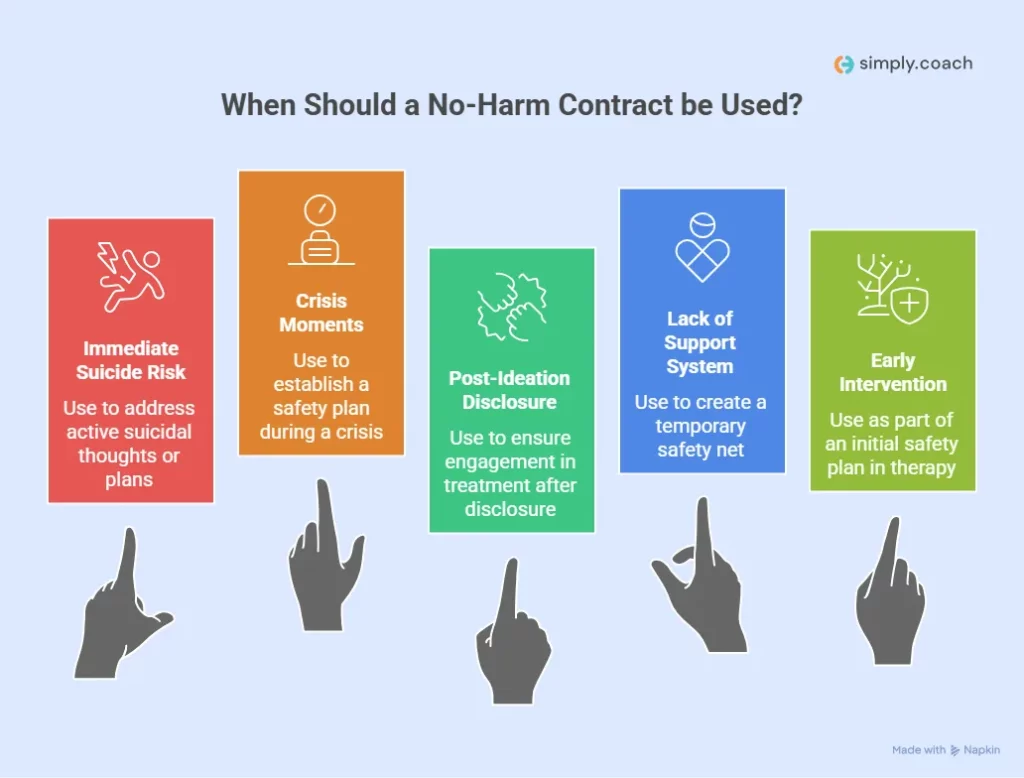
As a therapist, you’ve likely encountered situations where you needed to ensure a client’s immediate safety. No harm agreements were often seen as a straightforward tool for managing clients at risk of self-harm or suicide. Here’s when they were typically used:
- Immediate suicide or self-harm risk: If a client expresses active thoughts of suicide or plans to harm themselves, No-harm contracts provide a quick, structured response to address the immediate danger.
- Crisis moments: No-harm contracts were useful when clients were in a crisis, allowing you to quickly establish a safety plan while assessing the full extent of the risk.
- Post-suicide ideation disclosure: After a client disclosed recent suicidal thoughts or self-harming behaviors. No-harm contracts helped ensure that they remained engaged in treatment and followed through with safety measures until a more comprehensive plan could be created.
- Lack of immediate support system: If a client lacks a strong support system, such as family, friends, or emergency contacts. No-harm contracts could be used to create a temporary safety net while you work on building those connections.
- Early intervention in therapy: When working with clients early in treatment who had mild to moderate suicidal ideation, No-harm contracts were sometimes used as part of an initial safety plan, ensuring that immediate risks were addressed as part of a broader therapeutic strategy.
These agreements were meant as a short-term measure to stabilize the situation and allow for further intervention, but over time, you may have found that they weren’t sufficient on their own.
Limitations and Criticisms of No Harm Agreements
As a therapist, you may have relied on No Harm Agreements as part of your risk management strategy. However, there are several limitations and criticisms that challenge their effectiveness. Here’s why many therapists are moving away from them:
1. Lack of evidence-based support
No Harm Agreements have not been shown to reduce suicidal behavior reliably. Studies, such as one by Jerome Kroll in The American Journal of Psychiatry, and another by Lisa McConnell Lewis in Suicide and Life-Threatening Behavior, indicate that these agreements do not effectively prevent suicide or self-harm.
They simply don’t address the deeper issues at play in a client’s emotional or psychological state.
2. False sense of security
A signed No Harm Agreement can give both you and your client a sense of safety, but it doesn’t guarantee that the risk has been properly managed.
The presence of a contract does not necessarily mean that the client is any safer, nor does it indicate that the underlying risk has been fully addressed.
3. Potential pressure
Clients may feel compelled to sign these agreements to continue therapy, even if they’re unsure they can keep their commitment.
Research from the National Library of Medicine suggests that this pressure can hinder open communication, which is crucial for building a solid therapeutic alliance.
As a result, clients may withhold important information out of fear of being forced into an agreement they don’t feel capable of keeping.
4. Undermines autonomy and transparency
If clients feel they’ll be asked to sign another contract or face potential hospitalization, they may avoid sharing suicidal thoughts altogether.
This creates a barrier to honest discussions, preventing you from fully understanding their state of mind and effectively managing the risk.
5. Focus on the binary, not the whole picture
No Harm Agreements often reduce the complexity of client safety to a simple “I will or won’t harm myself” decision. This oversimplifies the issue, taking attention away from more meaningful safety planning.
Instead of focusing on coping mechanisms or social support systems, you’re left with a basic promise that doesn’t contribute to long-term recovery.
What to Do Instead of a No-Harm Contract: Alternatives
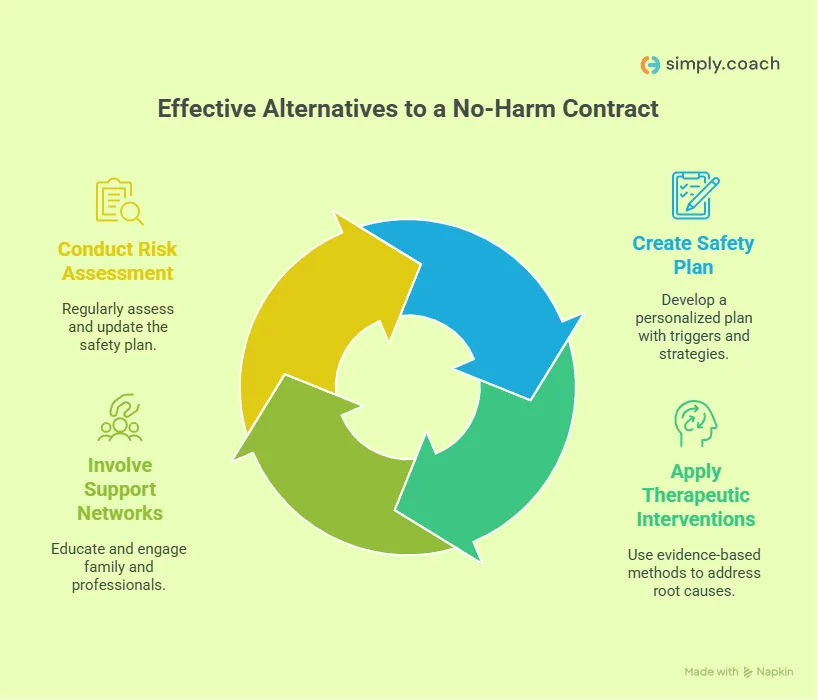
While No Harm Agreements can provide temporary relief, they often fall short in addressing the deeper emotional and psychological issues that contribute to self-harm and suicidal ideation.
Instead, there are more effective, long-term strategies that you can implement to ensure your clients receive comprehensive care. Here are some alternatives that can offer greater support:
1. Safety planning
Rather than relying on a No Harm Agreement, create a comprehensive safety plan with your client. This plan should be personalized, actionable, and collaborative.
- Identify specific triggers: Work with your client to identify situations or feelings that might increase their risk. This allows them to recognize early signs and take action before things escalate.
- Coping strategies: Develop specific techniques they can use to manage distress, such as grounding exercises, mindfulness, or creating a calming environment.
- Emergency contacts: Ensure that your client has a list of trusted people they can contact in a crisis, such as family members, close friends, or helplines.
- Actionable steps: Clearly define the steps your client should take if they feel at risk, like reaching out to you, calling a crisis hotline, or visiting a hospital.
2. Therapeutic intervention
Instead of focusing solely on a written agreement, incorporate ongoing therapeutic interventions that target the root causes of self-harm or suicidal ideation.
- Cognitive Behavioral Therapy (CBT): Use CBT to help your clients identify and challenge negative thought patterns that contribute to their self-destructive behaviors.
- Dialectical Behavioral Therapy (DBT): DBT is effective for clients struggling with emotional regulation. It teaches skills like distress tolerance and emotion regulation to prevent crises.
- Other evidence-based approaches: Explore alternative therapies, such as Acceptance and Commitment Therapy (ACT) or Mindfulness-Based Cognitive Therapy (MBCT), which focus on helping clients accept distressing thoughts and feelings without acting on them.
Read – 18 Effective Person-Centered Therapy Techniques & Interventions
3. Involving support networks
Creating a strong, external safety net for your client is crucial. Involve family, friends, or other professionals who can offer ongoing support and help manage the risk.
- Family involvement: Include family members in therapy sessions or discussions. Educating them on how to offer support can help them play a proactive role in your client’s recovery.
- Peer support: Encourage your client to connect with support groups or trusted friends who can provide emotional support outside of therapy.
- Professional networks: Collaborate with other healthcare providers (e.g., psychiatrists, social workers) to ensure comprehensive care that addresses all aspects of your client’s well-being.
4. Collaborative risk assessment:
Instead of relying solely on a one-time agreement, implement a broader, ongoing approach to assessing suicide risk.
- Client engagement: Encourage your client to assess and report their emotional state regularly. This active involvement increases their sense of control and responsibility.
- Behavioral observation: You should monitor changes in your client’s behavior, mood, and thought patterns. Any signs of escalation should prompt a reassessment of their safety plan.
- External input: Consider involving key people in the client’s life, family members, friends, or other clinicians, to provide their perspective on the client’s risk level. This allows for a more holistic view of the client’s emotional state and offers additional safety measures.
By focusing on these more dynamic, personalized strategies, you move away from the static, one-time nature of No Harm Agreements, creating a more effective, long-term approach to suicide prevention.
The Role of Technology in Managing Risk
Technology can enhance your ability to manage client risk more effectively. All in one therapy practice management platforms like Simply.Coach offer several digital tools that can provide real-time insights and improve client engagement in a way that traditional methods, such as No Harm Agreements, simply can’t.
Integrating Digital Tools:
These tools can make risk management more seamless and immediate.
- Automated reminders: Set up automated reminders for clients to check in regularly, track progress, and follow through on actions. This ensures that clients stay on top of their mental health journey without you needing to manually track every step.
- Video conferencing integration: Telehealth capabilities allow you to intervene instantly during high-risk situations, no matter where you or your client are. Video sessions provide the opportunity for real-time support, offering the flexibility to assess the situation and adjust strategies immediately.
- Tracking client progress: Simply.Coach lets you monitor client progress by capturing real-time updates on mood, behaviors, and actions. This feature allows you to spot any warning signs early and make necessary adjustments in therapy before a crisis develops.
- Maintaining client confidentiality: Simply.Coach is HIPAA-compliant, ensuring that all client data is securely stored and transmitted. This means you can manage sensitive client information confidently, knowing that their privacy is protected.
Unlike No Harm Agreements, which rely on simple written commitments, technology allows you to track a wealth of data on your clients.
Data on mood fluctuations, session attendance, and self-reported progress helps you understand underlying trends in your client’s mental health. This ongoing data collection ensures a more accurate and nuanced assessment of their well-being.
Read The Role of Technology in Counseling and Therapy to find out how technological advances are opening up innovative methods of care for therapists & counselors.
Conclusion
As a therapist, your responsibility is to provide effective care that goes beyond surface-level interventions. No Harm Agreements, while once helpful, don’t address the underlying issues contributing to self-harm or suicidal ideation.
Moving toward a more personalized and comprehensive approach, like safety planning and technology integration, allows you to meet your client’s needs better. This shift enables you to provide more meaningful support and ensure long-term progress.Simply.Coach offers tools to help you manage client risk with ease. Features like automated reminders, video conferencing, and progress tracking give you the power to support clients effectively. Plus, everything is HIPAA-compliant to protect sensitive data.