
Many life coaches struggle to define the boundary between coaching and therapy. Confusing these roles can risk client trust or ethical missteps. Without understanding psychological differences, you may apply techniques that are inappropriate or ineffective.
Knowing how coaching psychology differs from therapy ensures you support clients safely and professionally. It clarifies which methods you can use, how to focus sessions, and when to refer clients for mental health support.
In this blog, we will explore life coach psychology and highlight the difference between life coaches and therapists. You will gain insights to apply psychological principles effectively in your coaching practice.
Mastering these distinctions strengthens your credibility and results. You can create actionable plans while respecting ethical boundaries, helping clients achieve meaningful growth. Clear understanding also boosts confidence in every coaching session you lead.
Key Takeaways
- Life coach psychology helps you understand client thought patterns, motivations, and behavior, allowing you to structure sessions that produce measurable, sustainable growth.
- Therapy addresses mental health, trauma, and emotional regulation, so recognizing these differences ensures you stay within your scope and refer clients when needed.
- Key psychological principles for coaching include positive psychology, cognitive-behavioral strategies, and motivational frameworks, which help clients set goals, build habits, and maintain accountability.
- Maintaining clear ethical boundaries and understanding psychological red flags protects clients, strengthens trust, and ensures your coaching practice remains professional and safe.
- Tools like Simply.Coach allow you to integrate psychology-informed practices into your sessions, track progress, manage goals, and maintain client engagement efficiently.
What Life Coaches Need to Know About Psychology
Understanding psychology is essential for your coaching practice. It provides insights into how clients think, behave, and respond to challenges. Knowing these patterns allows you to structure sessions that create measurable, sustainable progress. Without this foundation, your coaching risks being less effective or inconsistent.
Psychological knowledge also protects your professional integrity. It helps you maintain clear boundaries, avoid misapplying techniques, and recognize when a client needs referral. Applying these principles strengthens trust, increases engagement, and ensures clients experience meaningful results from your coaching.
Psychology essentials for life coaches
Understanding psychology is the foundation of effective coaching. It helps you guide clients safely, ethically, and toward measurable growth.
Here are the key ways psychology impacts your coaching practice:
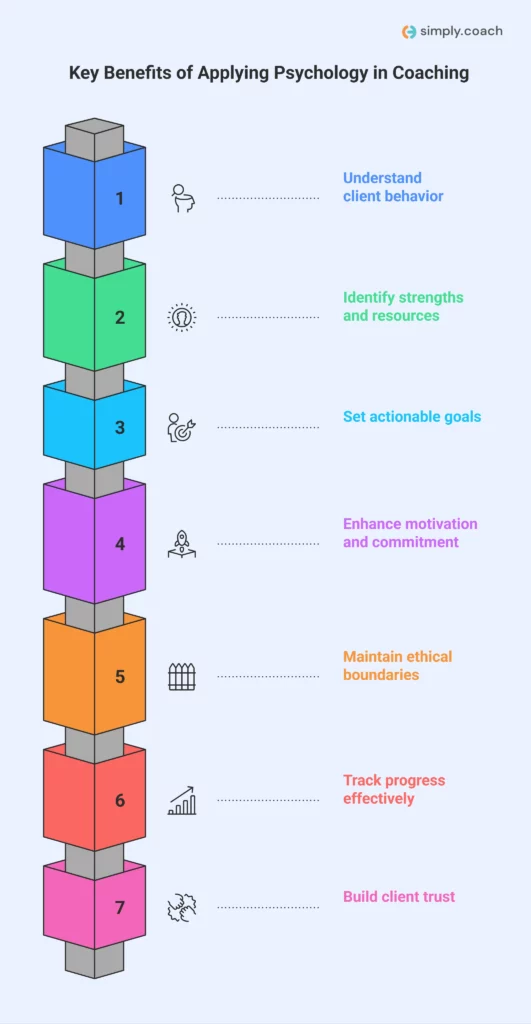
- Understand client behavior: Recognize thought patterns and actions that influence decisions, habits, and motivation.
- Identify strengths and resources: Spot client strengths to focus on solutions and build confidence.
- Set actionable goals: Use psychological insight to structure clear, achievable, and measurable objectives.
- Enhance motivation and commitment: Apply frameworks that increase follow-through and engagement in coaching plans.
- Maintain ethical boundaries: Ensure techniques remain within coaching scope, knowing when referral is necessary.
- Track progress effectively: Use psychological principles to measure behavior change, skill development, and habit formation.
- Build client trust: Demonstrate understanding and professionalism, strengthening relationships and coaching credibility.
Mastering these aspects ensures your sessions are focused, impactful, and grounded in evidence-based psychological insight.
Key Psychological Principles Every Life Coach Should Know
Understanding key psychological principles allows you to design coaching sessions that produce meaningful change. These principles guide how you set goals, engage clients, and support consistent progress. Applying them ensures your coaching is evidence-informed, measurable, and client-focused.
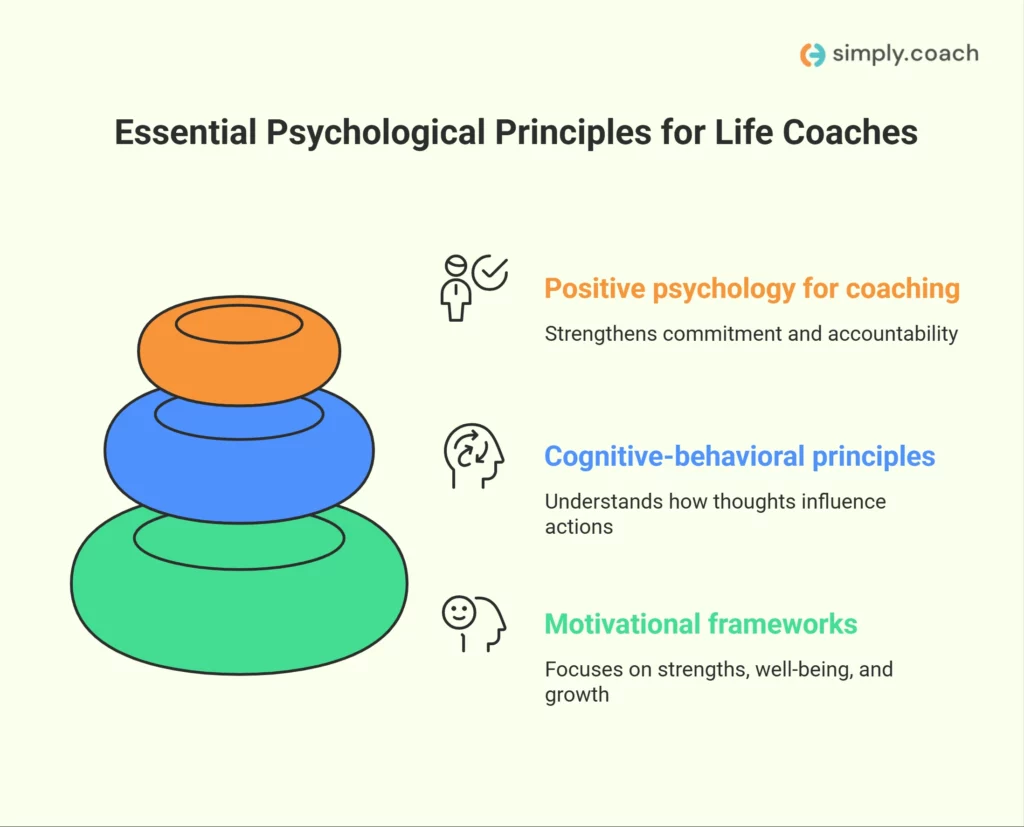
1. Positive psychology for coaching
Positive psychology focuses on client strengths, well-being, and growth instead of dwelling on problems. Using this perspective helps clients build confidence and resilience.
Key ways to apply positive psychology in coaching:
- Identify client strengths: Highlight natural talents, skills, and personal resources that can support growth.
- Use values clarification: Help clients define what matters most to guide decisions and priorities.
- Celebrate successes: Encourage reflection on achievements to reinforce confidence and progress.
- Apply “What Went Well” exercises: Support clients in noticing effective actions and repeating them.
- Foster optimism: Guide clients to reframe setbacks as learning opportunities and maintain forward momentum.
Implementing these strategies helps clients focus on solutions, creating sustainable growth and stronger engagement in coaching.
Related: How to Create a Positive Learning Environment : Tips for Life Coaches
2. Cognitive-behavioral principles
Cognitive-behavioral approaches help clients understand how thoughts influence actions and outcomes. They allow you to move coaching from discussion to measurable behavioral change.
Key ways to use cognitive-behavioral principles:
- Reframe limiting beliefs: Help clients identify and replace unhelpful thoughts with constructive alternatives.
- Track thought patterns: Observe recurring thoughts that block progress and explore alternatives.
- Support habit formation: Break tasks into actionable steps that align with goals and routines.
- Connect cognition to behavior: Show clients how changing thoughts produces measurable actions and results.
- Use guided reflection: Encourage clients to examine decisions and learn from outcomes.
These techniques ensure clients move from intention to action, turning insights into practical achievements.
Also read: Cognitive Coaching: Transform Client Thinking and Achieve Lasting Growth
3. Motivational frameworks
Motivational principles help clients stay committed and accountable, increasing follow-through and long-term success. They strengthen engagement by connecting actions to personal meaning.
Key ways to apply motivational frameworks:
- Align goals with values: Link client objectives to their intrinsic motivations for stronger commitment.
- Set clear accountability structures: Use check-ins, progress tracking, and milestone celebrations to maintain focus.
- Break goals into small steps: Create achievable tasks to prevent overwhelm and build momentum.
- Use reflective questioning: Encourage clients to explore motivations and deepen commitment to goals.
- Encourage self-monitoring: Help clients observe their own progress and adjust strategies independently.
Also read: 12 Proven Strategies to Boost Client Motivation in Coaching
Integrating these frameworks ensures clients remain focused, committed, and motivated to take consistent action toward their objectives.
Understanding Therapy from a Coaching Perspective
From a coaching perspective, therapy operates within defined psychological frameworks focused on mental health, emotional regulation, and healing. Understanding how therapists work psychologically helps you recognize boundaries, interpret client behavior accurately, and avoid applying methods outside your scope.
Therapy is shaped by specific psychological practices that differ from coaching in intent, depth, and measurement.
Key psychological aspects therapists apply in their work:
- Clinical assessment and diagnosis: Therapists evaluate symptoms, mental health history, and psychological functioning before guiding interventions.
- Cognitive restructuring techniques: Therapists actively challenge distorted thinking patterns linked to anxiety, depression, or emotional distress.
- Emotional regulation strategies: Sessions focus on helping clients manage intense emotions through grounding, coping, and stabilization techniques.
- Trauma-informed processing: Therapists address past trauma carefully, considering triggers, nervous system responses, and emotional safety.
- Psychodynamic exploration: Some therapeutic approaches examine unconscious patterns and early life experiences shaping current behavior.
- Symptom-based progress tracking: Success is measured through reduced distress, improved emotional stability, and healthier coping mechanisms.
- Regulated session depth: Therapists intentionally guide conversations into sensitive psychological areas requiring clinical training and oversight.
Recognizing these psychological foundations helps you respect therapeutic boundaries while positioning your coaching practice as future-focused and action-driven.
Psychological Differences Between Life Coaches and Therapists
Life coaching and therapy both rely on psychology, but they apply it at very different depths and for different purposes. As a life coach, understanding these psychological differences helps you choose appropriate tools, structure sessions correctly, and explain your role clearly when clients expect therapeutic outcomes.
The table below breaks down how psychology is applied in practice, including tools, session depth, risk handling, and outcome measurement.
| Aspect | Life Coach | Therapist |
| Psychological lens applied | Uses applied psychology to support self-awareness, goal clarity, and behavior change. | Uses clinical psychology to diagnose, treat, and stabilize mental health conditions. |
| Psychological tools used | Values clarification, future self-visualization, habit tracking, performance-focused reframing. | Diagnostic assessments, CBT protocols, trauma-processing techniques, emotional regulation strategies. |
| Work with thought patterns | Identifies thoughts that block progress, consistency, or confidence. | Treats distorted thinking linked to anxiety, depression, or psychological disorders. |
| Emotional depth explored | Addresses emotions only when they affect decisions or goal execution. | Explores emotions deeply, including trauma, grief, and unresolved psychological distress. |
| Client psychological baseline | Assumes psychological stability and readiness for self-directed change. | Assumes possible psychological impairment requiring clinical support. |
| Session structure psychology | Sessions follow structured, forward-focused frameworks tied to actions and accountability. | Sessions evolve based on emotional processing and therapeutic treatment plans. |
| Measurement of success | Tracks behavior change, habit consistency, and goal completion. | Tracks symptom reduction, emotional stability, and improved mental functioning. |
| Risk management approach | Refers clients when emotional distress exceeds coaching scope. | Manages high-risk cases within regulated clinical and ethical frameworks. |
| Regulatory responsibility | Operates under coaching ethics without diagnostic authority. | Practices under licensed regulations with legal responsibility for mental health care. |
Understanding these distinctions protects your coaching scope, strengthens client trust, and ensures your use of psychology supports growth rather than clinical intervention.
When a Life Coach Should Refer a Client to Therapy
Knowing when to refer a client to therapy is a psychological skill every life coach must develop. Referral decisions protect your client’s well-being, your ethical boundaries, and the credibility of your coaching practice.
This is not about avoiding difficult conversations. It is about recognizing psychological signals that require clinical support.
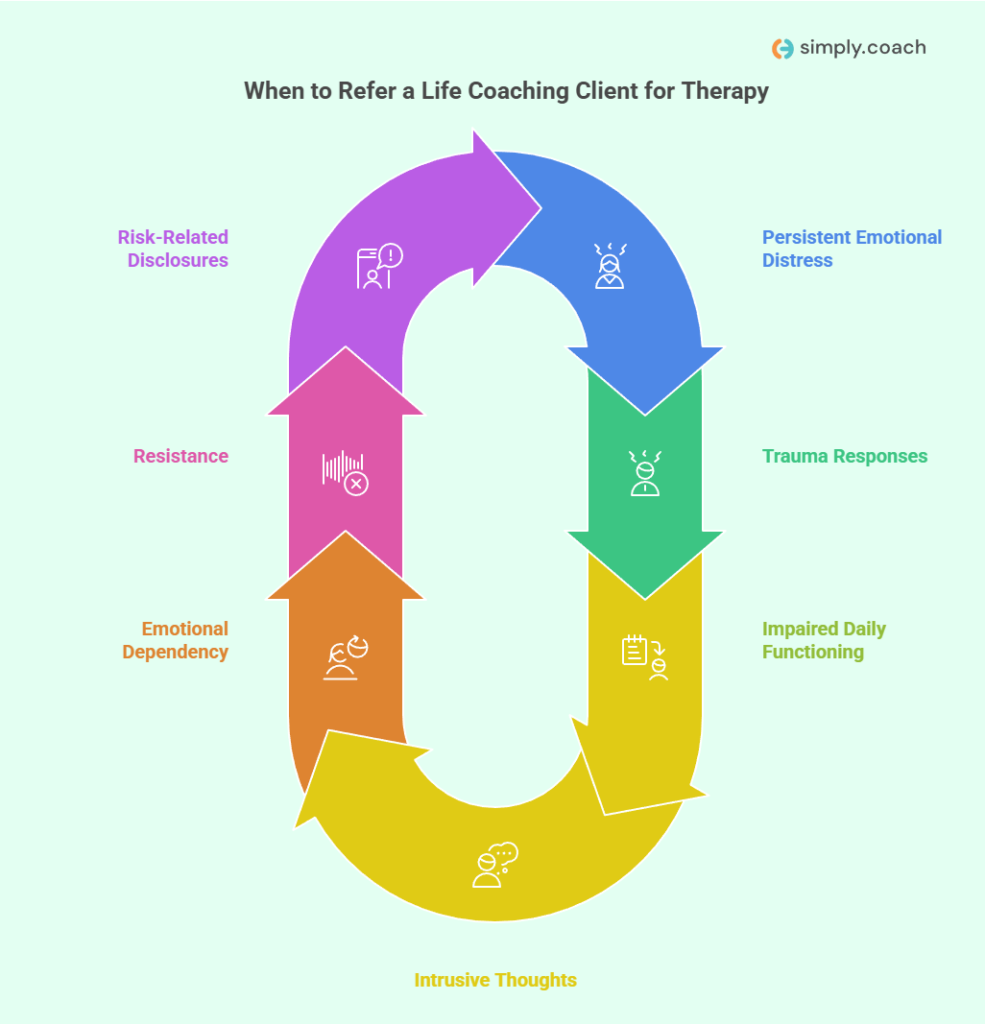
Psychological red flags that indicate referral is necessary:
- Persistent emotional distress: Clients report ongoing anxiety, sadness, or emotional overwhelm that does not improve with goal-focused coaching.
- Trauma responses: Clients show signs of emotional shutdown, panic reactions, or distress linked to past traumatic experiences.
- Impaired daily functioning: Work, relationships, or self-care are consistently disrupted due to emotional or psychological struggles.
- Intrusive or distressing thoughts: Clients describe thoughts that feel uncontrollable, frightening, or emotionally destabilizing.
- Emotional dependency patterns: Clients rely on sessions for emotional regulation rather than insight or action.
- Resistance rooted in emotional pain: Coaching stalls because unresolved emotional issues block decision-making or progress.
- Risk-related disclosures: Any indication of self-harm, harm to others, or severe emotional instability requires immediate referral.
Referring a client to therapy does not weaken your role as a life coach. It reinforces your professionalism and ensures clients receive the psychological support they need before returning to future-focused coaching.
How Life Coaches Can Ethically Use Psychology Without Crossing Therapeutic Boundaries
Using psychology ethically means applying insight without stepping into treatment. This clarity protects your clients and strengthens your coaching authority.
Practical guidelines for ethical psychological use in coaching:
- Define the coaching scope clearly: Frame sessions around goals, decisions, and actions, not emotional healing or diagnosis.
- Use psychology for awareness, not treatment: Help clients notice patterns and choices without processing trauma or symptoms.
- Anchor sessions in the present and future: Keep conversations focused on current behaviors and next steps.
- Apply tools transparently: Explain why you use reframing, values work, or habit tracking, and what outcomes to expect.
- Avoid clinical language: Do not label conditions or interpret behavior as pathology.
- Set referral thresholds early: Share referral criteria during onboarding to normalize therapy support when needed.
- Document boundaries consistently: Maintain clear notes tied to goals, actions, and progress markers.
Ethical use of psychology keeps your coaching effective, protects client trust, and reinforces your role as a forward-focused professional.
Conclusion
Understanding the psychological differences between life coaching and therapy strengthens how you serve clients and protect your practice. Clear knowledge helps you apply psychology responsibly, structure sessions effectively, and avoid techniques outside your professional scope. When you know what to use, what to avoid, and when to refer, your coaching becomes safer, more credible, and results driven.
Mastering life coach psychology allows you to create focused, actionable plans while maintaining ethical clarity. This confidence improves client trust, session outcomes, and your long-term growth as a professional life coach.
To apply these principles consistently, you need systems that support structure, accountability, and ethical practice. Simply.Coach is an all-in-one coaching platform designed to support life coaches at every stage of their journey.
How Simply.Coach supports your coaching practice:
- Goal setting: Create clear, measurable goals aligned with client values and coaching outcomes.
- Progress tracking: Monitor behavioral change, milestones, and session outcomes in one place.
- Session management: Structure sessions with notes, reflections, and action items.
- Accountability tools: Keep clients engaged with reminders and progress reviews.
- Client communication: Maintain professional, organized communication outside sessions.
With Simply.Coach, you can deliver structured, ethical, and psychologically informed coaching that drives real client progress.
FAQs
1. Why do clients choose a life coach over a therapist?
Clients choose life coaches to clarify goals, create action plans, and stay accountable when they are emotionally stable but want forward progress.
2. Can someone do both therapy and life coaching at the same time?
Yes. Some clients work with both to address emotional healing in therapy while pursuing growth and goals with a coach.
3. Do therapists ever use coaching techniques?
Many therapists use goal-setting and motivational strategies in sessions, but they apply them within a mental health treatment plan.
4. Are therapy and coaching covered by insurance?
Therapy sessions are often covered by health insurance when provided by licensed professionals, while life coaching typically is not.
5. Can therapists act as life coaches?
Yes. Licensed therapists can obtain coaching credentials and offer coaching-focused services separate from their clinical practice.