
If you keep running into the same wall during your coaching sessions, where a client believes their communication is clear, yet colleagues report friction, confusion, or avoidance. The Johari Window Model helps diagnose these perception gaps before they turn into recurring behavioral patterns. Strong Johari Window examples often reveal the difference between what a client thinks they express and what others actually experience.
The Johari framework gives you a simple diagnostic lens for examining feedback, emotional awareness, and interpersonal perception. Instead of broad self-reflection, you can pinpoint whether the issue sits in hidden beliefs, undisclosed intentions, or behaviors the client cannot see.
In this article, you’ll see a decision framework, practical Johari Window examples, and session-level coaching scenarios showing how you can apply the model in real conversations.
Key Takeaways
- The Johari Window Model helps clients identify blind spots, improve self-awareness, and align perceived and actual behaviors for stronger interpersonal effectiveness.
- Structured exploration of hidden and unknown areas reduces miscommunication, improves emotional regulation, and strengthens trust in both personal and professional relationships.
- Real-life applications include leadership feedback, team dynamics, conflict resolution, career transitions, and relationship coaching, making the model highly versatile for experienced practitioners like you.
- Misuse risks include over-disclosure, treating blind spots as instantly solvable, and applying the framework without client readiness, which can hinder progress or increase defensiveness.
- Simply.Coach streamlines the application of Johari Window insights with goal and progress tracking, automated reminders (email & text) with pre-session forms, client workspace, and reports and analytics, turning awareness into measurable client outcomes.
What Is the Johari Window Model and How Was It Developed
The Johari Window Model is a structured awareness framework used to examine how individuals perceive themselves and how others experience them. In coaching sessions, it helps identify gaps between internal intentions and external impact. Strong Johari Window examples often reveal why a client believes they are collaborative while teammates experience them as controlling. In executive, leadership, and relationship coaching, this framework becomes a practical lens for diagnosing communication breakdowns and behavioral blind spots.
The model was developed in 1955 by psychologists Joseph Luft and Harrington Ingham while studying interpersonal awareness and group dynamics. They combined their first names to create the term “Johari.” Their research focused on how feedback and disclosure form trust, cooperation, and emotional understanding within groups.
As emotional intelligence expert Daniel Goleman observed, “If you are tuned out of your emotions, you will never get tuned into other people,” which points out why expanding awareness in both the self and with others is foundational to meaningful coaching work.
With the origins of the model in mind, we can now break down the four quadrants that structure client self-awareness.
What Are the 4 Quadrants of the Johari Window Model
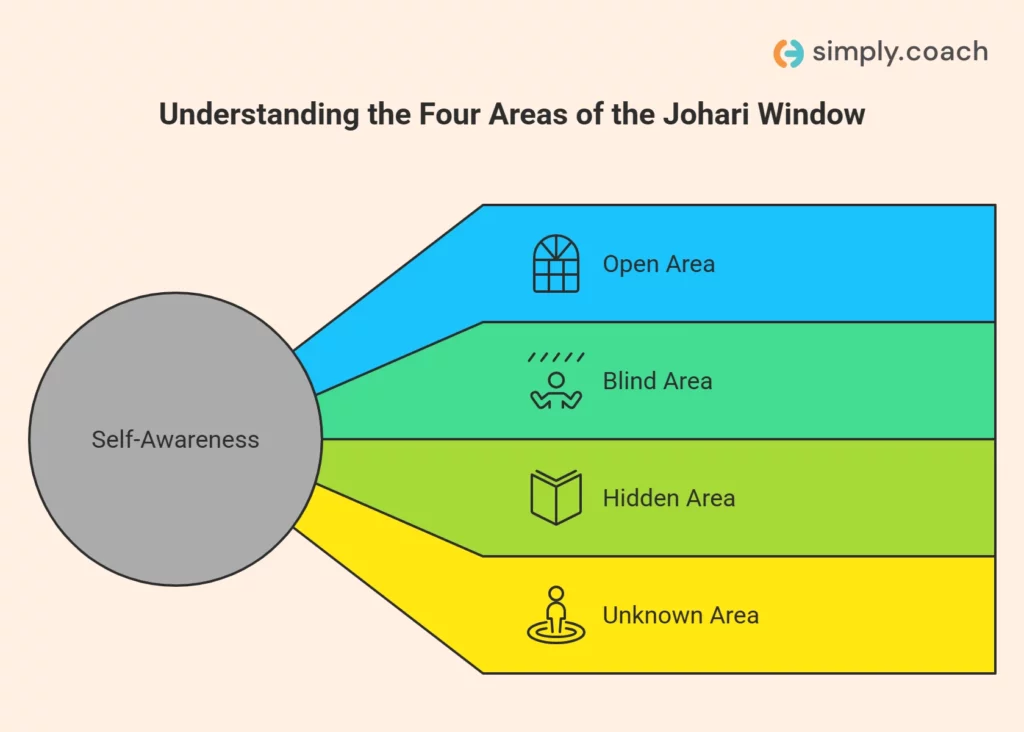
The Johari framework divides interpersonal awareness into four quadrants that describe what the client knows about themselves and what others can see. In coaching sessions, these quadrants help diagnose communication gaps, feedback resistance, and emotional blind spots. Below are the four quadrants and the folds that can deepen the analysis for experienced coaching work.
1. Open area
This quadrant contains information known to the client and visible to others. It includes behaviors, values, and communication styles that both the client and their environment recognize. In leadership coaching, this might include a client who openly acknowledges strengths, development areas, and leadership habits.
What it looks like in session:
- Clients freely share thoughts, feelings, and experiences without hesitation.
- You can observe transparency in communication and alignment between self-perception and feedback.
- Collaborative exercises emphasize strengths, achievements, and visible behaviors.
Prompts to explore this quadrant
- What leadership behaviors do your colleagues consistently acknowledge?
- Where do you and your team already agree about your strengths?
- What feedback have you heard repeatedly across roles or projects?
- Which communication habits do others clearly recognize in you?
What to assess in this stage?
- Whether the client’s self-perception aligns with how colleagues, partners, or stakeholders describe them.
- How comfortable the client feels discussing strengths, limitations, and past feedback during coaching conversations.
- Whether the client openly references previous development work, leadership feedback, or communication habits.
- Signs that the client actively seeks feedback and integrates it into decision-making or relationship dynamics.
- The degree of psychological safety the client experiences when discussing mistakes, growth areas, or interpersonal tensions.
Mistakes to avoid:
- Assuming openness equals full self-awareness, some blind spots may still exist.
- Overloading clients with feedback at once creates defensiveness or withdrawal.
- Ignoring small nonverbal cues that indicate discomfort or hidden hesitation.
2. Blind area
The blind area represents behaviors others can see, but the client does not recognize. In executive coaching, you will often find this area through structured feedback, reflection exercises, or stakeholder input. Many Johari Window examples materialize when clients realize how their intentions differ from their perceived behavior.
What it looks like in session:
- Clients may react defensively to feedback about behaviors they don’t recognize.
- You can facilitate structured reflection and peer feedback to surface blind spots.
- Role-playing or scenario-based exercises reveal discrepancies between self-perception and impact on others.
Prompts to explore this quadrant
- What feedback from colleagues surprised you the most?
- Where do people react differently than you expected?
- When have teammates described your behavior differently than you would?
- What patterns appear in feedback from multiple stakeholders?
What to assess in this stage?
- Patterns where the client’s intentions differ from how their behavior is perceived by others.
- Repeated feedback themes from colleagues, partners, or team members that the client struggles to recognize.
- Whether the client responds to feedback with curiosity, defensiveness, or dismissal.
- Situations where interpersonal friction appears despite the client believing communication is clear.
- The client’s readiness to explore feedback that challenges their existing self-image.
Mistakes to avoid:
- Pushing feedback too early, before emotional safety is established.
- Focusing solely on weaknesses rather than highlighting learning opportunities.
- Failing to debrief and process reactions leaves clients confused or disengaged.
3. Hidden area
The hidden area includes thoughts, motivations, or concerns the client knows but chooses not to disclose. These may involve personal insecurities, fears about leadership perception, or unresolved tensions with colleagues. The hidden quadrant often emerges when your clients begin sharing internal reasoning behind decisions that others misinterpret.
What it looks like in session:
- Clients choose what personal thoughts or feelings to share.
- You can create prompts that encourage gradual self-disclosure in a safe, structured environment.
- Confidential exercises allow private reflection and selective sharing.
Prompts to explore this quadrant
- What concerns do you rarely express to your team?
- What assumptions do others make about you that feel inaccurate?
- What internal pressures influence your decisions but remain unspoken?
- When do you hold back feedback or opinions in group settings?
What to assess in this stage?
- Whether the client withholds information due to trust concerns, reputation risk, or emotional safety.
- How often the client filters thoughts before sharing, especially during leadership or relationship discussions.
- Signs that internal motivations differ from what the client publicly communicates to colleagues, partners, or teams.
- Situations where the client avoids disclosure to protect authority, avoid conflict, or prevent vulnerability.
- Whether selective disclosure is strategic communication or fear-based withholding.
Mistakes to avoid:
- Pressuring clients to disclose sensitive information prematurely.
- Neglecting to establish trust or check readiness for sharing.
- Assuming silence equals disengagement, hidden areas may contain deep insights.
4. Unknown area
The unknown quadrant represents traits, reactions, or potential that neither the client nor others have recognized yet. This area often surfaces through new experiences, leadership challenges, or reflective exploration. Many Johari Window examples appear when clients encounter situations that reveal previously unrecognized capabilities or stress responses.
What it looks like in session:
- You can guide through experimentation, simulations, or new experiences.
- Clients explore untapped potential or unrecognized skills in a safe, low-risk environment.
- Reflection and feedback sessions reveal insights that neither the client nor others were aware of.
Prompts to explore this quadrant:
- What situations bring out behaviors you did not expect from yourself?
- When have you discovered a new strength during a difficult challenge?
- What leadership scenarios still feel unfamiliar or unpredictable?
- Where might experimentation reveal new capabilities?
What to assess in this stage?
- Whether unfamiliar situations trigger unexpected emotional or behavioral responses in the client.
- How the client reacts when encountering new leadership responsibilities, pressure, or unfamiliar group dynamics.
- Indicators of unrecognized strengths or decision-making capabilities that surface during challenging scenarios.
- Whether unexplored beliefs, stress responses, or coping patterns appear during reflective discussion.
- Opportunities for experimentation, stretch assignments, or behavioral testing that could reveal new capabilities.
Mistakes to avoid:
- Expecting immediate breakthroughs, discovery is iterative and contextual.
- Overloading clients with too many new challenges simultaneously.
- Ignoring emotional responses that may signal resistance or overwhelm.
Once you understand the quadrants, it’s easier to see how these sections of awareness create tangible coaching benefits.
5 Benefits of Using the Johari Window Model in Coaching
The value of the Johari Window Model appears when awareness gaps begin to block progress. Many clients struggle not because they lack goals, but because they misread how their behavior affects others. Below are the benefits you can observe in real sessions.
1. Expands self-awareness through structured feedback
The model gives you a clear way to explore how client self-perception compares with external feedback. Instead of discussing communication problems abstractly, you can map them directly to awareness gaps.
In executive coaching, this often reveals patterns such as a leader believing they encourage debate while their team experiences them as dismissive.
2. Improves communication clarity in relationships and teams
The Johari framework helps clients recognize how disclosure and feedback influence trust. Many Johari Window examples emerge when clients realize colleagues interpret silence, hesitation, or guarded responses differently than intended.
For relationship or leadership coaching, expanding the open area often improves transparency and reduces recurring misunderstandings.
3. Strengthens emotional regulation during feedback conversations
Clients frequently react defensively when confronted with feedback that challenges their identity. The model gives you a neutral structure to explore those reactions.
By discussing blind spots as part of the framework rather than as personal criticism, you can guide your clients toward curiosity rather than defensiveness.
4. Reveals hidden motivations and internal pressures
The hidden quadrant helps clients examine motivations they rarely share openly. These might include reputation concerns, fear of conflict, or uncertainty about authority.
Surfacing these internal drivers often explains behavior that previously appeared inconsistent or confusing to others.
5. Encourages growth through experimentation and reflection
The unknown quadrant reminds clients that some strengths and reactions only appear in unfamiliar situations. You can use this space to encourage leadership experimentation, behavioral testing, or new communication approaches.
Seeing the advantages in theory sets the stage for real-world examples where these insights change client behavior.
10 Examples for the Johari Window Model
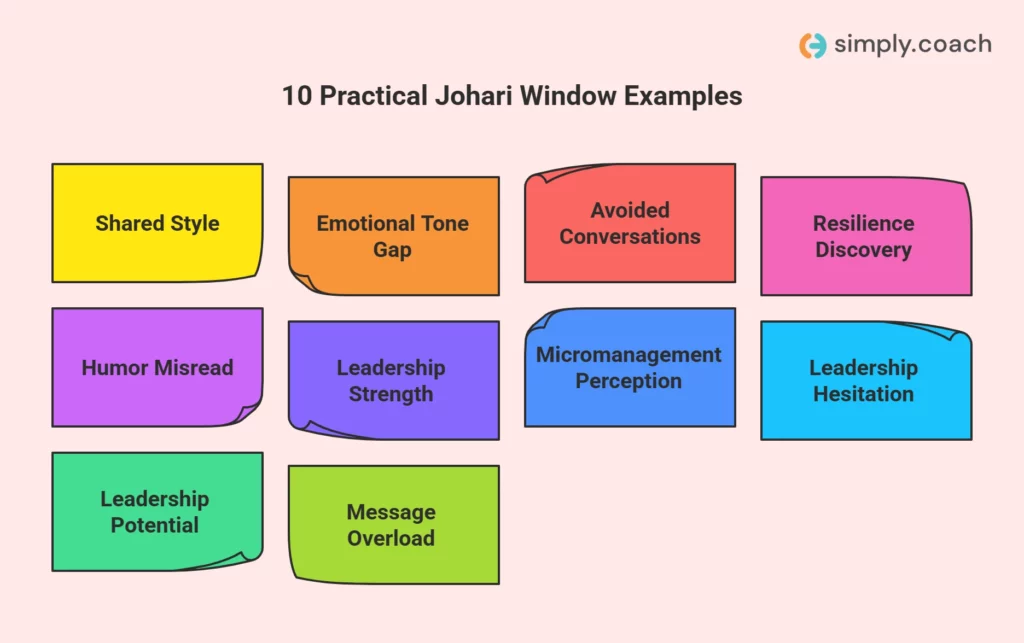
If you have years of experience as a coach, the Johari framework becomes most useful when clients can see how awareness gaps operate in real situations. Practical Johari Window examples help clients understand how perception, disclosure, and feedback influence communication patterns.
In coaching sessions, these scenarios often appear during feedback analysis, relationship discussions, or leadership reflection. The examples below illustrate how each quadrant of the model surfaces in everyday life and workplace dynamics.
First, let’s look at the Johari Window examples in personal coaching.
1. Shared communication style in a relationship (open area)
A relationship coaching client describes themselves as direct and transparent during disagreements. Their partner confirms this pattern, noting that the client prefers resolving issues immediately rather than avoiding tension.
Because both individuals recognize the same communication behavior, it sits within the open area of the Johari Window. In sessions, you can expand this quadrant by helping clients identify additional strengths that both partners already acknowledge.
2. Unrecognized emotional tone (blind area)
A client believes they provide practical advice when family members share problems. However, relatives often experience these responses as dismissive or emotionally distant.
During coaching, the client realizes their focus on solutions unintentionally minimizes the other person’s feelings. This gap between intention and emotional impact is a classic blind-area insight frequently revealed through Johari Window examples.
3. Avoiding difficult conversations (hidden area)
A client feels frustrated about repeatedly handling household responsibilities alone but chooses not to raise the issue. They worry the conversation might create unnecessary conflict.
Their partner interprets the silence as satisfaction with the arrangement. The client’s internal frustration remains hidden, illustrating how the hidden quadrant can quietly sustain unresolved tension.
4. Discovering resilience during a crisis (unknown area)
A client has always described themselves as someone who struggles with pressure. When a family emergency occurs, they unexpectedly coordinate logistics, communicate with relatives, and manage difficult decisions.
The experience reveals problem-solving capabilities the client had never previously recognized. Situations like this expand the unknown quadrant, where new strengths appear through unfamiliar challenges.
5. Misinterpreting humor (blind area)
A client frequently uses sarcasm during conversations with friends. They believe this style makes discussions lighter and more entertaining.
Over time, some friends begin to withdraw from certain conversations because the humor feels critical or dismissive. Coaching conversations reveal that the client’s perceived humor functions as unintended criticism, exposing a blind communication pattern.
Next, let’s see examples of the Johari Window in Workplace coaching
6. Recognized leadership strength (open area)
A leadership coaching client regularly facilitates team meetings where every participant contributes ideas. Colleagues consistently describe the client as approachable and inclusive.
Because both the leader and the team acknowledge this strength, it sits clearly within the open quadrant. You can use this area to reinforce behaviors that already support trust and collaboration.
7. Micromanagement perception (blind area)
A manager believes frequent project check-ins demonstrate support and accountability. Their intention is to help the team avoid mistakes and maintain quality.
Team members interpret the same behavior as micromanagement that limits autonomy. When this feedback appears during coaching, it becomes a powerful blind-spot realization frequently illustrated in Johari Window examples.
8. Hesitation to challenge senior leadership (hidden area)
An executive privately doubts whether a proposed strategy will succeed. However, they avoid expressing concerns in leadership meetings because they worry about appearing unsupportive.
Colleagues assume the executive fully agrees with the decision. The gap between internal hesitation and external silence illustrates how hidden information influences organizational dynamics.
9. Emerging leadership capability (unknown area)
A technical specialist unexpectedly leads a cross-department initiative when their manager leaves mid-project. The situation requires coordination, decision-making, and stakeholder communication.
Through the experience, the individual demonstrates leadership capability previously unnoticed by both themselves and their organization. This discovery expands the unknown quadrant, where new abilities surface through experience.
10. Communication overload (blind area)
A client believes frequent status updates keep their team aligned and informed. They send multiple messages throughout the day to ensure transparency.
Team members begin ignoring some of these updates because the volume becomes overwhelming. Coaching conversations reveal that information overload can reduce clarity, highlighting another blind-spot communication habit.
Also read: Top 14 Coaching Models Every Professional Coach Should Master
After seeing concrete examples, exercises show how you can turn theory into action to reveal client awareness in real sessions.
3 Johari Window Exercises You Can Use in Sessions
The Johari framework becomes far more useful when clients actively work through structured reflection and feedback. Well-designed exercises create the conditions where meaningful Johari Window examples emerge during conversation.
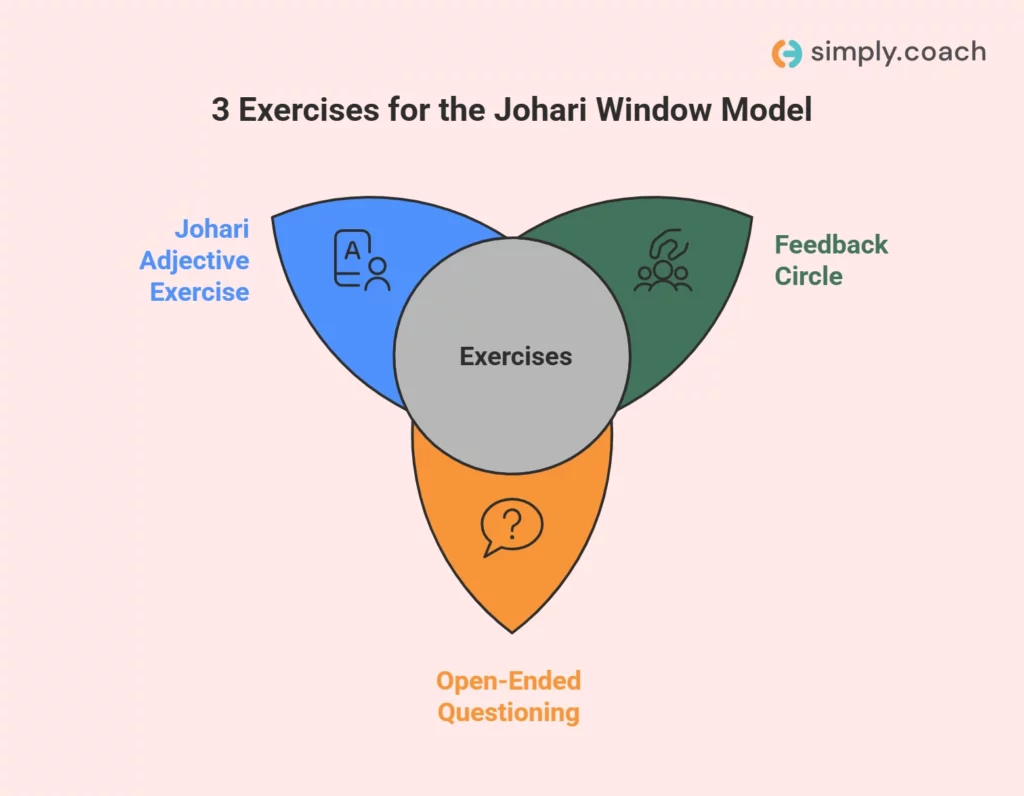
You can introduce these activities when clients need clearer insight into communication patterns, emotional responses, or interpersonal perception.
1. Johari adjective selection
This classic exercise asks the client and people around them to select adjectives that describe the client’s personality or behavior. The comparison reveals where perceptions align and where blind spots exist.
What it looks like in a session:
A leadership coaching client selects words such as “decisive,” “organized,” and “strategic.” Team members also choose decisive, but several add intimidating and impatient. The difference prompts a conversation about how decision speed may unintentionally discourage team input.
2. Feedback circle
The feedback circle introduces structured feedback from a small group of trusted individuals. Instead of casual comments, participants share observations about strengths, communication patterns, and behaviors they notice consistently.
What it looks like in a session:
An executive coaching client invites three colleagues to participate in a short feedback discussion. One colleague explains that the client’s fast decision-making keeps projects moving but sometimes limits debate.
Another colleague notes that team members hesitate to challenge the client’s ideas during meetings. This type of dialogue produces powerful Johari Window examples because multiple perspectives reveal patterns the client may never have noticed.
3. Open-ended question discussions
Open-ended questioning is one of the simplest ways you can explore hidden and unknown areas of the Johari framework. Instead of providing feedback directly, you can invite the client to reflect on experiences, assumptions, and emotional reactions.
These conversations often surface motivations, concerns, or patterns the client has not previously articulated. The goal is not interrogation but thoughtful exploration of how the client interprets their own behavior.
What it looks like in a session:
A career coaching client struggles with repeated conflict in project teams. You can ask questions such as:
- What reactions from colleagues surprise you the most during disagreements?
- When do you feel most comfortable expressing your opinion in meetings?
- Where do you usually hold back feedback, especially when you disagree?
As the client reflects, they realize they often avoid voicing disagreement early in discussions, which leads to frustration later. These moments create valuable Johari Window examples, helping clients recognize how disclosure patterns influence relationships and decision-making.
Once exercises are complete, follow-ups ensure insights are reinforced, helping clients turn awareness into consistent behavioral change.
5 Follow-Up Strategies After Johari Window Exercises
Johari Window insights are only valuable if they inform ongoing development and measurable behavior change. Thoughtful follow-up ensures clients translate awareness into actionable growth.
- Document key observations in the client workspace: Capture quadrant shifts, feedback received, and emerging blind spots for session-to-session tracking.
- Set specific goals based on insights: Align hidden or unknown area discoveries with concrete behaviors or skill-building exercises.
- Pair feedback with behavioral experiments: Encourage clients to test communication or leadership adjustments in safe environments and review results in the next session.
- Revisit quadrants periodically: Track progress in blind and hidden areas over time to reinforce learning, increase self-awareness, and expand the open area.
- Integrate insights with other coaching models: Combine the Johari findings with TGROW, GROW, or CLEAR frameworks to create structured goal-setting and decision-making follow-ups.
Also read: Top 10 Training Evaluation Models in 2026
With follow-up in place, observing how the model flows in actual sessions highlights practical timing, prompts, and facilitation approaches.
How the Johari Window Model Works in Practice
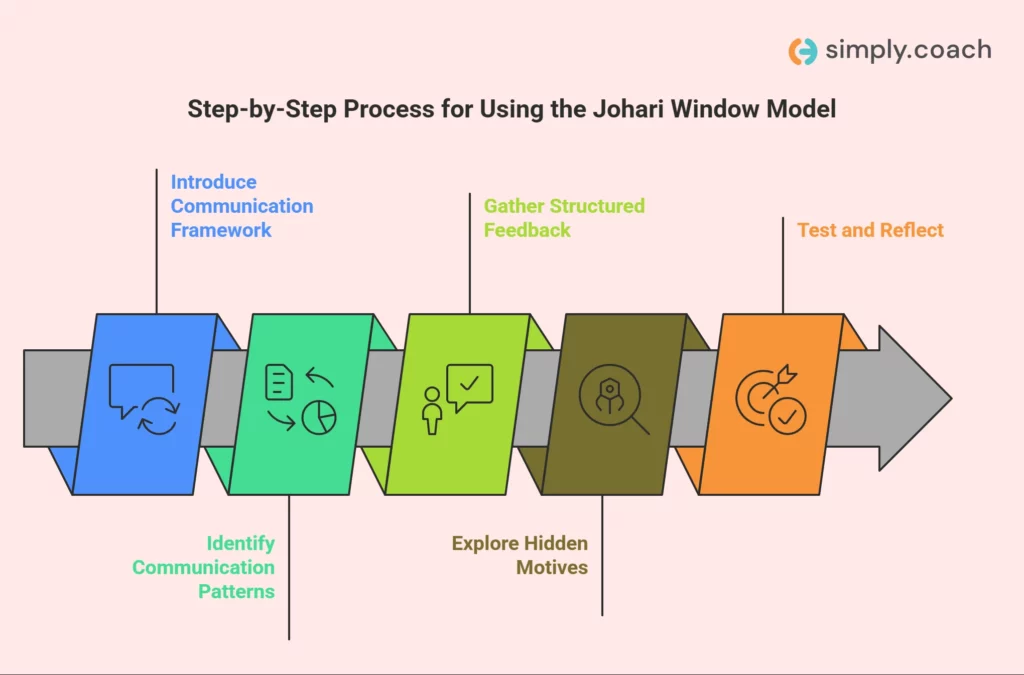
You can typically apply the Johari framework through a structured exploration rather than a one-time exercise. Each step gradually reveals patterns in perception, disclosure, and interpersonal awareness.
Step 1: Introduce the awareness framework
Begin by explaining the four quadrants of the Johari Window: open, blind, hidden, and unknown. The goal is not to analyze personality but to explore how information about the client becomes visible or invisible in relationships.
You can also share short Johari Window examples so clients understand how communication gaps emerge between intention and perception.
Step 2: Identify current communication patterns
Ask the client to describe how they believe others experience their communication style, decision-making approach, or emotional reactions.
At this stage, you can observe where the client demonstrates confidence and where uncertainty appears. These initial reflections provide clues about potential open and hidden areas.
Step 3: Introduce structured feedback
Next, bring in feedback from colleagues, partners, or trusted peers. This can occur through a formal exercise, stakeholder interviews, or reflective discussion.
When clients compare their own descriptions with external perspectives, blind spots often become visible. These moments frequently produce the most powerful Johari Window examples in coaching work.
Step 4: Explore disclosure and hidden motivations
Once blind spots emerge, you can guide your client to reflect on thoughts or concerns they rarely share with others. This stage focuses on the hidden quadrant.
Clients may reveal worries about reputation, conflict avoidance, or leadership pressure that impact their behavior without being openly discussed.
Step 5: Encourage experimentation and reflection
Finally, the coaching process invites the client to test new behaviors in real situations. These might include requesting feedback more openly, sharing concerns earlier, or adjusting communication tone.
Through these experiences, new insights emerge from the unknown quadrant, expanding the client’s awareness and strengthening their ability to manage relationships more effectively.
Seeing the step-by-step application clarifies why the model drives self-awareness, stronger communication, and emotional insight for clients.
Why Should You Use the Johari Window Model in Coaching Sessions
The Johari Window Model becomes valuable when self-awareness gaps begin blocking progress in communication, leadership, or relationships. Here’s why the model works in practice.
- Surfaces blind spots that slow client progress: Clients often repeat the same interpersonal problems without recognizing their role in them. The Johari model helps identify patterns where external feedback contradicts self-perception.
- Creates structured conversations around feedback: Instead of presenting feedback as criticism, you can place it within the blind quadrant. This framing helps clients examine feedback with curiosity rather than defensiveness.
- Improves communication clarity in relationships and teams: Many Johari Window examples appear when clients realize that silence, hesitation, or overly direct language sends unintended signals to others.
- Encourages appropriate disclosure and transparency: The hidden quadrant often reveals concerns clients rarely express openly. Exploring these thoughts can explain behaviors that otherwise appear inconsistent.
- Supports leadership and interpersonal development: In executive and relationship coaching, you can use the model to help your clients understand how their communication patterns affect trust, collaboration, and decision-making.
Knowing why it works naturally leads to understanding the right contexts, so you can avoid misuse and maintain client safety.
When to Use and Not to Use the Johari Window Model in Sessions
The Johari framework works best when the coaching goal involves interpersonal awareness, feedback interpretation, or communication improvement.
| Situation | When the Johari Window model works well | When it may not be appropriate |
| Feedback exploration | When clients want to understand how colleagues or partners perceive their behavior. | When the client is not ready to receive external feedback without becoming defensive. |
| Communication coaching | When recurring misunderstandings appear in personal or professional relationships. | When the issue is primarily technical skill development rather than interpersonal behavior. |
| Leadership development | When executives need clearer insight into how their leadership style affects teams. | When the organization cannot provide reliable or honest stakeholder feedback. |
| Relationship coaching | When partners or family members struggle with disclosure, assumptions, or misinterpretation. | When emotional safety is low or unresolved conflict makes open feedback risky. |
| Self-awareness work | When the client shows curiosity about their own behavior patterns and motivations. | When the client expects quick solutions without reflective exploration. |
| Early coaching engagement | When you want to establish awareness of perception gaps early in the process. | When trust between coach and client is still developing and disclosure feels unsafe. |
Once the context is clear, practical applications demonstrate how the model strengthens collaboration, reflection, and decision-making in client sessions.
Real-Life Applications of the Johari Window
The Johari framework becomes useful when clients need to interpret feedback, understand communication patterns, or surface hidden motivations affecting relationships and leadership behavior. Strong Johari Window examples typically appear during moments where perception and intention diverge.
Below are situations where the framework consistently proves useful in coaching work.
- Executive leadership reflection: You can apply the Johari model when leaders receive mixed stakeholder feedback. Mapping feedback into open and blind areas helps clients understand how their leadership behavior is interpreted across teams:
- Relationship coaching conversations: In relationship sessions, the model clarifies how unspoken expectations or withheld concerns influence communication. Hidden-area insights often explain recurring tension between partners.
- Career transition coaching: Clients changing roles frequently discover abilities or reactions they had not previously encountered. These discoveries expand the unknown quadrant as new responsibilities reveal untested strengths.
- Conflict resolution discussions: During conflict coaching, the model helps clients recognize how their tone, timing, or communication style contributes to misunderstandings with colleagues or family members.
- Team coaching and group development: You can sometimes use structured feedback activities within teams to reveal blind spots in collaboration, decision-making, or communication habits.
- Self-awareness development for high-performing staff: Many high-achieving clients have strong technical expertise but limited feedback exposure. Johari discussions help them examine how their behavior affects trust, collaboration, and influence.
Also read: The GROW Model Template: A Proven Framework for Coaching Success
With real-life applications in mind, it’s easier to see where assumptions can mislead and how you can guide clients correctly.
4 Common Misconceptions About the Johari Window Model
The Johari framework is widely referenced in coaching and leadership development, but it is often oversimplified or misapplied. Below are common misconceptions and the practical clarifications you can rely on in real sessions.
- The Johari Window is just about labels: Many clients assume the model categorizes personality traits or communication styles. They treat the quadrants as labels rather than conversation tools.
What happens in practice: The framework simply organizes information about awareness, feedback, and disclosure during interpersonal interaction.
- The blind area shows only weaknesses: Clients often believe one feedback conversation will permanently resolve blind areas. They expect immediate clarity about how others experience them.
What happens in practice: Blind spots change continuously because new contexts, relationships, and pressures reveal different behaviors.
- The hidden area must be fully shared: Some clients interpret the model as encouragement for full transparency in every conversation. This can lead to oversharing or poorly timed disclosure.
What happens in practice: Effective disclosure requires judgment about timing, context, and psychological safety.
- The unknown area is unknowable: Clients sometimes assume the unknown area represents unresolved issues waiting to surface. This interpretation can create unnecessary anxiety.
What happens in practice: In many Johari Window instances, the unknown area simply contains strengths or reactions that appear when clients face new experiences.
After avoiding common pitfalls, technology like Simply.Coach ensures that insights are tracked, reinforced, and scaled effectively across clients.
Turn Johari Window Insights into Actionable Coaching Progress with Simply.Coach
The Johari Window Model helps your clients recognize perception gaps, but insight alone rarely changes behavior. You know that the real work begins after awareness appears, tracking feedback patterns, documenting behavioral shifts, and following up consistently across sessions.
That process becomes difficult when coaching notes, client reflections, and feedback conversations live across scattered tools. You may even lose valuable Johari Window cases because insights remain buried inside session memories rather than structured coaching data.
A leading digital coaching platform like Simply.Coach helps you translate awareness work into measurable development by organizing feedback, reflection, and behavioral follow-ups in one place.
- Client workspace: Keep client reflections, session notes, and awareness insights organized so patterns in communication and feedback become easier to track over time.
- Goals and development planning: Convert Johari discoveries into structured development goals such as improving feedback response, strengthening communication clarity, or practicing new leadership behaviors.
- Session notes: Document insights from stakeholder feedback or reflection exercises and link them directly to behavioral commitments clients test between sessions.
- Video conferencing integration: Run coaching sessions inside the platform so feedback discussions, reflection exercises, and follow-up conversations remain connected to the client’s development record.
- Facilitating payments: Manage coaching engagements seamlessly while keeping the focus on client development rather than administrative work.
- Forms: Create structured reflection forms or feedback questionnaires that help clients capture insights from Johari Window exercises. These forms allow you to collect consistent self-perception and feedback data, making it easier to identify recurring blind spots and communication patterns across sessions.
- Reports: Generate progress reports that highlight behavioral changes and development milestones emerging from Johari Window insights. You can review patterns in feedback, reflection responses, and goal progress to evaluate whether awareness is translating into measurable growth over time.
Instead of letting awareness fade after a powerful conversation, Simply.Coach helps you capture insights, track behavioral change, and sustain development across multiple coaching engagements.
Conclusion
The Johari Window Model remains one of the most practical frameworks for exploring awareness gaps in coaching conversations. When applied thoughtfully, it helps clients understand how perception, disclosure, and feedback define their relationships, leadership behavior, and communication patterns. The Johari Window examples discussed in this guide show how the framework moves beyond theory and becomes a structured way to surface blind spots, identify hidden motivations, and reveal untapped strengths.
Mapping feedback, guiding disclosure, and testing new behaviors gradually expand the client’s open area. Over time, this process strengthens self-awareness, improves interpersonal communication, and helps clients deal with complex professional and personal dynamics with greater clarity.
However, insight alone does not create lasting change. You also need reliable ways to capture feedback patterns, track behavioral experiments, and follow up on the commitments clients make during these conversations. Without structure, valuable discoveries from Johari exercises often remain scattered across notes or memory.
Simply.Coach offers tools like goal and progress tracking, automated reminders (email & text) with pre-session forms, video conferencing integration, client workspace, and reports and analytics. You can document insights from coaching conversations, monitor behavioral shifts, and keep clients accountable between sessions, without adding administrative complexity.
FAQs
1. What is the Johari Window model, and how is it used in coaching?
The Johari Window is a framework for understanding self-awareness, feedback, and disclosure; you can use it to help clients identify blind spots and expand their open area.
2. What are the four quadrants of the Johari Window?
The quadrants are Open (known to self and others), Blind (unknown to self, known to others), Hidden (known to self, unknown to others), and Unknown (unknown to both).
3. How can I apply the Johari Window examples in leadership coaching?
Use stakeholder feedback, team reflections, and communication exercises to reveal blind spots, hidden strengths, and patterns of misalignment in leadership behavior.
4. When is the Johari Window model most effective in sessions?
It works best during feedback, conflict resolution, self-awareness exploration, and interpersonal skills coaching, especially when clients are ready to reflect on perception gaps.
5. Can the Johari Window model be applied in team coaching?
Yes, facilitating group feedback exercises, mapping blind spots, and sharing perceptions can improve collaboration, trust, and team communication patterns.
6. What are common mistakes when using the Johari Window in coaching?
Treating it as a personality test, assuming blind spots disappear instantly, over-disclosure, or rushing insight without reflection can reduce its effectiveness.
7. How do I measure client progress using the Johari Window?
Track changes in feedback alignment, communication clarity, behavioral adjustments, and client comfort with disclosure across sessions using structured tracking methods.