
You often struggle to keep group therapy sessions focused when participants share conflicting emotions and experiences. Managing diverse needs while maintaining progress can leave you exhausted and unsure which techniques will truly help. Sessions can quickly feel chaotic, making it hard to ensure each participant gains meaningful insights.
Effective group therapy techniques provide structure, foster trust, and help participants apply coping strategies consistently. They also allow you to navigate triggers, guide difficult conversations, and ensure everyone feels acknowledged and supported.
In this blog, you will explore 11 evidence-based group therapy techniques, from role-playing and CBT to trauma-informed approaches and IPT groups. You’ll learn how to apply each method effectively, manage group dynamics, and track client outcomes for measurable progress.
Key Takeaways
- Group therapy techniques are structured methods that help clients explore emotions, behaviors, and interpersonal patterns safely.
Using techniques like role-play, CBT, mindfulness, trauma-informed, IPT, and ACT ensures measurable client outcomes and skill-building. - Structured sessions with warm-ups, core activities, reflection, and wrap-up improve engagement, participation, and emotional regulation.
- Awareness of common challenges (dominating participants, conflict, emotional triggers) helps maintain a safe and productive group environment.
- Tools like Simply.Coach support goal tracking, peer feedback, reflection forms, and session documentation for better therapy management.
What Are Group Therapy Techniques?
Group therapy techniques are structured methods you use to guide participants’ interactions and facilitate personal growth. They include exercises, discussions, and activities designed to help clients explore thoughts, emotions, and behaviors in a collaborative setting.
These techniques aim to improve client outcomes by promoting self-awareness, strengthening coping skills, and encouraging constructive communication. They also help you observe patterns, address conflicts, and support behavioral change within the group context.
Historically, group therapy emerged in the mid-20th century, pioneered by Jacob L. Moreno with psychodrama, and further developed by Irvin Yalom, who emphasized therapeutic factors like universality and interpersonal learning. Today, these techniques are integrated into CBT, trauma-informed, IPT, and mindfulness-based group programs to address a variety of mental health challenges.
Benefits of Using Group Therapy Techniques
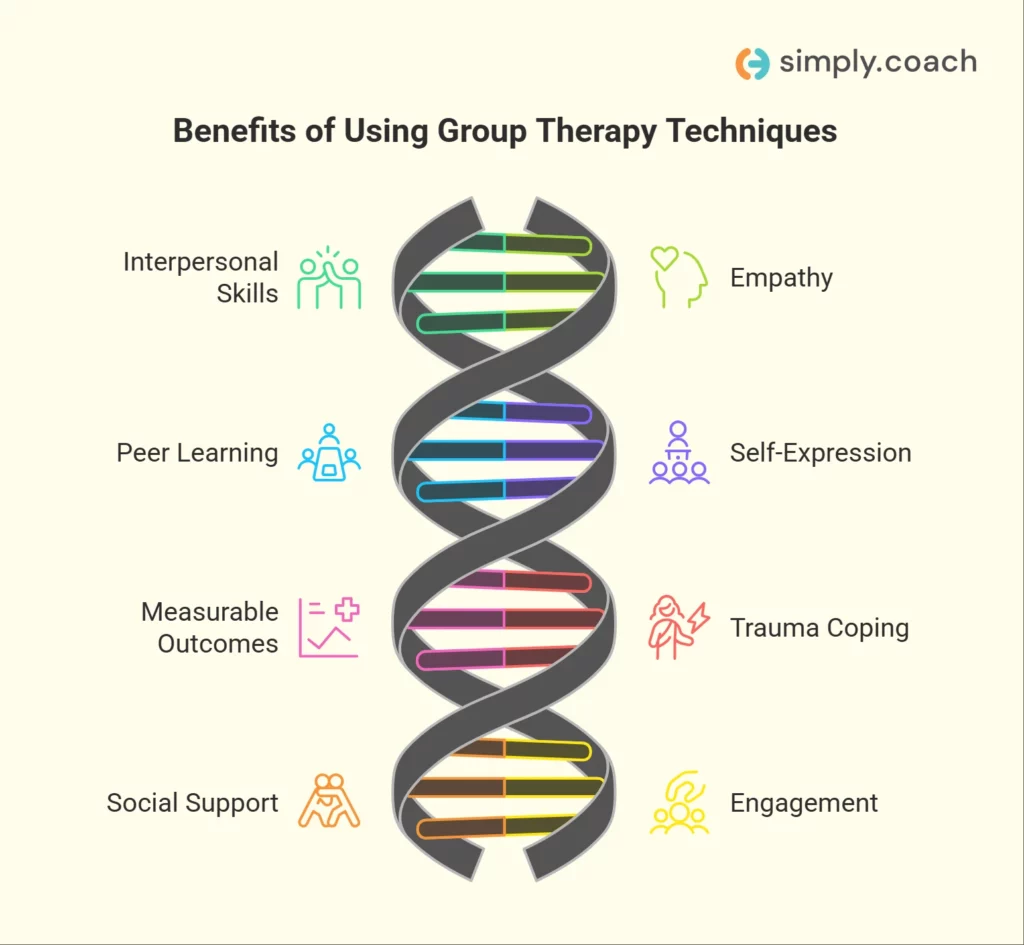
When you implement structured group therapy techniques, each session becomes more than a discussion, it becomes an opportunity for measurable growth. These methods help you guide clients toward self-awareness, skill-building, and emotional regulation while maintaining a safe and collaborative environment.
- Enhances interpersonal skills: You can guide clients to practice active listening, conflict resolution, and collaborative problem-solving in real-time.
- Builds empathy and emotional intelligence: Techniques such as role-playing and reflective exercises help participants recognize emotions in themselves and others.
- Encourages peer learning and accountability: Clients learn from peers’ experiences while you facilitate responsibility for progress and participation.
- Provides a safe space for self-expression: Structured activities like journaling, guided discussions, or creative exercises allow clients to explore sensitive topics safely.
- Facilitates measurable therapeutic outcomes: You can track skill development, symptom reduction, and behavioral improvements using worksheets, scales, or digital tools like Simply.Coach.
- Improves coping with trauma and stress: Trauma-informed and Seeking Safety techniques equip clients with actionable strategies to manage triggers during group sessions.
- Strengthens social support networks: By fostering group cohesion, participants build lasting connections that reinforce therapy beyond sessions.
- Increases engagement and motivation: Variety in exercises and techniques keeps participants attentive, reducing dropout and enhancing consistency.
Applying these techniques consistently ensures that each session produces observable progress, strengthens group cohesion, and helps you maintain structure while addressing diverse client needs.
Also read: Top 10 HIPAA-Compliant Therapy Practice Management Software: A 2026 Guide for Therapists
Top Group Therapy Techniques
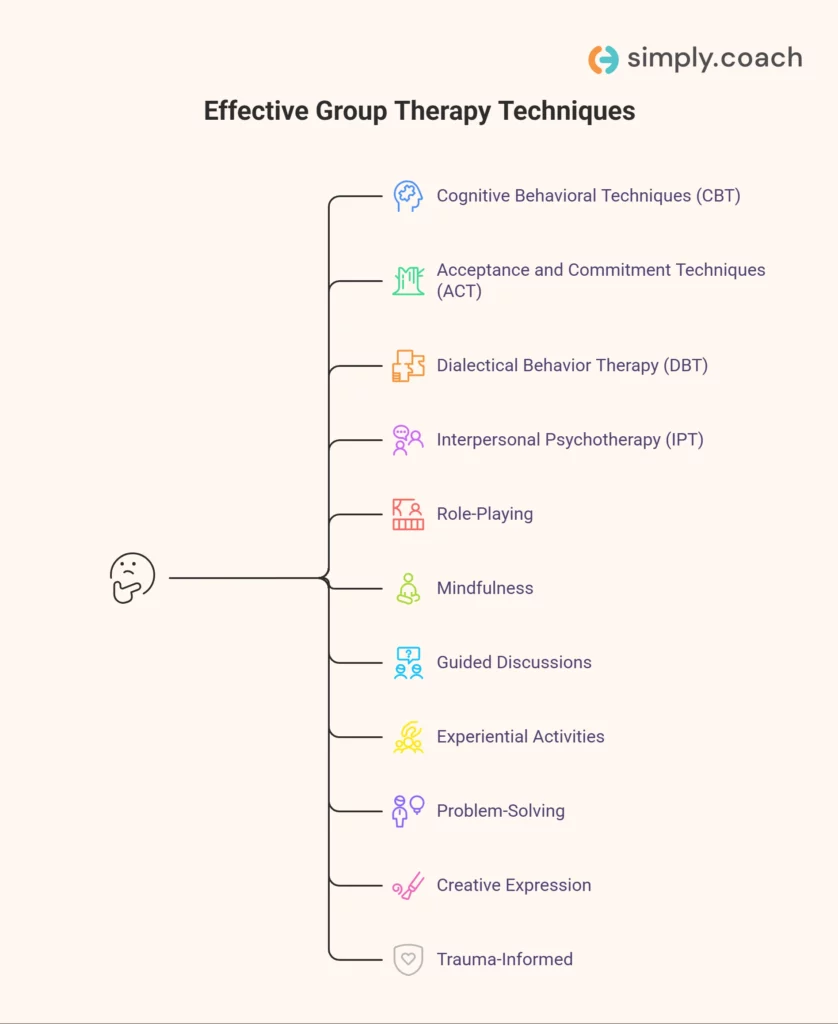
Using structured group therapy techniques allows you to create predictable session flow, address individual needs, and guide measurable client progress. Each method targets specific goals, such as emotional regulation, interpersonal skill-building, or trauma processing. Applying techniques thoughtfully ensures every participant feels heard, safe, and actively engaged in skill practice.
1. Cognitive Behavioral Techniques (CBT)
CBT helps clients identify distorted thoughts, challenge assumptions, and replace maladaptive patterns. In a group, you guide participants to share, analyze, and reframe thoughts collaboratively.
Practical examples for sessions:
- Thought log exercise: Each participant notes triggers, automatic thoughts, and alternative responses, then discusses insights in pairs.
- Behavioral experiments: Encourage participants to test assumptions through role-play or real-life tasks, then share outcomes with the group.
- Cognitive restructuring discussion: Facilitate a group conversation on common cognitive distortions like catastrophizing or overgeneralizing.
Tips for implementation:
- Keep discussions structured to prevent dominant voices from taking over.
- Use visual aids or worksheets to help participants track thought patterns.
- Encourage peer feedback while maintaining a nonjudgmental environment.
- Follow up in subsequent sessions to reinforce learning and skill application.
Common pitfalls to avoid:
- Allowing sessions to veer off-topic without redirecting discussion.
- Failing to clarify thought-reframing steps, which can confuse participants.
- Neglecting to validate emotional responses while challenging cognitive distortions.
2. Acceptance & Commitment Techniques (ACT)
ACT helps participants identify personal values, accept difficult thoughts, and take purposeful action. This technique aligns behaviors with meaningful goals, supporting long-term growth and resilience.
Step-by-step approach:
- Clarify values: Ask each participant to write down 3–5 values that guide their choices.
- Observe thoughts: Have participants notice negative or intrusive thoughts without judgment, describing them as passing events.
- Commit to action: Encourage clients to take small steps consistent with their values, then share experiences with the group.
- Reflect and adapt: Discuss obstacles encountered and strategies used to overcome them.
Practical example:
- A participant struggling with procrastination identifies “family connection” as a core value. They commit to a nightly 10-minute call with a loved one and share outcomes in the next session.
3. Dialectical Behavior Therapy (DBT)
DBT groups focus on emotion regulation, distress tolerance, interpersonal effectiveness, and mindfulness. Using modules allows participants to learn and practice skills systematically while you observe and provide guidance.
Module highlights and applied techniques:
- Emotion regulation: Teach clients opposite action, identifying triggers, and labeling emotions to reduce intensity.
- Distress tolerance: Practice grounding exercises, distraction techniques, or self-soothing strategies for high-stress moments.
- Mindfulness: Guide participants to notice thoughts and emotions without reacting impulsively, using body scans or focused attention exercises.
Applied scenario:
- During a group mindfulness exercise, a participant notices rising anger in response to criticism. They practice deep breathing and labeling the emotion, then reflect on how their response changed.
Tips for therapists:
- Focus on observing skill application rather than solving problems for participants.
- Encourage discussion of successes and challenges to reinforce learning.
- Track patterns in emotion regulation across sessions to tailor future exercises.
4. Interpersonal Psychotherapy (IPT)
IPT groups help clients improve interpersonal relationships and social functioning, addressing role transitions, grief, conflicts, or communication difficulties. Using structured exercises, you guide participants to practice new behaviors in a supportive group environment.
Step-by-step approach:
- Identify interpersonal focus: Determine whether the group will work on role transitions, social conflicts, grief, or interpersonal deficits.
- Structured exercises: Use role-play to practice difficult conversations, social skills, or boundary-setting.
- Group reflection: Discuss what participants noticed about their reactions and communication patterns.
- Skill application: Encourage members to apply new interpersonal strategies outside the session and report outcomes in the next meeting.
Practical scenario example:
- A participant struggles to express frustration at work. In group role-play, they practice assertive communication. Feedback from peers helps refine tone and phrasing.
Tips for therapists:
- Encourage peer validation and feedback to enhance learning.
- Observe patterns in social interactions across sessions to guide future exercises.
- Highlight progress in mood regulation and relationship skills over time.
5. Role-playing & psychodrama
Role-playing and psychodrama let clients rehearse real-life situations to explore emotions, behaviors, and interpersonal patterns safely. You act as facilitator, guiding reflection and feedback while maintaining a structured environment.
Practical examples for sessions:
- Conflict resolution exercise: Two participants act out a disagreement while others observe, then provide constructive feedback.
- Coping skills practice: Participants role-play responses to anxiety triggers, such as workplace stress or social interactions.
- Family dynamics exploration: Members reenact family conversations to identify communication blocks and emotional responses.
Tips for managing group dynamics:
- Establish ground rules for respect, confidentiality, and constructive feedback before starting.
- Rotate participants in roles to ensure equal practice opportunities.
- Conduct a debrief after each role-play, guiding reflection on emotions, thoughts, and alternative strategies.
- Encourage peer support and validation, reinforcing learning without judgment.
Therapist insight: Observe body language, tone, and engagement throughout role-play, intervening only to clarify misunderstandings or refocus the group.
6. Mindfulness & meditation practices
Mindfulness and meditation improve emotional regulation, focus, and stress management. You can integrate brief exercises at the start, middle, or end of a session to ground participants.
Practical examples for sessions:
- Grounding exercise: Ask participants to name five things they see, four they touch, three they hear, two they smell, one they taste.
- Breathing exercise: Guide the group through deep diaphragmatic breathing for 2–3 minutes to reduce tension.
- Body-scan meditation: Lead participants through a slow awareness of bodily sensations, highlighting areas of tension or discomfort.
Tips for effective practice:
- Maintain consistent session timing for exercises to build participant expectation and comfort.
- Keep instructions simple and clear, especially for beginners or high-anxiety participants.
- Encourage post-exercise reflection, asking participants what sensations or thoughts they noticed.
- Combine mindfulness with journaling or sharing to deepen insight and emotional processing.
Therapist insight: Monitor engagement closely. Some participants may struggle with focus or emotional release. Adjust pacing and provide reassurance when needed.
7. Guided discussions & reflective listening
Guided discussions help participants share thoughts and feelings while learning to listen actively. This technique lets you identify patterns in communication and emotional responses across the group. Reflective listening encourages members to understand others’ perspectives, increasing empathy and self-awareness.
How you can use it effectively:
- Start with a specific prompt: “Describe a situation this week where you felt challenged emotionally.”
- Ask each participant to summarize another person’s sharing before giving their own response.
- Highlight common themes or emotions, connecting them to coping strategies or personal growth opportunities.
Practical example:
- In a session on workplace stress, participants share conflicts with colleagues. Each person reflects back what they heard, helping peers recognize emotional patterns and solutions.
Tips for maintaining focus:
- Set clear speaking limits so everyone has time to contribute.
- Gently redirect conversations if discussions become repetitive or personal boundaries are crossed.
- Encourage participants to notice both words and body language to improve emotional awareness.
8. Experiential activities & icebreakers
Experiential activities break the initial tension in groups and allow participants to engage without relying solely on talking. Icebreakers build trust, while creative exercises help members express emotions and explore behaviors in ways they might not during traditional discussion.
Examples of activities you can use:
- Two truths and a challenge: Participants share two true statements and one personal challenge, prompting honesty and vulnerability.
- Mirrored movements: In pairs, one mirrors the other’s gestures, creating connection and non-verbal awareness.
- Emotion charades: Participants act out feelings while others guess, reinforcing emotional recognition and empathy.
How to guide reflection:
- After each activity, ask: “What did you notice about yourself or others?”
- Connect experiences to real-life situations, like conflict resolution or communication improvement.
- Adjust activities for participants who may feel anxious, shy, or physically limited to ensure everyone participates safely.
Quick scenario:
- During a trust-building exercise, a participant hesitates to rely on a partner. Discussing the hesitation afterward can highlight barriers to trust and social engagement.
9. Problem-solving & decision-making exercises
Problem-solving exercises allow participants to work together on realistic challenges, practicing collaboration, critical thinking, and communication skills. They reveal individual and group decision-making patterns and help you address recurring behavioral or cognitive obstacles.
How to structure a session:
- Present a concrete challenge, e.g., “Your team must meet a project deadline with limited resources.”
- Divide the group into small teams to brainstorm solutions and assign roles.
- Ask teams to present outcomes and explain reasoning, encouraging discussion about what worked and what didn’t.
- Reflect as a group on the process, emphasizing collaboration, negotiation, and problem-solving strategies.
Scenario example:
- Participants work on a community project scenario with resource constraints. Observing their planning process helps you identify tendencies like avoidance, overcontrol, or strong collaboration skills.
Tips for making it effective:
- Focus on the thinking process, not just the solution.
- Highlight different perspectives and approaches to problem-solving.
- Encourage participants to identify lessons learned and apply them to personal or professional challenges.
10. Art, music, & creative expression
Creative expression provides participants with non-verbal ways to process emotions, especially helpful for teens, trauma survivors, and adult clients struggling to articulate feelings. Using art or music reveals emotional patterns you might not observe in discussion alone.
Example scenarios:
- Emotion drawing: Ask clients to draw how they felt during a recent stressful event. Discuss colors, shapes, and intensity to uncover underlying emotions.
- Song reflection: Have participants pick a song representing their current mood. Use the lyrics to open conversation about coping strategies.
- Collaborative mural: The group creates an image together, highlighting shared experiences and reinforcing connection.
Observation tips for therapists:
- Look for recurring themes or symbols across artworks to identify emotional patterns.
- Encourage participants to describe their process, not just the final product, to reveal thought processes.
- Reinforce that no output is “wrong”, focusing on emotional insight rather than artistic skill.
11. Trauma-informed & seeking safety groups
Trauma-informed groups ensure that clients engage in therapy without being retraumatized, while Seeking Safety focuses on coping strategies for trauma and co-occurring substance use. Both approaches prioritize safety, stability, and empowerment in a group context.
Core techniques you can apply:
- Grounding exercises: Ask participants to notice surroundings, engage senses, or use breathing techniques to reduce distress.
- Coping skills practice: Teach strategies such as self-soothing, setting boundaries, and emotion labeling in real-time scenarios.
- Safe environment protocols: Establish clear group rules, encourage voluntary sharing, and monitor triggers carefully.
- Psychoeducation: Explain how trauma impacts thoughts, emotions, and behaviors to normalize experiences and foster insight.
Practical scenario example:
- A participant shares anxiety related to past trauma. Guide them to use grounding techniques, then discuss which coping strategies helped reduce distress.
Tips for therapists:
- Check in individually with clients who may feel triggered during discussion.
- Use repetitive practice of skills to reinforce safety and stability.
- Encourage participants to notice improvements in managing distress between sessions.
These group therapy techniques give you structured ways to address communication patterns, emotional regulation, trauma responses, and interpersonal challenges within a group setting. When applied thoughtfully, they help participants practice new coping behaviors, receive peer feedback, and test healthier responses in real interactions.
Structuring an Effective Group Therapy Session
A clear structure helps you guide discussions, maintain focus, and ensure every participant contributes meaningfully. It also helps participants understand what to expect during each session, which reduces uncertainty and encourages consistent engagement. When sessions follow a predictable flow, clients can focus more on reflection and skill practice rather than adjusting to shifting activities.
Recommended session flow:
- Introduction: Brief check-in where participants share mood, challenges, or progress since the last session.
- Warm-up: Short mindfulness exercise, icebreaker, or reflection prompt to help participants settle into the session.
- Core activity: Apply a group therapy technique such as role-play, CBT exercise, or collaborative problem-solving task.
- Reflection: Participants discuss insights, emotional responses, and lessons learned from the activity.
- Wrap-up: Summarize key takeaways and assign a small practice task to apply before the next session.
Practical tips for therapists:
- Group size: Keep groups between 6–10 participants for balanced discussion and manageable dynamics.
- Time control: Allocate clear time blocks for each session segment to avoid rushed discussions.
- Balanced participation: Encourage quieter members while gently redirecting dominant voices.
- Emotional safety: Pause discussions and introduce grounding exercises if conversations become overwhelming.
Following a consistent structure like this helps you manage group dynamics effectively while ensuring participants leave each session with clear insights and practical takeaways.
How Simply.Coach Helps You Conduct Effective Group Therapy Sessions
Simply.Coach is an all-in-one HIPAA-compliant therapy practice management software designed to help therapists organize, track, and improve their group therapy programs. It gives you structured tools to manage sessions, monitor participant progress, and maintain clear documentation without disrupting the therapeutic process.
Key ways Simply.Coach supports your group therapy practice:
- Goal and progress tracking: Set therapy goals for each participant and monitor behavioral or emotional progress across multiple sessions.
- Structured reflection forms: Use digital reflection forms to capture participant insights after exercises, discussions, or role-play activities.
- Peer feedback collection: Gather structured peer feedback from group members to observe improvements in communication and interpersonal skills.
- Session notes and documentation: Maintain organized session notes, activity summaries, and therapist observations for every group session.
- Client engagement data: Monitor participation levels, attendance patterns, and engagement trends across sessions.
- Centralized client profiles: Store participant goals, progress updates, and feedback in one secure dashboard for quick access.
- Outcome reporting: Generate reports that help you evaluate which group therapy techniques produce measurable improvements.
Using a structured platform like Simply.Coach helps you focus more on guiding participants and less on managing administrative tasks, allowing you to deliver more consistent and effective group therapy sessions.
Common Challenges in Group Therapy
Group therapy sessions often involve complex interpersonal dynamics that can influence participation, trust, and overall therapeutic progress. As a therapist, staying aware of these common challenges helps you anticipate potential disruptions and maintain a balanced group environment.
- Dominating participants: One member may frequently interrupt others, speak for extended periods, or redirect discussions toward personal experiences.
- Reluctance to share personal experiences: Some participants may avoid speaking due to fear of judgment, social anxiety, or lack of trust within the group.
- Interpersonal conflicts between members: Differences in opinions, emotional triggers, or misunderstandings can sometimes create tension between participants.
- Uneven participation levels: Certain members may actively contribute while others remain passive or disengaged during discussions and activities.
- Emotional triggers during discussions: Conversations about trauma, relationships, or personal struggles may cause strong emotional reactions among participants.
- Side conversations and distractions: Members occasionally form sub-conversations that interrupt the group’s focus and reduce overall engagement.
- Difficulty maintaining confidentiality awareness: Participants may unintentionally reference discussions outside the session, which can affect trust within the group.
If these challenges go unnoticed, they can quickly disrupt discussion flow, reduce trust among members, and limit the effectiveness of your group therapy techniques. Staying aware of these patterns allows you to maintain productive dialogue and keep sessions focused on therapeutic progress.
Also read: Top 18 Apps for Therapists to Use With Clients in 2026
Conclusion
Effective group therapy techniques give you structured ways to help clients practice communication, emotional regulation, and healthier behavioral responses in a supportive environment. When sessions include the right mix of discussions, experiential activities, and reflective exercises, participants learn not only from you but also from each other. The techniques discussed in this guide help you design sessions that encourage engagement, peer insight, and real behavioral change beyond the therapy room.
Managing group sessions also requires organized tracking, clear documentation, and consistent monitoring of participant progress. This is where Simply.Coach helps streamline your therapy practice. With tools for session notes, goal tracking, reflection forms, surveys, and client engagement analytics, the platform allows you to manage group therapy programs with greater clarity and efficiency. By keeping client progress, feedback, and session insights in one secure system, Simply.Coach helps you focus on guiding meaningful therapeutic conversations rather than on administrative work.
FAQs
1. What makes group therapy different from a support group?
A licensed therapist leads group therapy and uses evidence‑based techniques to address specific goals. Support groups may be peer‑led without professional therapeutic structure. Group therapy focuses on skill development and measurable outcomes.
2. Can group therapy be done online as effectively as in person?
Yes, online group therapy can be effective when it uses structured exercises, active engagement, and clear clinician guidance. It requires strong privacy and participation norms to maintain trust and interaction quality. Online sessions often include video discussions and digital exercises.
3. How long does a typical group therapy program last?
Group therapy programs vary but often run for a set series of sessions (e.g., 8–20 weeks), depending on the focus and goals. Each session usually lasts about 60–120 minutes. Duration is tailored to client needs and therapeutic objectives.
4. Who is a good candidate for group therapy?
Clients who want peer support, social skill practice, and shared learning often benefit most from group therapy. It is suitable for individuals working on emotional regulation, interpersonal issues, or specific diagnoses like anxiety or depression. A therapist determines fit before joining.
5. Is confidentiality maintained in group therapy?
Yes, confidentiality is a foundational rule in professional group therapy. Participants agree not to share others’ personal disclosures outside the group. Therapists also reinforce privacy guidelines at the start of every program.
6. How is progress measured in group therapy?
Progress is measured through goal tracking, self‑report scales, reflection forms, and peer feedback. Therapists also observe behavioral changes in session interactions. Tracking tools can provide data on emotional regulation and social skill improvement.