
In leadership programs, you often notice teams struggling to communicate clearly despite shared goals. Conflicts arise when work styles clash or decision-making approaches differ. These patterns can slow collaboration and reduce program effectiveness.
Personality assessments help you as a coach identify how leaders think, make decisions, and interact with teams. Understanding these patterns allows you to guide leaders toward more productive communication and behavior.
Two assessments stand out for organizational coaching: the Big Five and MBTI. Both provide insights, yet they measure personality in very different ways. In this guide on Big Five vs. MBTI, you will understand their core differences, strengths, limitations, and how to apply them effectively in leadership, team development, and HR programs.
Key Takeaways
- Big Five measures personality as continuous traits, helping you predict leadership performance, behavior, and team outcomes.
- MBTI categorizes personality into 16 types, helping you understand decision-making styles and communication preferences.
- Use Big Five when your coaching requires data-backed insights, performance evaluation, and leadership assessment.
- Use MBTI when your focus is self-awareness, team communication, and leadership mindset development.
- Big Five is more scientifically reliable, while MBTI is more intuitive and easier for team discussions.
- Big Five explains what leaders do in the workplace; MBTI explains how they think and decide.
- Combining both gives you a complete view of behavior and cognition, leading to stronger coaching outcomes.
- Platforms like Simply.Coach help you embed assessments into coaching workflows, track progress, and measure impact.
What Is the Big Five Personality Model?
The Big Five Personality Model is a scientifically validated framework that explains core personality traits in humans. It is widely used in organizational coaching to understand leadership behavior, team dynamics, and workplace interactions. Using this model, you can identify how individual differences influence collaboration, decision-making, and engagement.
The Big Five dimensions and their relevance in organizational settings are:
- Openness: Creativity, curiosity, and willingness to embrace new ideas. Leaders high in openness explore innovative strategies but may challenge traditional workflows.
- Conscientiousness: Organization, reliability, and goal-oriented focus. Highly conscientious individuals drive performance, maintain deadlines, and uphold standards consistently.
- Extraversion: Energy in social interactions, assertiveness, and engagement in teams. Extraverted leaders energize meetings, facilitate engagement, and strengthen cross-functional collaboration.
- Agreeableness: Cooperation, supportiveness, and conflict resolution ability. Teams high in agreeableness demonstrate smoother conflict management and stronger trust networks.
- Neuroticism: Emotional stability, stress response, and resilience under pressure. Elevated neuroticism can increase stress under tight deadlines, affecting morale and decision-making clarity.
Understanding these traits allows you, as a coach, to anticipate behaviors, guide leadership development, and tailor interventions for both individuals and teams.
When coaches should use big five assessments in organizational coaching
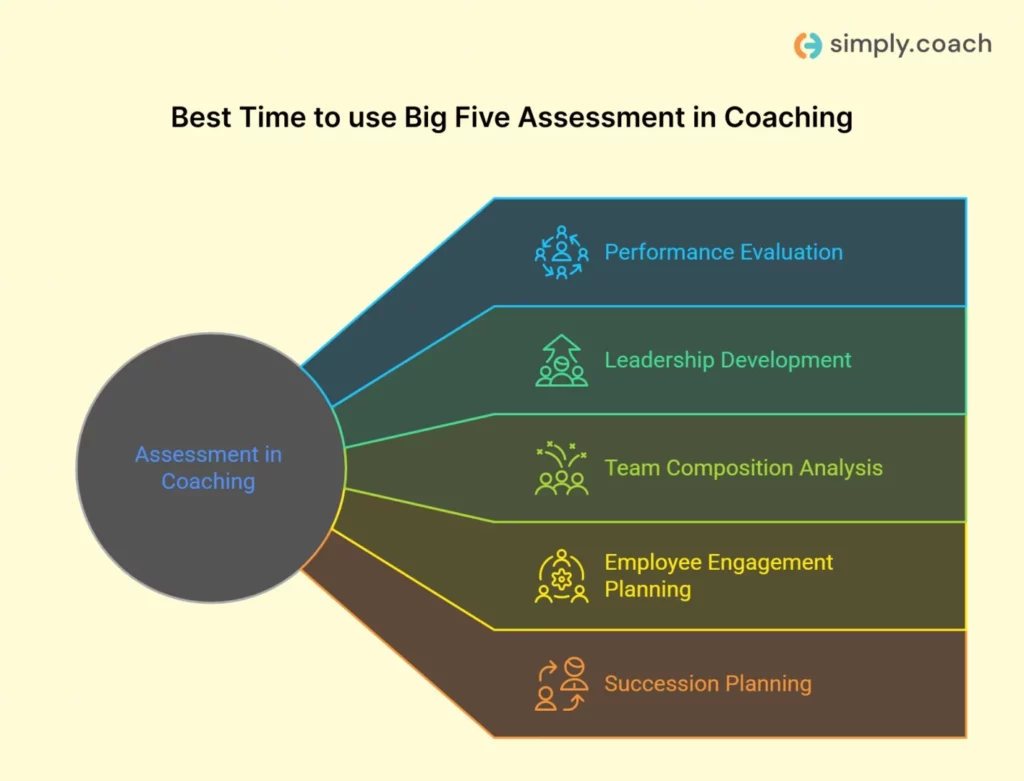
Big Five assessments are not just diagnostic; they are actionable tools for organizational development. You can integrate them into leadership and team programs to target specific outcomes.
- Performance evaluation: Align traits with key competencies and role requirements.
- Leadership development: Identify leaders’ natural tendencies and potential areas for growth.
- Team composition analysis: Understand how trait combinations influence collaboration, communication, and conflict.
- Employee engagement planning: Tailor interventions to individuals’ personality profiles for better motivation and retention.
- Succession planning: Highlight traits that predict readiness for future leadership roles.
Incorporating Big Five insights into coaching allows you to design targeted, measurable interventions that improve both individual and team performance.
What Is the Myers-Briggs Type Indicator (MBTI)?
The Myers-Briggs Type Indicator (MBTI) is a psychological framework that explains how people perceive information, make decisions, and interact with others. In organizational and leadership coaching, MBTI helps you understand leaders’ thinking patterns, decision-making preferences, and interpersonal dynamics. Using MBTI, you can guide leaders to improve collaboration, self-awareness, and team effectiveness.
The MBTI categorizes personality into 16 types using four preference pairs:
- Extraversion (E) vs Introversion (I): Indicates where leaders focus their energy—externally with teams or internally through reflection.
- Sensing (S) vs Intuition (N): Shows how leaders process information—through concrete facts or patterns and possibilities.
- Thinking (T) vs Feeling (F): Explains how leaders make decisions—using logic and analysis or values and people considerations.
- Judging (J) vs Perceiving (P): Reveals leaders’ approach to structure—preferring organization and planning or flexibility and adaptability.
These combinations produce 16 distinct personality types, each influencing leadership style, team interaction, and workplace behavior. Understanding MBTI types allows you to tailor coaching to leaders’ decision-making styles, communication preferences, and problem-solving approaches.
When coaches should use MBTI in organizational coaching
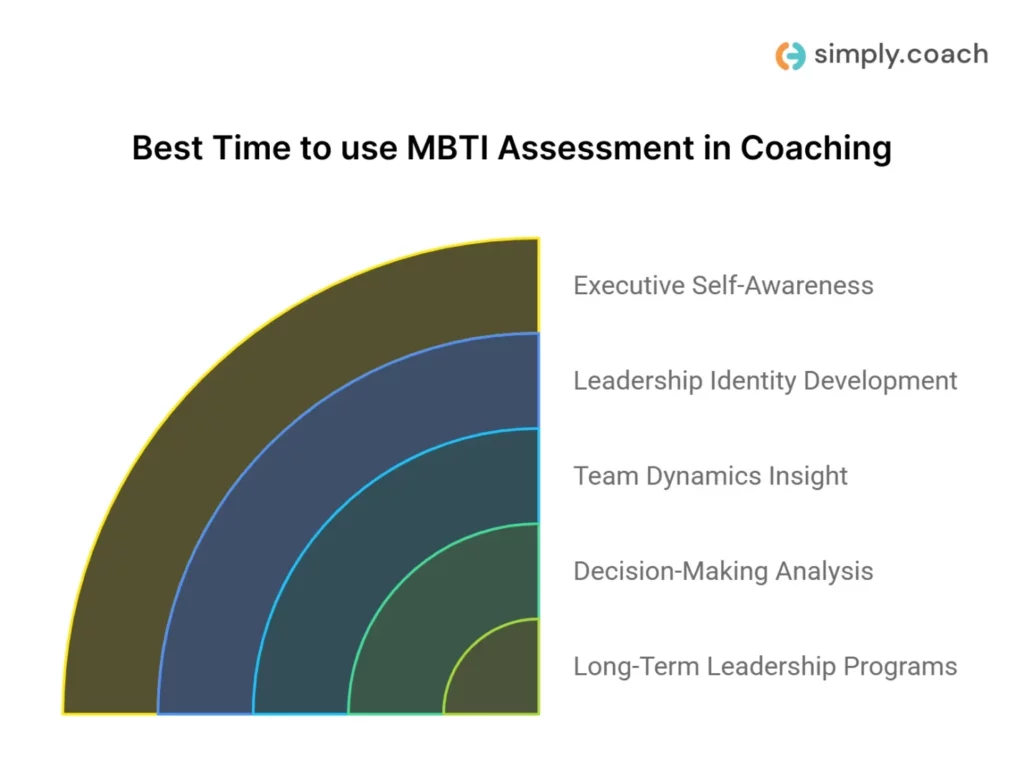
Myers-Briggs assessments are most effective when coaching focuses on self-awareness, leadership mindset, and team collaboration rather than immediate behavior change.
- Executive self-awareness: Help leaders understand how their preferences shape communication, decision-making, and team influence.
- Leadership identity development: Explore how values, motivations, and cognitive preferences drive leadership style.
- Team dynamics insight: Identify how different personality types interact, anticipate conflict, and improve collaboration.
- Decision-making analysis: Guide leaders in understanding their natural approach and how to adapt for strategic outcomes.
- Long-term leadership programs: Use MBTI insights across multiple sessions to track growth and mindset evolution.
Integrating MBTI into coaching programs strengthens leaders’ psychological insight, improves team cohesion, and supports sustainable leadership development.
Also read: Best Alternative Personality Tests to Myers-Briggs
Key Differences Between Big Five and Myers-Briggs Personality Indicators
As a coach working with leadership teams, the difference between these frameworks shapes how you assess leaders, design interventions, and measure outcomes. The Big Five gives you predictive behavioral data, while MBTI helps you interpret how leaders think and make decisions.
1. Trait vs type
When you assess leaders in organizational settings, the level of precision in personality measurement directly affects your coaching recommendations.
Big Five operates on continuous scales
- Leaders score along a range, such as moderately high conscientiousness or low agreeableness
- Helps you identify subtle differences between high performers and average performers
- Useful when coaching requires fine adjustments in leadership behavior
MBTI assigns fixed personality types
- Leaders are grouped into one of 16 categories (e.g., ENTJ, ISFP)
- Simplifies communication in workshops but reduces behavioral nuance
- Two leaders with the same type may still perform very differently under pressure
Coaching insight: Use Big Five when you need precision in leadership assessment. Use MBTI when you want a shared language for discussing personality in teams.
2. Scientific credibility
If your coaching outcomes are tied to performance, promotion, or leadership readiness, the reliability of the assessment becomes a critical factor.
Big Five is strongly validated in workplace research
- High test-retest reliability, often above 0.80 across time
- Consistent across industries, cultures, and leadership levels
- Predicts job performance, leadership effectiveness, and team contribution
- Aligns closely with peer and manager observations
MBTI shows mixed reliability in research settings
- 39–76% of individuals receive a different type on retest
- Binary classification does not reflect how personality actually distributes
- Limited ability to predict measurable outcomes like performance
Coaching insight: Use Big Five when your program requires data-backed decisions and measurable outcomes. Use MBTI when your goal is reflection, awareness, and discussion.
3. Behavior vs cognition
In leadership coaching, you often need to decide whether to focus on changing behavior or understanding the thinking behind it.
Big Five focuses on observable workplace behavior
- How leaders communicate in meetings and feedback sessions
- How they respond to pressure, deadlines, and conflict
- How they collaborate, delegate, and execute tasks
- Directly connects to performance and team outcomes
MBTI focuses on cognitive preferences and decision-making style
- How leaders interpret information and assess situations
- How they balance logic with people considerations
- How they approach planning, structure, and flexibility
- Explains the reasoning behind leadership behavior
Coaching insight: Use Big Five when you need to improve visible leadership behavior quickly. Use MBTI when you want leaders to understand the thinking patterns driving those behaviors.
4. Simplicity vs depth
The effectiveness of an assessment often depends on how easily leaders can understand and apply the insights during coaching programs.
Big Five is easier to apply in organizational programs
- Trait scores map directly to competencies like accountability or collaboration
- Works well in large-scale HR and L&D initiatives
- Leaders can apply insights without extensive interpretation
MBTI requires guided interpretation
- Sixteen personality types require explanation before application
- Insights emerge through facilitated discussions and coaching sessions
- Better suited for smaller groups or executive coaching engagements
Coaching insight: Use Big Five for scalable programs with clear outcomes. Use MBTI for deeper coaching conversations and leadership reflection.
5. Use case alignment in organizations
Selecting the right framework depends on the specific coaching objective and the outcomes your organization expects from the program.
| Coaching objective | Big Five application | MBTI application |
| Leadership assessment | Identify traits linked to performance and readiness | Understand leadership style and preferences |
| Team development | Analyze trait mix affecting collaboration and conflict | Explore communication and thinking differences |
| Performance improvement | Link traits to measurable behavior gaps | Reflect on decision-making and interpersonal style |
| Succession planning | Predict leadership potential using trait patterns | Support leadership identity development |
| L&D programs | Standardize assessments across large groups | Facilitate interactive workshops and discussions |
Big Five helps you predict and measure leadership behavior in real work environments. MBTI helps you interpret how leaders think, decide, and interact. When used together, you can design coaching programs that move from awareness to measurable leadership improvement.
Big Five vs MBTI: Core Comparison for Organizational Coaching
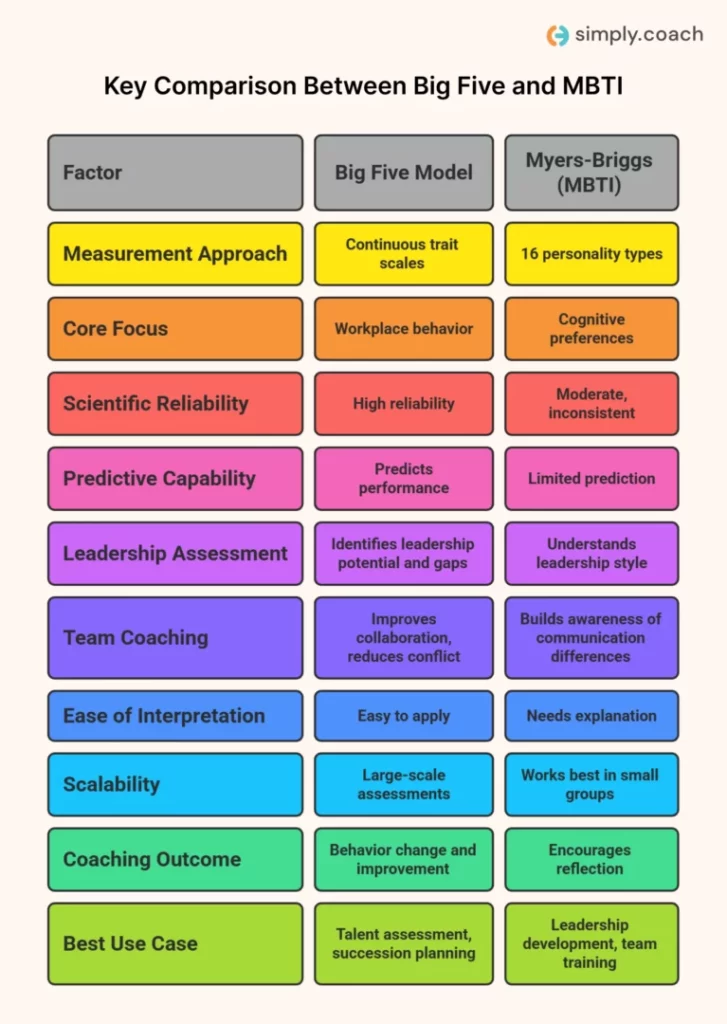
Before selecting an assessment, you need clarity on what each framework actually measures and how it applies in real coaching scenarios. This comparison helps you align the right tool with your coaching objectives.
| Factor | Big Five personality model | Myers-Briggs (MBTI) |
| Measurement approach | Measures personality on continuous trait scales (low to high) | Categorizes individuals into 16 fixed personality types |
| Core focus | Observable workplace behavior and consistent patterns | Cognitive preferences and decision-making styles |
| Scientific reliability | High reliability and strong validation across research studies | Moderate reliability with inconsistent retest results |
| Predictive capability | Predicts job performance, leadership effectiveness, and team behavior | Limited ability to predict performance outcomes |
| Use in leadership assessment | Identifies leadership potential, risk areas, and performance gaps | Helps leaders understand their leadership style and preferences |
| Application in team coaching | Analyzes trait mix to improve collaboration and reduce conflict | Builds awareness of communication and thinking differences |
| Ease of interpretation | Easy to interpret and apply in HR and L&D programs | Requires guided explanation and facilitated discussion |
| Scalability in organizations | Suitable for large-scale assessments and standardized programs | More effective in workshops and smaller group settings |
| Coaching outcome | Drives measurable behavior change and performance improvement | Encourages self-awareness and reflection |
| Best use case | Talent assessment, succession planning, performance coaching | Leadership development, team workshops, communication training |
If your program requires data-driven decisions and measurable outcomes, Big Five gives you stronger direction. If your focus is improving team understanding and leadership awareness, MBTI supports better conversations.
Also read: DISC vs Myers-Briggs: A Coach’s Guide to Choosing the Right Test
Can coaches use both Big Five and MBTI together?
Many organizational coaches combine the Big Five and MBTI during leadership development programs to get a more complete view of leaders and teams. Each framework explains a different dimension of personality. The Big Five focuses on observable workplace behavior, while MBTI explains the thinking patterns that influence decisions and interactions.
Using both frameworks together allows you to connect what leaders do in the workplace with how they think behind those actions. This creates more focused coaching conversations and stronger development outcomes.
Big Five provides clear insight into behavioral patterns that affect leadership performance and team dynamics. You can use it to identify how leaders operate in real work situations and where adjustments are needed.
Big Five helps you understand:
- How consistently a leader delivers on goals and commitments
- How they respond to pressure, deadlines, and uncertainty
- How they collaborate and manage interpersonal relationships
- How their behavior impacts team engagement and performance
These insights allow you to address visible gaps in leadership behavior that affect outcomes in organizational programs.
MBTI complements this by explaining the cognitive preferences behind those behaviors. It helps you understand how leaders interpret situations, process information, and approach decisions.
MBTI helps you explore:
- How leaders gather and interpret information in complex situations
- How they evaluate decisions using logic or people considerations
- How they approach structure, planning, and adaptability
- How their thinking style shapes communication and leadership approach
When you combine these frameworks, you move beyond surface-level observations. You can explain not only what needs to change in leadership behavior, but also why those patterns exist.
This combined perspective helps you design coaching interventions that improve communication, strengthen decision-making awareness, and create sustainable leadership development across teams.
Also read: Essential Coaching Tools for Leadership Development Programs
Pros and Cons of Big Five and MBTI
Understanding the strengths and limitations of both frameworks helps you choose the right tool for specific leadership coaching objectives. The table below highlights key advantages and drawbacks of each assessment in organizational contexts:
| Aspect | Big Five | MBTI |
| Pros | – Strong empirical support and reliability for predicting workplace behavior- Continuous traits allow a nuanced understanding of leaders and teams- Applicable across cultures and industries- Helps predict performance, engagement, and leadership potential | – Popular and widely recognized in organizations- Easy to introduce and discuss with leaders- Encourages self-reflection and awareness of thinking styles- Supports team communication and leadership workshops |
| Cons | – Less intuitive for leaders unfamiliar with psychological research- May require expert interpretation for deeper insights- Focuses on behavior, less on internal motivations or decision-making preferences | – Categorical types can oversimplify complex personalities- Test-retest reliability is moderate; leaders can receive different results over time- Limited predictive power for performance or outcomes- Requires coaching to translate insights into actionable behavior |
Big Five excels in predicting observable behaviors and leadership potential, while MBTI adds value in exploring thinking patterns and interpersonal dynamics. Using them strategically can enhance both behavioral and cognitive insights during organizational coaching.
How Simply.Coach Helps Implement Big Five and MBTI Assessments in Coaching
In leadership and organizational coaching, personality insights are only useful when they are captured, tracked, and tied to outcomes. Simply.Coach provides digital tools that let you embed assessments into your coaching process, translate results into development goals, and share progress with clients and stakeholders, all from one secure platform.
- Digital tools for assessment delivery: You can create and send custom forms, surveys, or assessment templates to clients directly through the platform, then capture all responses in one place.
- Centralized client workspace: Assessment forms, results, and coaching deliverables live in the same client dashboard, making interpretation contextual and easier to reference during sessions.
- Goal and development planning based on traits/types: Connect Big Five scores or MBTI insights to specific goals and actions, and track progress over time.
- Action plans and nudges: Turn assessment insights into actionable steps. You can assign tasks, reminders, and follow‑ups that keep leaders accountable between sessions.
- Stakeholder integration for 360‑degree perspectives: Include managers, HR partners, or sponsors in feedback loops that validate assessment results and contextualize growth areas.
- Progress and impact reporting: Generate reports that connect personality data with coaching outcomes, making it easier to demonstrate ROI to organizational stakeholders.
- Reusable coaching journeys: Build structured coaching programs that embed assessments at key stages of the process, ensuring consistency across cohorts and leaders.
By integrating personality assessments into the coaching workflow rather than treating them as standalone documents, Simply.Coach helps you turn Big Five and MBTI insights into actionable development pathways that align with organizational leadership goals.
Conclusion
Understanding personality frameworks like the Big Five and MBTI equips you to decode leadership behavior, team dynamics, and decision-making styles. Each framework provides unique insights. Big Five for observable traits and performance prediction, MBTI for cognitive preferences and leadership mindset. Applying these assessments thoughtfully helps you design targeted coaching interventions. Combining insights from both can create a more complete picture of your leaders and teams.
Simply.Coach makes integrating Big Five and MBTI assessments seamless within your coaching workflow. Track results, set development goals, and measure progress all from one secure platform. Its tools help transform personality insights into actionable leadership growth strategies. With Simply.Coach, you can deliver consistent, impactful coaching that drives measurable organizational outcomes.
FAQs
1. Can the Big Five and MBTI results contradict each other?
Yes, Big Five measures traits on a continuum, while MBTI assigns fixed types. Because of this, a leader may score moderately on a Big Five trait yet be placed in a specific MBTI category on preference. The two frameworks can therefore produce seemingly conflicting profiles.
2. Is one assessment better for hiring decisions than the other?
Big Five is generally considered more suitable for hiring and performance prediction because of its strong scientific foundation and predictive validity. MBTI is less reliable for selection decisions and better suited for self‑awareness or team dialogue.
3. Can organizational teams take both Big Five and MBTI simultaneously?
Yes, many organizations have teams complete both assessments to gain complementary insights: Big Five for behavior prediction and MBTI for understanding cognitive styles. Combined data gives a richer picture of team dynamics.
4. Do Big Five traits change over time like MBTI types?
Big Five traits show gradual change across the lifespan but remain relatively stable once adulthood is reached. MBTI types can fluctuate more easily, especially with retesting within weeks.
5. Can Big Five and MBTI results be used together in leadership development?
Yes, using both lets you connect observable behavior (Big Five traits) with underlying decision‑making preferences (MBTI). This helps coaches tailor interventions to both action and cognition.
6. Are Big Five or MBTI assessments more scientifically accepted?
The Big Five has broader scientific acceptance due to extensive research, cross‑cultural replication, and predictive validity. MBTI remains popular in applied and coaching contexts but has weaker empirical support.
7. Does MBTI measure emotional stability like the Big Five?
MBTI does not directly measure emotional stability. The Big Five includes Neuroticism, which predicts stress responses and resilience, a trait often linked to workplace outcomes.