
You’ve already solved hard business problems. Yet, when a client asks “Why isn’t marketing working?” you may hit familiar roadblocks: tactics disconnected from revenue, fragmented vendor output and lack of clear measurement. Leaders want clear outcomes, not just activity. This gap slows growth, wastes budget, and makes it hard to sell longer-term work.
This blog shows a direct path to add marketing outcomes to the services you already sell. You’ll get a compact, repeatable way to diagnose where growth stalls, set a tight pilot that proves value, and run oversight so results stick.
That approach matters because companies still fund marketing: in 2026, marketing spending is expected to average between 7.7 – 9 % of company budgets, which means there’s real budget you can help convert into measurable pipeline and revenue.
The issue is not spending, it’s direction, oversight, and measurement. Learning how to become a marketing consultant means applying the skills you already use, diagnosing problems, setting priorities, and tracking results, to how companies generate and convert demand.
In this blog, we’ll walk through the steps to move into marketing consulting, the core skills you need to strengthen, and how to shape this into a clear, repeatable service you can offer with confidence.
Key Takeaways
- A marketing consultant focuses on growth, not just marketing tasks. The job is to find what’s blocking revenue, make a focused plan, and tie all marketing work to business results.
- Start with a diagnosis before doing anything else. A short audit that shows key bottlenecks, baseline numbers, and quick wins builds trust and sets up paid work.
- Sell a 90-day pilot, not vague ongoing help. A fixed-scope pilot with clear KPIs makes it easier for clients to say yes and gives you a chance to prove impact fast.
- Your value is in oversight and direction, not doing all the work yourself. You guide teams and vendors, keep efforts aligned with goals, and ensure quality and timelines stay on track.
- Simply.Coach helps consultants run structured, outcome-focused engagements. The platform supports client management, goal tracking, session workflows, reporting, and compliance needs for consulting practices.
What is a Marketing Consultant?
A marketing consultant is an external expert who advises businesses on how to solve marketing problems that block growth. You don’t just “run ads” or write copy, you diagnose where growth stalls, set a clear plan that ties marketing to revenue, and make sure someone actually delivers and measures the outcome. Think of the role as: diagnose → plan → oversee delivery → prove impact. This keeps the work tied to business results, not just activity.
You already know how to translate business goals into actions. When you apply that skill to marketing, you move from handing off tactical work to owning the outcomes that matter to leadership.
What does a marketing consultant do?
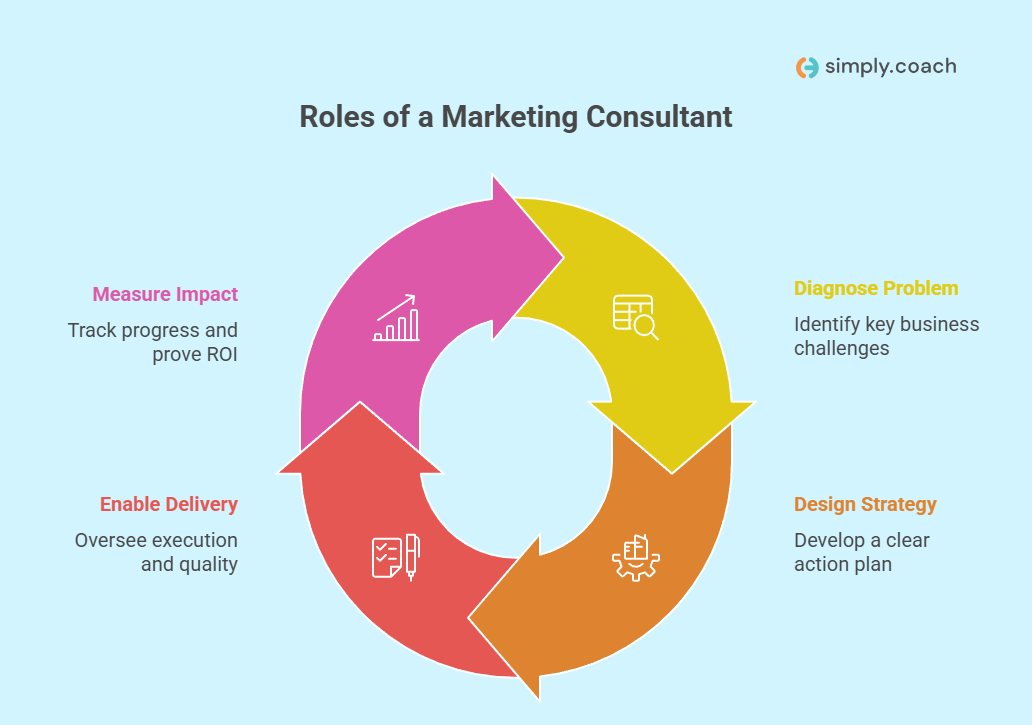
You can group the work into four outcome-focused activities. Each item below outlines what to deliver and how to package it, so you can win pilots and expand into retainer work.
- Diagnose the business problem (Discovery & Audit)
- Deliverable: A concise diagnostic memo (3–6 pages) with baseline metrics, top 3 growth bottlenecks, and quick wins.
- How you do it: Review analytics and CRM, interview 3–5 stakeholders, and map the buyer journey. Focus on gaps that block the pipeline or revenue.
- Design a focused strategy (One-page plan + 90-day roadmap)
- Deliverable: One-page strategy brief + prioritized 60–90 day roadmap with clear KPIs and owners. This is your sales packet for the pilot.
- Why it works: Clients pay for clarity and measurable expectations, not long lists of tactics.
- Enable and manage delivery (Execution oversight)
- Deliverable: Vendor brief, acceptance criteria, and weekly delivery cadence. You manage teams/agencies and keep quality tight without being the day-to-day doer.
- Measure and prove impact (KPI map & dashboard)
- Deliverable: A simple dashboard showing baseline vs. progress for 3–6 metrics tied to revenue or pipeline. Reporting should be plain language for executives.
- Measurement matters: Top firms emphasize building the measurement architecture first so you can prove ROI quickly.
Sell the first engagement as a 90-day pilot with a fixed scope (audit + roadmap + managed pilot). Make the pilot price cover your time + a small implementation oversight fee. If you hit the agreed KPIs, propose a 6–12-month retainer to scale results.
Those responsibilities describe what you deliver. To do them consistently and credibly, you need a set of underlying capabilities that support your work across different clients, industries, and growth challenges.
Core Skills You Need to Succeed as a Marketing Consultant
Below are the capability clusters you should sharpen. Each cluster builds on what you likely already do well: translate business needs into actions, run projects, and communicate with leaders.
1. Strategic capabilities
Strategic capability is the ability to connect business goals, such as revenue growth, market expansion, or improved win rates, to a clear marketing direction. It’s about deciding where marketing should focus and why, rather than listing everything marketing could do.
In today’s market, marketing is expected to support growth with fewer resources. Leadership looks for focus, not volume. A strong strategy ensures marketing efforts align with how the business actually sells and competes, which is why strategic clarity enables marketing to influence the pipeline and long-term growth.
2. Analytical & measurement capabilities
This capability centers on defining meaningful metrics and creating a clear line of sight between marketing activity and business outcomes. It’s about consistency in measurement, shared definitions, and credible reporting that leaders can rely on.
When budgets are under scrutiny, data becomes the basis for trust. Marketing that clearly shows impact on the pipeline or revenue is far more likely to retain and expand investment. Industry research shows that organizations with aligned, outcome-focused measurement frameworks make better decisions and see stronger returns from marketing spend.
3. Execution oversight (not execution itself)
Execution oversight is the ability to ensure marketing plans are delivered effectively through teams, agencies, or partners. It focuses on governance, accountability, and quality rather than hands-on production.
Most marketing work today is distributed across multiple vendors and tools. Without strong oversight, execution becomes fragmented and inefficient. Effective governance protects investment, reduces risk, and shortens time to results—making it a critical business skill, not just an operational one.
4. Client & stakeholder management
This skill is about managing relationships at the decision-maker level. It includes setting expectations, translating marketing outcomes into business language, and creating structured moments for review and alignment.
Trust is what turns short projects into long-term engagements. When stakeholders consistently see clear communication, realistic timelines, and business-level insights, they’re more likely to expand scope and continue investing. Strong stakeholder management directly influences retention and lifetime client value.
Taken together, these capabilities shift marketing consulting from activity-based work to outcome-based partnerships. They help marketing earn credibility at the leadership table, justify spending in tighter markets, and position marketing as a dependable growth lever rather than a cost center. That’s the level of value clients are willing to pay for, specially when growth matters more than ever.
With those capabilities in mind, the next step is turning them into a clear, practical path forward.
How to Become a Marketing Consultant
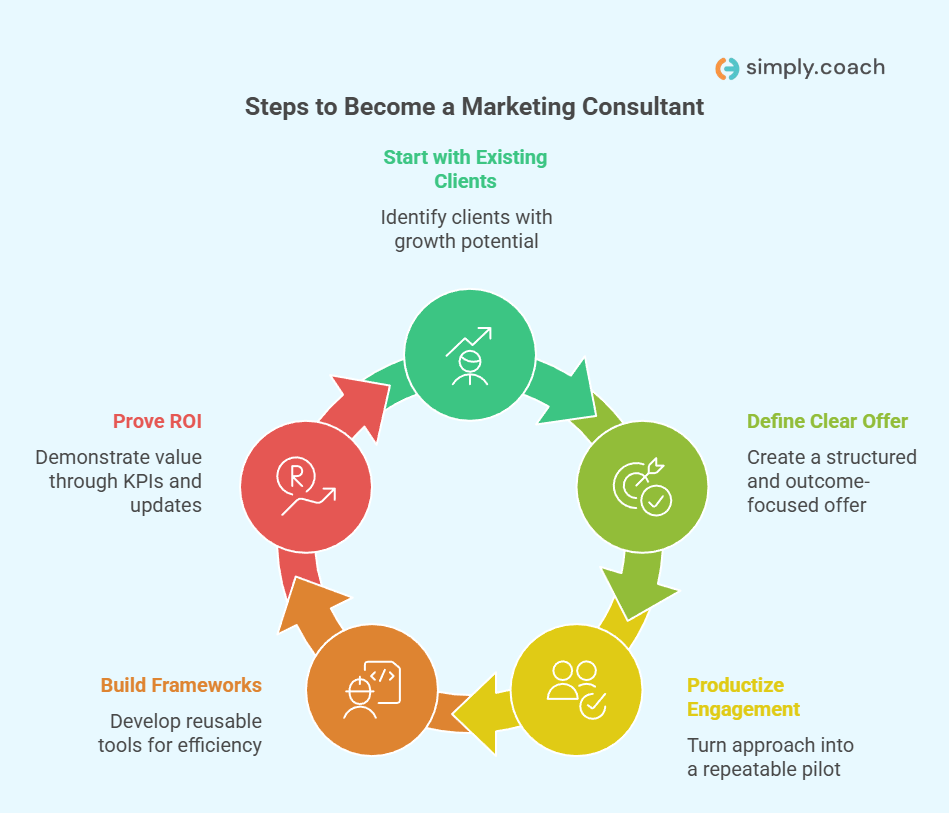
Becoming a marketing consultant does not mean changing who you are or starting from zero. It means applying your existing strengths, problem diagnosis, structured thinking, and results accountability to marketing decisions that directly affect growth. The goal is to help clients move faster, spend smarter, and clearly see what is working.
The most reliable path is not to chase new markets or learn every marketing tactic. Instead, you build on relationships you already have, introduce marketing as a growth lever, and deliver it through a clear, repeatable consulting process.
Here is a proven way to do that step by step:
Step 1: Start with your existing client base
The fastest and lowest-risk way to begin is with clients you already work with. You already understand their business model, decision-makers, and growth challenges. That context is hard to replicate with new prospects.
Start by identifying clients where:
- Growth has slowed or stalled
- Lead quality is inconsistent
- Sales teams struggle with follow-up or conversion
- Leadership asks, “Why isn’t marketing working?”
Reach out with a focused message centered on outcomes, not marketing activities. For example:
“I see a few places where marketing could support your growth goals more directly. I’d like to run a short, focused pilot to identify quick wins and show measurable impact.”
What you are offering here is clarity and direction, not campaigns.
Your first deliverable at this stage should be a short discovery or audit that sets a baseline. This creates trust and opens the door to a paid pilot engagement.
Step 2: Define a clear marketing consulting offer
A clear offer makes it easier for clients to say yes and for you to deliver consistently.
Your marketing consulting offer should include:
- A clear name (for example, “90-Day Growth Pilot”)
- Specific deliverables (audit, roadmap, KPI baseline, progress reviews)
- A defined timeline
- Clear success criteria tied to business outcomes
Avoid vague promises like “improve brand awareness.” Instead, focus on the results leadership cares about, such as pipeline growth, lead quality, or conversion rates.
Keep the scope tight. A focused offer feels safer to clients and provides the structure you need to quickly prove value.
Once defined, this offer should be reusable. Every proposal, kickoff, and delivery should follow the same structure to keep your work efficient and predictable.
Step 3: Productize your first marketing engagement
Productizing means turning your approach into a repeatable engagement rather than a custom project every time.
A practical and widely used format is a 90-day pilot, broken into clear phases:
- Kickoff and access setup: Confirm goals, stakeholders, data access, and decision rules.
- Discovery and audit: Review current marketing, funnel performance, messaging, and handoffs. Establish baseline metrics.
- Strategy and roadmap: Deliver a one-page strategy and a prioritized 60–90 day plan with owners and KPIs.
- Execution oversight: Coordinate internal teams or vendors, review progress weekly, and keep work aligned to the plan.
- Results and recommendation: Compare results to the baseline and present a clear recommendation to scale, adjust, or stop.
This structure keeps the engagement focused and outcome-driven. It also gives both sides a clear decision point at the end of the pilot.
Step 4: Build repeatable frameworks and templates
To grow without burning out, you need systems, not more effort.
Create a small set of reusable tools:
- A discovery and audit checklist
- A one-page strategy brief template
- A KPI definition sheet so everyone measures success the same way
- A weekly progress summary format
- A client review agenda for monthly and quarterly check-ins
These frameworks help you:
- Deliver consistent quality
- Onboard collaborators or associates easily
- Reduce time spent recreating work
- Keep clients aligned and confident
Keep templates simple. One or two pages is enough. The goal is clarity, not documentation for its own sake.
Step 5: Prove ROI and expand the engagement
Proof is what turns a pilot into long-term work. From the start, agree on a small number of meaningful KPIs and set a baseline.
During the engagement:
- Track progress against those KPIs regularly
- Share short, clear updates in plain business language
- Focus on trends and impact, not vanity metrics
At the end of the pilot, present:
- What changed compared to the baseline
- What worked and what didn’t
- What should happen next to increase impact
Expansion should be specific and tied to results. For example:
“Based on the pilot, we can scale this into a six-month program focused on improving conversion and pipeline velocity, with monthly reviews and clear performance targets.”
This approach keeps the conversation grounded in value and makes pricing discussions easier and more credible.
You don’t become a marketing consultant by learning every tool or channel. You become one by bringing structure, focus, and accountability to how marketing supports growth.
When you start with trusted clients, offer a clear pilot, deliver through repeatable frameworks, and prove impact with simple metrics, marketing consulting becomes a natural extension of the work you already do, one that increases both client results and the value of your engagements.
How to Package and Price Marketing Consulting Services
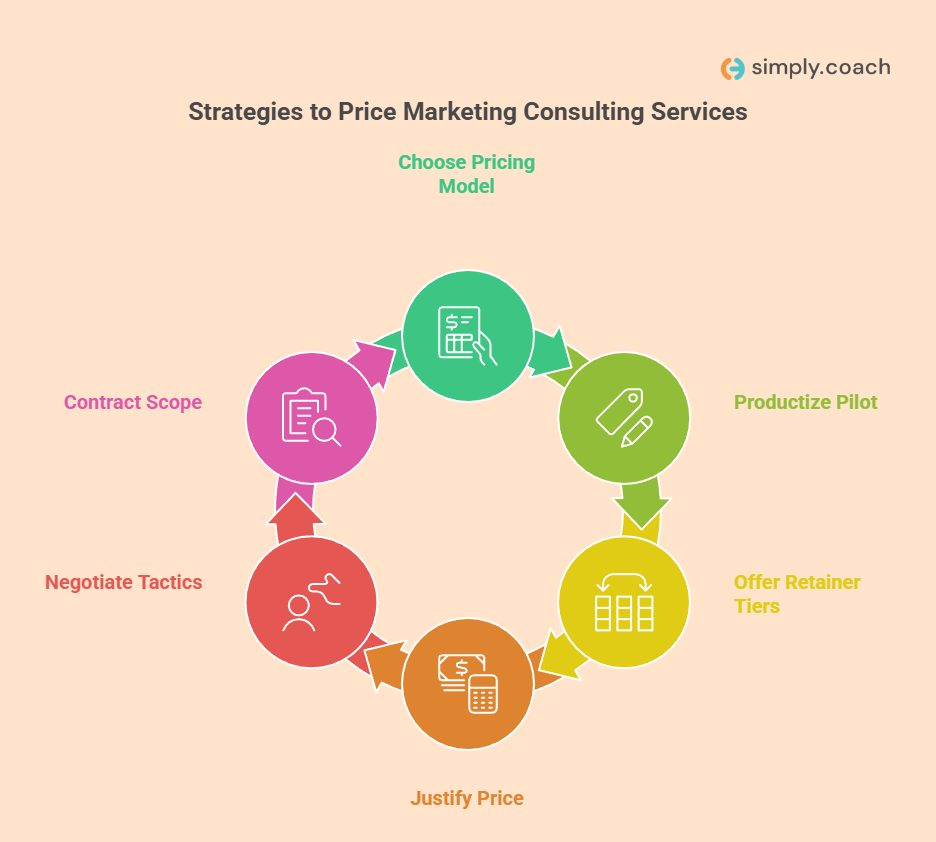
Packaging and pricing are how you turn expertise into predictable revenue. Done well, they make selling easier, delivery consistent, and measurement clear. Below are the practical choices and the exact language you can use when presenting your offer to a client.
1. Choose the right pricing model for the engagement
Pick one primary model and be ready to mix in others:
- Fixed-fee pilot (90-day pilot): Great for proving value and reducing buyer risk. You define scope, deliverables, and acceptance criteria. Typical pilot packages range from the low thousands to the mid five figures, depending on complexity. (Use a fixed fee when the scope and timeline are clear.)
- Monthly retainer: Best for ongoing strategy, oversight, and continuous optimization. Keeps revenue predictable and ties you to longer outcomes. Typical retainers for high-value strategic consulting commonly range from a few thousand to tens of thousands per month.
- Value-based (outcome) pricing: You set fees based on the business result (e.g., increase in pipeline or revenue). This aligns incentives but needs solid measurement and legal clarity on how outcomes are defined and credited. Large consultancies are increasingly using outcome-based models for some work.
- Hybrid: A small fixed fee + a success bonus tied to agreed KPIs. This is highly saleable: it reduces client risk while letting you capture upside.
2. Productize a 90-day pilot (pricing bands and deliverables)
Productize one standard pilot you can sell quickly. That makes proposals fast and delivery repeatable.
Across the U.S. market in 2026, consultant fees vary widely based on experience level, engagement type, and deliverables:
- Hourly rates: Typically range from around $50 to $500+ per hour, with junior consultants at the lower end and senior or fractional CMO-level consultants at the higher end.
- Project-based fees: For defined deliverables such as audits or strategy development, expect $2,000 to $50,000+, depending on complexity and expected outcomes.
- Monthly retainers: Commonly start around $1,500 per month, extend into mid-tier strategic work around $3,000–$8,000, and can exceed $15,000+ per month for high-level strategy and leadership roles.
These ranges reflect that pricing is shaped by the type of work (tactical execution versus strategic guidance), the consultant’s level of expertise, and the extent to which they participate in planning, measurement, and execution.
3. Retainer tiers (sample structure)
Retainer models are widely used for ongoing consulting and typically fall into tiers like:
- Basic / maintenance retainer: Around $1,500–$3,000 per month, suited for periodic strategic check-ins or light oversight.
- Growth / mid-level retainer: Around $3,000–$8,000 per month, includes more involved planning, reporting, and execution oversight.
- Strategic/leadership retainer: Typically $8,000–$15,000+ per month covers comprehensive strategic partnership or fractional leadership roles.
These monthly retainer ranges are consistent with broad industry benchmarks where ongoing support, strategy updates, performance tracking, and regular business reviews justify predictable monthly fees.
4. Use simple value math to justify the price
Build a 1-page ROI case you can show in proposals. Simple formula:
- Estimate incremental revenue from the engagement (e.g., additional pipeline × win rate).
- Decide the attribution you’ll credit to marketing (e.g., 30% of pipeline lift).
- Charge a percentage of that captured value (common ranges: 5%–25%, depending on role and risk split).
Example:
- Expected incremental pipeline: $500,000.
- Likely marketing-attributed revenue (30%): $150,000.
- Fee at 10% of value: $15,000 (one-time or spread over months).
Value pricing requires clear measurements and agreed-upon definitions up front.
Practical wording for proposals:
“Pilot fee: $12,500 (fixed). If the pilot increases pipeline by >$X (variable dollar amount), we’ll convert to a 6-month retainer of $Y/month (recurring monthly fee) or an outcome fee of Z% (performance-based or value-based) of revenue influenced.”
5. Practical negotiation tactics that work
- Always include acceptance criteria in the SOW (e.g., access requirements, KPI definitions, approval gates).
- Start with a small pilot if the client is risk-averse. Close the pilot with a clear expansion proposal.
- Offer an option to convert fixed pilot fees into a retainer credit if the client signs within 30 days after pilot completion. That eases the buying decision.
- Use clear deliverable language and list the exact reports, meetings, and outputs to limit scope creep.
6. Contracts & scope tips
- Spell out the responsibilities for data access, and note that tracking measurement failures is often due to missing access rights.
- Define how you will attribute results (e.g., pipeline influenced vs. closed deals).
- Include a clause for scope change (additional work priced at hourly rate model (X/hour) or via a change order).
When your services are packaged clearly and priced around outcomes, selling becomes simpler, and delivery becomes more consistent. Clients know exactly what they are buying, and you know exactly how success will be measured. This clarity sets the stage for predictable work, stronger trust, and the ability to grow each engagement over time.
With pricing and packaging in place, the next natural question is how this translates into real income and what actually drives earnings as you scale your marketing consulting work.
Also read: How to Set and Raise Your Consulting Rates Successfully
What Marketing Consultants Can Earn (and What Drives Income Growth)
Earnings vary widely based on how you package work, the clients you target, and whether you sell retainers or one-off projects. Below is what you should expect and what directly lifts your income.
1. Market benchmarks (U.S., 2025–2026)
Reported averages vary by source and sample, but current U.S. data show:
- Median/average marketing consultant pay commonly ranges from roughly $66K to $88K per year for salaried roles or a typical freelancer-equivalent income. Top earners can exceed six figures. These figures represent many types of marketing consultants, from junior to senior.
Remember: Your true earnings are determined by how much billable value you deliver and how you package it, not by job-site averages.
2. What increases your income (real levers you control)
- Move from time-based to value-based pricing: Charge for outcomes or value to increase upside and separate price from hours.
- Sell retainers instead of one-offs: Retainers create predictable monthly revenue and increase lifetime client value. Many experienced consultants secure retainers in the $5K–$20K+ range.
- Productize offers: A standard pilot product shortens sales cycles, improves margins, and lets you deliver with fewer hours per dollar. Productized offers often fall within the $1.5K–$25K range, depending on complexity.
- Focus on higher-value outcomes: Helping clients increase revenue, reduce churn, or speed up sales cycles commands a higher fee than “brand awareness” work.
- Scale with associates or partners: Use vetted freelancers or white-label partners for execution. While you keep the client relationship and strategy, you can bill higher and acquire more clients.
3. Example earning paths
- Solo consultant, 2 pilots/month at $10K each (project work): $20K/monthly gross.
- One retainer at $10K/month + 1 pilot/month at $8K: $18K/monthly gross.
- Hybrid: 3 retainers at $6K/month: $18K/monthly gross.
These examples are simplified. Net income depends on taxes, overhead, subcontractors, and how many hours you actually bill.
4. How to justify raising prices as you scale
- Show clear pilot results and ROI, then link price increases to evidence of outcomes.
- Add services that increase client ROI (measurement setups, quarterly business reviews).
- Offer premium tiers that provide faster response times, deeper access, or more senior involvement.
5. Risk management and pricing traps to avoid
- Don’t underprice to win work; low fees attract scope creep and poor margins.
- Avoid open-ended “do whatever it takes” language. Use a clear SOW (Statement of Work) and change-order process.
- Be cautious with outcome-only fees unless you control most of the execution and measurement, or you share risk with clients via a hybrid model.
Income growth in marketing consulting does not come from working more hours. It comes from choosing the right engagement model, focusing on business-critical outcomes, and building repeatable ways to deliver value at scale. When you price for impact and structure work for long-term partnerships, earnings increase naturally alongside client results.
With a clear understanding of earning potential, the final step is knowing how to bring all of this together, skills, systems, and structure, so marketing consulting becomes a sustainable and valuable extension of your existing practice.
Also read: A 12-Step Guide to Become a Successful Consultant in 2026
Conclusion
If you’re figuring out how to become a marketing consultant, turn your skills into one clear, sellable offer that proves business value quickly. Price that offer around the value you expect to create, agree on a small set of measurable targets, and use short pilots to build credible proof. Standardize the work with tight templates and automations so you spend time advising, not firefighting, and let measurable wins drive longer retainers and higher fees.
Simply.Coach lets consultants digitize those pilots and run client workflows from a single platform. It offers core features such as goal and development planning, digital assessments and forms, session scheduling, resource libraries, shareable reports on impact and ROI, plus invoicing, contracts, and integrations that cut admin load. It fits naturally into a structured consulting model built on clarity, accountability, and visible results, making scale feel far more manageable as you grow.
FAQ’s
1. How to become a marketing consultant if I already work with clients?
Start by offering a tight, paid 90-day pilot (audit + one-page strategy + managed pilot) to a client who’s stalled, so you can prove value fast and expand into a retainer.
2. What core skills do I need to become a marketing consultant?
Focus on four clusters: strategy (linking marketing to revenue), measurement/analytics, execution oversight (governance, not doing every task), and stakeholder management.
3. How should I package and price my services?
Productize a standard 90-day pilot, offer 2–3 retainer tiers, and mix fixed fees with value-based or hybrid bonuses to match client risk and upside.
4. How do I prove results quickly so a pilot becomes long-term work?
Agree on 3–6 business-focused KPIs up front, set a baseline, and show simple dashboarded progress in plain language that ties to pipeline or revenue.
5. Do I need to learn every tool and channel to be a consultant?
No, clients pay for a clear diagnosis, a focused plan, and reliable oversight of delivery; you can partner with vendors for execution.