
Starting a new consulting project without a clear consultation contract can quickly lead to problems. Deadlines can slip, payments can be delayed, and expectations can get mixed up. A well-written consulting agreement helps you avoid all of this and keeps the project on track.
A solid consulting agreement is essential for both you and your client. It clearly defines what services you’ll provide, the payment terms, and the project timeline. Consultants who use clear agreements often face fewer misunderstandings and disputes compared to those who don’t.
Without a consulting agreement, it’s easy to get caught up in unclear expectations and miscommunications. A strong agreement removes those issues, saving you time, stress, and potential legal problems.
Let’s look at why a clear consulting agreement is a must-have for any successful consulting relationship.
What is a Consulting Agreement?
A consulting agreement is a formal contract between you, the consultant, and your client. It outlines the terms and conditions of your professional relationship, making sure everyone is on the same page.
This agreement details the services you’ll provide, your payment terms, deadlines, and other key aspects of the collaboration. It’s essentially a blueprint that helps guide the project from start to finish.
This agreement doesn’t just keep things organized, it also acts as a legal framework that protects both you and your client. It ensures that you’re paid on time and that the client gets the services they’re expecting.
With a solid consultation contract in place, you reduce the risk of misunderstandings, protect your interests, and set clear boundaries for the work you’ll do. This way, both you and your client know exactly what to expect, keeping things professional and stress-free.
Read: A 12-Step Guide to Become a Successful Consultant in 2025
Key Components to Include in a Consulting Agreement

Here are the 11 essential components that every consulting agreement should include, each playing a critical role in protecting both you and your client.
By ensuring these elements are clearly defined, you create a solid foundation for a professional, transparent, and legally sound relationship.
This helps prevent misunderstandings and sets clear expectations, allowing both parties to focus on successful collaboration.
| Component | Explanation |
| 1. Parties | Identifies you (the consultant) and the client, ensuring the agreement is clear about who is involved. |
| 2. Date | Specifies the effective date the agreement becomes valid, marking the official start of the relationship. |
| 3. Signatures | Both parties’ signatures are required to make the agreement legally binding and enforceable. |
| 4. Description of services | Clearly defines the scope of services you’ll provide, including specific tasks, deliverables, and deadlines. |
| 5. Duration of the collaboration | States the start and end dates, and any clauses for renewal or extension, so both parties know how long the agreement lasts. |
| 6. Payments and fees | Specifies the agreed payment amount (e.g., hourly, flat rate), due dates, and acceptable payment methods, ensuring financial clarity. |
| 7. Termination policy | Defines how and when the agreement can be terminated by either party, including any required notice periods or conditions for early termination. |
| 8. Confidentiality | Ensures that sensitive information shared between you and the client remains confidential, protecting proprietary data. |
| 9. Intellectual property | Clarifies ownership rights for any intellectual property created during the project, such as reports or custom work products. |
| 10. Cancellation policy | Outlines the process and penalties involved if either party cancels the agreement prematurely (cancellation policy is generally used in situations that are less severe than a full termination), protecting both sides from unexpected disruptions. |
| 11. Miscellaneous | Includes additional clauses that might apply, such as dispute resolution, governing law, or indemnity clauses, offering extra protection. |
Once your consulting agreements are in place, managing client relationships efficiently becomes essential for business success. Explore the Best CRM Software for Consultants to streamline your client interactions and grow your consulting practice
How to Write a Consulting Agreement
Now that you know the key components of a consulting agreement, let’s dive into each one in detail.
This section will walk you through how to draft each component, providing specific guidance and examples so that your contract is clear, comprehensive, and legally sound.
By understanding each section, you can ensure that your agreement protects both you and your client while setting clear expectations from the start.
1. Parties
The “Parties” section identifies the individuals or organizations entering into the contract. It’s essential to be clear about who is involved in the agreement to avoid confusion down the line.
This part should state the full legal names of both parties, along with any relevant titles or business designations, ensuring that both you and the client are clearly recognized.
Example:
“John Doe Consulting LLC, represented by John Doe, hereinafter referred to as ‘Consultant,’ and XYZ Corp, represented by Jane Smith, hereinafter referred to as ‘Client.’”
2. Date
The date marks when the consulting agreement officially becomes valid. A clear start date is important for defining the timeline of your collaboration. It ensures both parties know when the agreement begins, avoiding any confusion about when terms such as payment, deliverables, and timelines take effect.
Example: “This agreement is effective as of January 15, 2025.”
Be sure to specify the exact date of commencement. If the work is expected to start later, make that clear so everyone is aligned on when the formal relationship kicks off.
3. Signatures
Signatures make the agreement legally binding. Without both parties’ signatures, the contract is not enforceable, which could lead to complications if disputes arise. The signature section should clearly designate a space for both parties to sign and include the date to confirm mutual consent to the agreement’s terms.
Example:
- Consultant signature: ____________________________
- Client signature: ____________________________
- Date: ____________________________
Both signatures must be provided, and it’s also a good idea to specify whether the agreement can be signed electronically to accommodate modern business practices.
4. Description of services
The “Description of Services” section is crucial for outlining what exactly you will provide for the client.
Being as specific as possible about the tasks, deliverables, and timelines ensures both you and the client are on the same page. It also minimizes the risk of scope creep by clearly defining what is and isn’t included in your services.
Example: “The Consultant will provide marketing strategy development for XYZ Corp, including:
- Conducting a market analysis and providing a detailed report on key competitors.
- Developing a 3-month social media campaign to boost online presence.
- Holding bi-weekly meetings with the Client’s marketing team to track progress.”
The more detailed this section is, the clearer both parties will be about expectations and deliverables.
5. Duration of the collaboration
The duration of the collaboration establishes the timeline for your project, ensuring both parties know how long the contract will last.
This section should clearly state the start and end date of the engagement, and whether there are provisions for renewing or extending the agreement if both parties are satisfied.
Example: “This agreement begins on January 15, 2025 and ends on April 15, 2025, unless extended by mutual agreement.”
Clearly outlining the duration helps avoid ambiguity, especially if both parties want to renew or extend the contract. It’s essential for setting expectations and managing timelines.
6. Payments and fees
The payment terms outline how and when you’ll get paid. It’s important to be clear about the amount, payment method, and due dates to avoid payment-related disputes.
Additionally, if you offer different payment structures (hourly, flat fee, retainer), this should be specified in detail.
Example: “The Consultant will be compensated at a rate of $150 per hour. Payments will be due within 30 days of receiving the invoice, with an initial deposit of $500 upon signing this agreement.”
Providing options like milestone-based payments or deposits helps ensure financial clarity. Be sure to also note any late payment penalties to protect your cash flow.
7. Termination policy
A termination policy ensures both parties know how to legally end the agreement if needed. Clearly defining the conditions under which the agreement can be terminated helps prevent potential legal issues down the line.
It should include the necessary notice period and specify what happens if either party terminates the agreement prematurely.
Example: “Either party may terminate this agreement with 30 days’ written notice. If the agreement is terminated prior to completion, the Client agrees to pay for all services rendered up to the date of termination.”
Make sure the termination terms are reasonable for both you and your client, outlining fair notice and payment terms for any work completed up until that point.
8. Confidentiality
Confidentiality clauses are vital for protecting sensitive information. This section ensures that proprietary business information, strategies, or personal data shared during the consulting process remains private. It helps to establish trust between you and your client and provides legal recourse if confidentiality is breached.
Example: “The Consultant agrees to keep all client data, business strategies, and proprietary information confidential, both during and after the termination of this agreement. The Consultant will not disclose any confidential information to third parties without prior written consent from the Client.”
Clearly define what constitutes “confidential” information, and specify any exceptions where disclosure might be necessary (e.g., legal requirements).
9. Intellectual property
Intellectual property (IP) rights are important to define at the start of the agreement, especially if you are creating any unique work product. This section will clarify who owns the work created during the engagement, whether it’s the client, you, or a shared ownership arrangement.
Example: “All materials, reports, strategies, and other intellectual property created during the project shall remain the property of the Client. The Consultant retains the right to use any methodologies or tools developed independently from the Client’s project.”
If there are any shared IP rights or restrictions on how the work can be used post-project, be sure to include that here to avoid disputes later.
10. Cancellation policy
The cancellation policy sets clear expectations in case the agreement needs to be terminated before the work is completed. This section should include conditions under which the client or consultant can cancel and whether there are penalties or refunds involved.
Example: “If either party cancels the agreement after 30 days of commencement, the Client agrees to pay a cancellation fee of 50% of the remaining balance.”
This clause ensures that you’re compensated for any time or effort you’ve already invested in the project, protecting your business from unfair cancellation.
11. Miscellaneous
This final section is a catch-all for any additional provisions that don’t fall under the above categories but are still important for the contract. This could include the governing law (which jurisdiction the contract falls under), dispute resolution procedures, or any other necessary legal protections.
Example: “This agreement is governed by the laws of the state of California. Any disputes arising from this agreement will be resolved through mediation before pursuing legal action.”
The miscellaneous section ensures that all potential legal concerns are addressed and clarifies any other operational details for a smoother collaboration.
| To help you get started, we’ve created a downloadable PDF consulting agreement template that you can use for free. This sample agreement is designed to save you time by providing a solid foundation, so you don’t have to build a contract from the ground up. Feel free to customize it according to your specific needs, and we recommend having it reviewed by a legal professional to ensure it fits your business requirements.Download – Consulting Agreement Template.pdf |
Common Mistakes to Avoid While Writing a Consulting Agreement
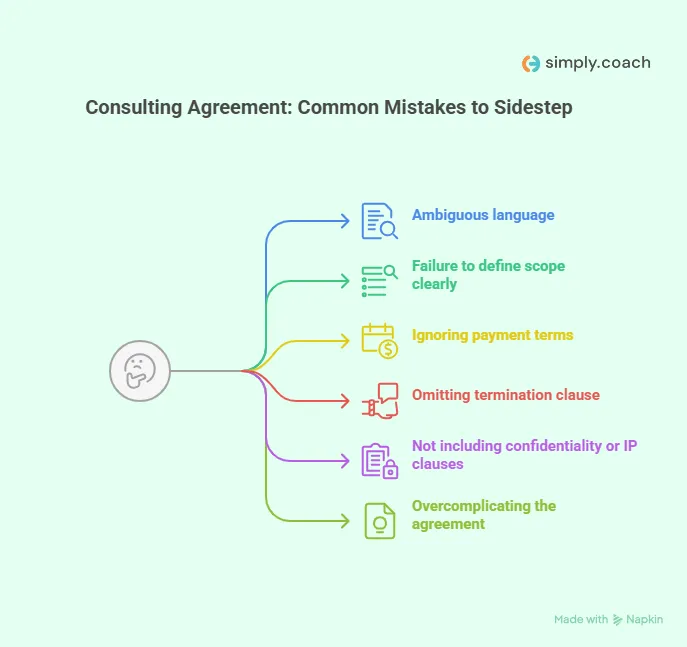
When drafting a consulting agreement, small mistakes can lead to big problems, from payment disputes to unclear expectations. These mistakes not only strain the working relationship but can also create legal and financial risks for both you and your client.
By being aware of the most common pitfalls and addressing them early, you can create an agreement that fosters a professional, efficient, and transparent collaboration.
- Ambiguous language: Using unclear or vague terms can lead to confusion and disputes later on. Be precise with your language to define responsibilities, timelines, and deliverables clearly.
- Failure to define scope clearly: If you don’t define the scope of work clearly, it can lead to scope creep, where clients may expect additional work beyond what was agreed upon. Ensure all services and deliverables are outlined in detail.
- Ignoring payment terms: Not specifying clear payment terms can cause issues like delayed payments or disputes over fees. Always define the amount, payment method, and due dates to ensure transparency.
- Omitting termination clause: Failing to include a termination clause leaves both parties vulnerable if things go wrong. Define how the contract can be terminated, with notice periods and any penalties for early termination.
- Not including confidentiality or IP clauses: Neglecting confidentiality or intellectual property clauses puts sensitive information and work at risk. Always include clauses that protect your and your client’s proprietary data and define ownership of intellectual property.
- Overcomplicating the agreement: Overloading the agreement with excessive legal jargon or unnecessary clauses can confuse or frustrate both parties. Keep the agreement clear, concise, and focused on key terms to ensure it’s easy to understand.
Customizing Your Consulting Agreement for Different Consulting Niches
Each consulting niche comes with its own set of expectations and legal considerations. Tailoring your consulting agreement to meet the specific demands of your niche ensures both parties are aligned and protected.
Below is how you can customize your consulting agreements for various consulting niches:
1. Consulting agreement for marketing consultants
- As a marketing consultant, your agreements should be clear on deliverables, timelines, and metrics for success.
- Specify the exact campaigns, advertising channels, and performance metrics you will focus on, such as conversion rates, website traffic, or social media engagement.
- It’s also essential to outline any content ownership and use of intellectual property related to marketing materials you create, such as graphics, copy, or strategic plans. Be sure to define who owns the content after the project is completed.
2. Consulting agreement for business consultants
- Business consultants often work with companies to improve efficiency, profitability, or operational processes. Your agreement should be extremely clear on the specific business processes or departments you will be consulting on, such as HR systems or supply chain management.
- Include detailed performance metrics, such as revenue growth or cost reduction targets, that both you and the client will track during the course of the engagement.
- Define milestone payments or success-based fees tied to achieving specific outcomes or business goals. This ensures alignment with your client’s expectations and your compensation.
3. Consulting agreement for financial advisors
- Financial consultants must be specific about the services they provide to avoid liability or confusion. Whether it’s retirement planning, tax strategies, or investment advice, outline exactly what areas you will cover.
- Include clear disclosure of fees, especially if you receive any commissions or referrals for financial products. Transparency in this area is key to maintaining trust.
- Given the regulatory nature of the industry, include language about compliance with financial regulations, such as SEC or Fiduciary Standards, and outline any specific disclaimers related to the financial advice you provide.
4. Consulting agreement for tech consultants
- Tech consultants often deal with proprietary code or software, making intellectual property (IP) clauses extremely important. Be clear about who owns the rights to any software, code, or technology solutions you develop for the client.
- Define data security measures and compliance requirements if you’re dealing with client data, particularly if working with sensitive data that may fall under laws like GDPR or CCPA.
- If you are building or customizing software for the client, ensure that the contract includes warranties regarding software performance, updates, and future support to prevent disputes.
By tailoring your agreement to address these specific needs within your niche, you minimize risk and ensure your client’s expectations align with the services you will deliver. This not only protects you but also positions you as a professional who understands the unique requirements of your consulting field.
Stephen T, a Human Resources Consultant, shares his thoughts
My experience with Simply.Coach has been fantastic. The responsive support team and features like Google Docs integration, private notes, and Google Calendar scheduling have been invaluable in managing my workload. It’s the best solution for my needs.

Conclusion
A solid consultation contract is key to setting clear expectations and protecting both you and your client throughout your engagement.
By addressing essential components such as scope of services, payment terms, intellectual property, and confidentiality, you ensure that both parties are on the same page and that potential issues are avoided from the start.
Customizing this template for your business will give you the foundation for a professional and secure relationship with your clients.If you’re ready to take your consulting business to the next level, Simply.Coach’s all in one consulting software offers the perfect solution. With powerful features to automate agreements, track client progress, and manage invoicing, Simply.Coach makes it easier for consultants like you to focus on growing your business while staying organized and efficient.