
How much can you actually earn as an autism coach in 2026, and is it worth pursuing?
Autism support demand continues to rise across the United States, creating a clear need for skilled coaches like you. According to the Centers for Disease Control and Prevention, about 1 in 31 children in the U.S. has autism, the highest rate ever recorded.
This steady increase means more families, schools, and organizations actively seek structured guidance and long-term support. As an autism coach, you play a direct role in helping clients build independence, communication skills, and daily functioning strategies.
If you plan to build or grow your coaching career, you need accurate salary data before making decisions. Clear numbers help you set pricing, evaluate job offers, and identify the most profitable paths in this field.
In this guide, you will learn the average autism coach salary in the USA, including hourly and annual breakdowns. You will also explore salary differences by state, role type, experience level, and practical ways to increase your income.
Key Takeaways
- An autism coach helps individuals on the spectrum build life, social, and communication skills through structured guidance and real-world support.
- Average annual salary is $40,970 in the U.S., approximately $19.70/hour or $3,414/month.
- Salaries range from $22,500 for entry-level to $51,500 for top earners, with strong growth potential.
- State pay varies: Washington $46,403, District of Columbia $46,297, New York $44,823, reflecting demand and cost of living.
- Top-paying cities include Berkeley, CA ($50,166), Atqasuk, AK ($49,888), and Sitka, AK ($49,356).
- Factors affecting income include certification, experience, niche specialization, employment setting, and client base.
- Strategies to increase salary include multi-week programs, group coaching, hybrid models, strategic pricing, and diversifying services.
- High demand continues as 1 in 31 U.S. children is diagnosed with autism, creating stable opportunities for skilled coaches.
Who Is an Autism Coach?
An autism coach is a trained professional who supports individuals on the autism spectrum in building practical life, communication, and social skills. You work closely with clients to create structured, goal-focused plans that improve daily functioning and independence. Your role focuses on guidance, accountability, and real-world application rather than clinical diagnosis or medical treatment.
You may work with children, teens, or adults, depending on your specialization and training. Your approach often complements therapy, education plans, or family support systems already in place.
What does an autism coach do?
As an autism coach, your role focuses on practical, real-world skill building tailored to the needs of individuals on the spectrum. You help clients navigate daily situations with structured guidance, consistency, and clear behavioral strategies.
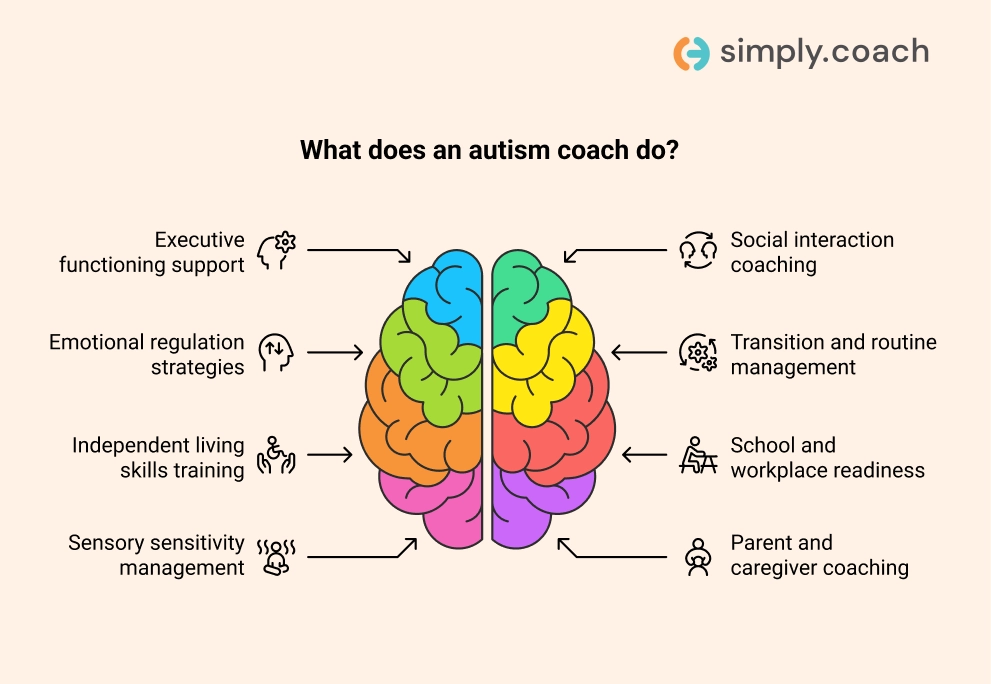
- Executive functioning support: You help clients plan tasks, manage time, follow routines, and complete daily responsibilities without becoming overwhelmed.
- Social interaction coaching: You teach clients how to start conversations, read social cues, and respond appropriately in different social settings.
- Emotional regulation strategies: You guide clients to identify triggers, manage anxiety, and use calming techniques during stressful situations.
- Transition and routine management: You support clients in handling changes in schedules, environments, or expectations with minimal distress.
- Independent living skills training: You work on practical skills such as personal hygiene, organization, and decision-making for daily independence.
- School and workplace readiness: You prepare clients to handle classroom expectations, job responsibilities, and structured environments with confidence.
- Sensory sensitivity management: You help clients identify sensory triggers and develop coping strategies for noise, light, or crowded environments.
- Parent and caregiver coaching: You train families to apply consistent strategies at home, ensuring continuity and long-term progress.
Your work directly impacts how clients function in everyday life, helping them build independence, confidence, and stability over time.
How Much Does an Autism Coach Make in the USA?
If you want to build a stable income as an autism coach, you need a clear view of current salary benchmarks. These numbers help you set realistic expectations, compare job offers, and plan your career growth with confidence.
Recent data shows that autism coach salaries vary based on experience, location, and the type of work you take on. Understanding these figures allows you to position your services better and move toward higher-paying opportunities.
Average salary breakdown
- National average salary: $40,970 per year
- Hourly rate: $19.70
- Monthly pay: $3,414
- Weekly pay: $787
- Typical annual range: $22,500 to $63,000
These figures show that autism coaching offers steady income potential, with room to grow as you gain experience or specialize further.
Autism coach salary by percentile
Your earnings as an autism coach can vary significantly depending on your skills, experience, and location. The percentile breakdown below shows where most professionals fall and how much top earners make:
| Percentile | Salary |
| 10th | $22,500 |
| 25th | $33,000 |
| 50th | $40,970 |
| 75th | $43,000 |
| 90th | $51,500 |
This data shows a clear gap between entry-level and top-tier earnings, giving you strong potential to increase your income. As you gain experience, specialize in high-demand areas, or work in better-paying regions, you can move toward the higher salary brackets.
State-by-State Salary Overview for Autism Coaches in the USA
Your salary as an autism coach can change significantly depending on the state where you work. Differences in demand, cost of living, and access to autism services directly affect how much you can earn.
If you want to increase your income, you need to understand which states offer better pay and stronger opportunities. The table below gives you a clear comparison of annual and hourly earnings across states, helping you plan your next move strategically.
| State | Annual salary | Hourly wage | State | Annual salary | Hourly wage |
| Alabama | $37,135 | $17.85 | Montana | $37,604 | $18.08 |
| Alaska | $44,123 | $21.21 | Nebraska | $39,063 | $18.78 |
| Arizona | $38,180 | $18.36 | Nevada | $41,720 | $20.06 |
| Arkansas | $33,878 | $16.29 | New Hampshire | $39,844 | $19.16 |
| California | $40,434 | $19.44 | New Jersey | $41,594 | $20.00 |
| Colorado | $43,081 | $20.71 | New Mexico | $39,703 | $19.09 |
| Connecticut | $38,974 | $18.74 | New York | $44,823 | $21.55 |
| Delaware | $41,006 | $19.71 | North Carolina | $37,234 | $17.90 |
| District of Columbia | $46,297 | $22.26 | North Dakota | $43,350 | $20.84 |
| Florida | $30,617 | $14.72 | Ohio | $38,950 | $18.73 |
| Georgia | $34,595 | $16.63 | Oklahoma | $37,829 | $18.19 |
| Hawaii | $42,566 | $20.46 | Oregon | $43,317 | $20.83 |
| Idaho | $38,549 | $18.53 | Pennsylvania | $41,069 | $19.74 |
| Illinois | $39,701 | $19.09 | Rhode Island | $40,123 | $19.29 |
| Indiana | $38,986 | $18.74 | South Carolina | $38,019 | $18.28 |
| Iowa | $38,482 | $18.50 | South Dakota | $40,970 | $19.70 |
| Kansas | $36,539 | $17.57 | Tennessee | $37,185 | $17.88 |
| Kentucky | $35,584 | $17.11 | Texas | $38,170 | $18.35 |
| Louisiana | $35,035 | $16.84 | Utah | $37,298 | $17.93 |
| Maine | $39,667 | $19.07 | Vermont | $43,562 | $20.94 |
| Maryland | $39,763 | $19.12 | Virginia | $40,619 | $19.53 |
| Massachusetts | $44,745 | $21.51 | Washington | $46,403 | $22.31 |
| Michigan | $35,709 | $17.17 | West Virginia | $31,718 | $15.25 |
| Minnesota | $40,127 | $19.29 | Wisconsin | $41,353 | $19.88 |
| Mississippi | $38,802 | $18.65 | Wyoming | $39,381 | $18.93 |
| Missouri | $38,430 | $18.48 |
This data shows that states like Washington, District of Columbia, and New York offer higher salaries due to stronger demand and higher living costs. These regions often have more structured support programs, better funding, and a higher concentration of private clients seeking specialized autism coaching services.
If you want to increase your earnings, consider targeting these markets or working with clients based in these locations through remote coaching. You can also position your services toward schools, clinics, or high-income families in these areas to access better-paying opportunities and long-term contracts.
Top 10 highest-paying cities for autism coaches in the USA
If you are looking to maximize your earnings as an autism coach, location plays a critical role in your income potential. Some cities offer salaries well above the national average due to higher demand, better funding, and access to private clients.
The cities listed below show the highest-paying opportunities, with salaries consistently above the national average. This makes them strong options if you plan to relocate or target high-paying markets through remote coaching services.
| City | Annual salary | Monthly pay | Weekly pay | Hourly wage |
| Berkeley, CA | $50,166 | $4,180 | $964 | $24.12 |
| Atqasuk, AK | $49,888 | $4,157 | $959 | $23.98 |
| Sitka, AK | $49,356 | $4,113 | $949 | $23.73 |
| Los Altos, CA | $48,444 | $4,037 | $931 | $23.29 |
| San Francisco, CA | $48,270 | $4,022 | $928 | $23.21 |
| Santa Clara, CA | $48,117 | $4,009 | $925 | $23.13 |
| Sunnyvale, CA | $48,085 | $4,007 | $924 | $23.12 |
| Livermore, CA | $48,058 | $4,004 | $924 | $23.10 |
| San Jose, CA | $47,940 | $3,995 | $921 | $23.05 |
| Ketchikan, AK | $47,628 | $3,969 | $915 | $22.90 |
These cities show only a small variation in salary, with less than a five percent difference between the highest and lowest paying locations. This means your earning potential stays relatively consistent across top cities, even if you change locations.
Instead of focusing only on salary, you should also consider the cost of living, client demand, and availability of long-term contracts. Choosing a city with lower living expenses but similar pay can help you retain more income and improve overall financial stability.
Key Factors That Affect Autism Coach Salaries in the USA
Several elements determine how much you can earn as an autism coach. Understanding these factors helps you make strategic career decisions, target higher-paying roles, and structure your services for maximum income.
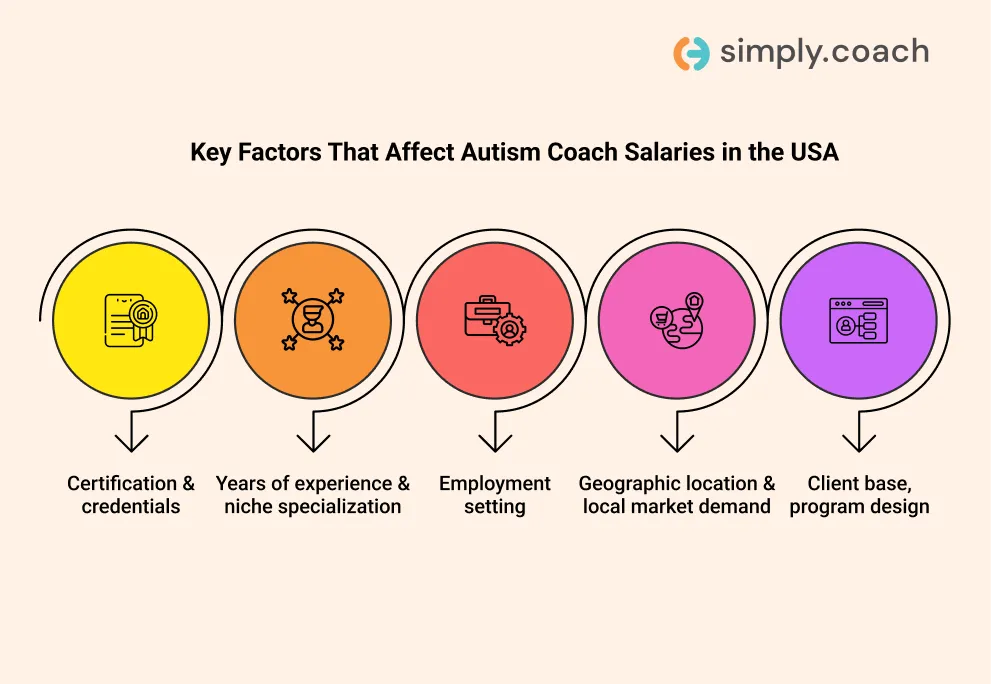
1. Certification and credentials
Holding recognized certifications increases your credibility and allows you to charge higher rates. Specialized credentials, such as in autism intervention techniques or developmental support, can boost earnings by 10–25% compared to uncertified peers.
2. Years of experience and niche specialization
Experience directly impacts your salary. Coaches with 5+ years in autism support, behavioral coaching, or educational intervention often command higher pay. Niche expertise, such as working with children with severe ASD or transition-aged youth, also allows premium rates.
3. Employment setting
Your workplace affects income significantly. Private practice or online coaching offers flexibility and potential for higher per-client fees. Corporate programs, schools, and clinics may offer steady salaries and benefits but often have fixed pay structures.
4. Geographic location and local market demand
Regions with higher demand for autism services or better-funded programs pay more. Urban centers, well-funded school districts, and states with stronger healthcare budgets typically offer higher salaries than rural or low-demand areas.
5. Client base, program design, and business model
Income depends on how you structure your services. Multi-week programs, group sessions, or subscription-based online coaching can increase revenue beyond hourly rates. Working with private clients or corporate contracts often yields higher pay than standard one-on-one sessions.
Considering these factors together helps you strategically grow your income and advance your career as an autism coach.
Strategies to Increase Your Autism Coach Salary
Your income as an autism coach depends on your expertise, niche focus, delivery model, and ability to structure programs that deliver measurable results. Implementing the right strategies can move you beyond base hourly rates, increase client engagement, and create a more predictable revenue stream. Below are practical ways to boost your earnings while providing high-value support to clients.
1. Offer multi-week autism coaching programs
Structured programs allow you to deliver consistent outcomes while increasing revenue per client. Designing tiered offerings ensures clients see measurable progress while paying for added value.
- Tiered 6–12 week programs: Offer foundational ($600–$1,200), intermediate ($1,800–$2,500), and premium packages ($3,000+) with clear developmental goals.
- Outcome-focused programs: Structure around skill-building, social communication, emotional regulation, or executive functioning.
- Additional resources: Include progress tracking, check-ins, and parent/caregiver support to justify premium pricing.
Multi-week programs also improve cash flow predictability and allow you to schedule sessions efficiently.
How to Design & Launch Your Signature Coaching Program.
If you want a step-by-step guide to structure profitable autism coaching packages, explore Simply.Coach’s “How to Design & Launch Your Signature Coaching Program.” It teaches program positioning, transformation mapping, pricing tiers, and delivery methods.

2. Run group programs and workshops
Supporting multiple clients simultaneously scales income without adding extra hours. Group sessions also encourage peer interaction, which boosts skill generalization and client engagement.
- Small group coaching: Cohorts of 4–8 children or teens balance personalized attention with scalability.
- Focused workshops: Conduct sessions on social skills, communication strategies, or behavior management.
- Digital programs or memberships: Offer recurring access to structured coaching resources, skill practice tools, or parent support groups.
Group models multiply revenue per hour worked while establishing your reputation as an expert in autism coaching.
3. Create hybrid coaching models
Combining individual and group coaching, plus digital offerings, lets you meet diverse client needs and maximize income.
- Integrated coaching: Mix one-on-one sessions with group workshops for broader impact.
- Ongoing digital support: Provide access to progress-tracking tools, practice videos, or parent guides.
- Extended client relationships: Offer follow-ups or maintenance programs to maintain steady revenue.
Hybrid models improve client satisfaction, often resulting in referrals and long-term contracts.
4. Set strategic rates
Pricing reflects your expertise, certifications, and the results you deliver. Smart rate-setting ensures clients perceive value while boosting your earning potential.
- Evaluate local and remote demand: Adjust rates based on geographic location and online market trends.
- Highlight niche expertise: Focus on specific autism interventions, transition support, or behavioral therapy to command higher rates.
- Use certifications: Credentials like BCBA, RBT, or specialized autism coaching certificates increase credibility.
- Package services: Combine individual sessions, group programs, and multi-week packages to increase revenue per client.
The Complete Guide: Pricing Strategies for Your Coaching Business
You can boost earnings through multi-week packages, group sessions, and hybrid coaching models. Simply.Coach’s “The Complete Guide: Pricing Strategies for Your Coaching Business” helps you implement proven pricing models and value-based positioning to maximize your revenue.

5. Diversify income streams
Expanding beyond standard coaching sessions creates predictable, scalable revenue and reduces dependence on single clients.
- Workshops and corporate programs: Partner with schools, clinics, or organizations for higher-paying contracts.
- Online courses and subscriptions: Develop digital programs to reach families nationwide.
- Membership or follow-up plans: Offer monthly or quarterly skill-maintenance programs for consistent income.
Diversifying ensures your earnings align with the value you deliver while reaching more clients.
6. Build reputation, experience, and specialization
Your professional credibility directly impacts your ability to charge premium rates. Experienced and specialized autism coaches attract clients willing to pay for measurable results.
- Establish credibility: Collect testimonials, case studies, and outcome data.
- Offer specialized programs: Focus on niche skills like social communication, executive functioning, or transition planning.
- Target high-demand markets: Urban areas, corporate clients, and well-funded schools often pay higher rates.
Investing in experience, reputation, and niche expertise positions you among the highest-paid autism coaches.
This approach combines strategic program design, pricing, and service diversification to increase your autism coach salary while delivering measurable value to clients.
Conclusion
Understanding the autism coach salary in 2026 helps you make informed career decisions. Earnings vary by experience, certification, niche, and location, with high-demand regions offering stronger pay. Knowing national averages, state-level differences, and top-paying cities allows you to target growth strategically. Applying these insights can help you plan, structure, and scale your coaching career effectively.
Simply.Coach equips autism coaches with tools to manage clients, deliver structured programs, and track progress efficiently. Its platform supports one-on-one, group, and hybrid coaching models to maximize both impact and income. Automating scheduling, payments, and program delivery reduces administrative burden. With Simply.Coach, you can focus on coaching outcomes while growing your practice sustainably.
FAQs
1. Is an autism coach a high‑demand career in the United States?
Yes, demand for autism coaching continues to grow as diagnosis rates rise and schools, clinics, and families seek structured skill‑building support. Strong demand often correlates with steady job openings and contract work.
2. Can certified autism coaches earn more than uncertified ones?
Generally, yes. Coaches with formal credentials or specialized training are more likely to command higher fees and secure contracts with schools or clinics.
3. How does remote autism coaching affect salary potential?
Remote autism coaching lets you reach clients nationwide, often increasing your income potential compared to local in‑person rates alone. Coaches who offer online programs can set higher fees for broader access.
4. Do autism coach salaries grow with experience?
Typically, yes. With more years of experience and a proven track record, you can increase your rates, attract higher‑paying clients, or move into supervisory or training roles.
5. What is the impact of working with schools versus private clients on salary?
Working in schools often offers stable pay and benefits but lower hourly rates, while private coaching lets you set premium rates based on value, niche, and outcomes.
6. Are autism coaching salaries higher in certain industries?
Yes. Autism coaches working with corporate programs, educational consultancies, or telehealth platforms often earn more than those in basic one‑on‑one private practice due to contract value and scale.
7. How do autism coach salaries compare between adults and children?
Coaching adults, especially in employment and independent living skills, can yield higher fees than early childhood support work, reflecting specialized skill demands and program complexity.
8. Can offering group autism coaching increase overall income?
Yes. Running group sessions, workshops, or targeted skill bootcamps lets you earn from multiple clients at once, often increasing your revenue per hour compared to individual sessions.