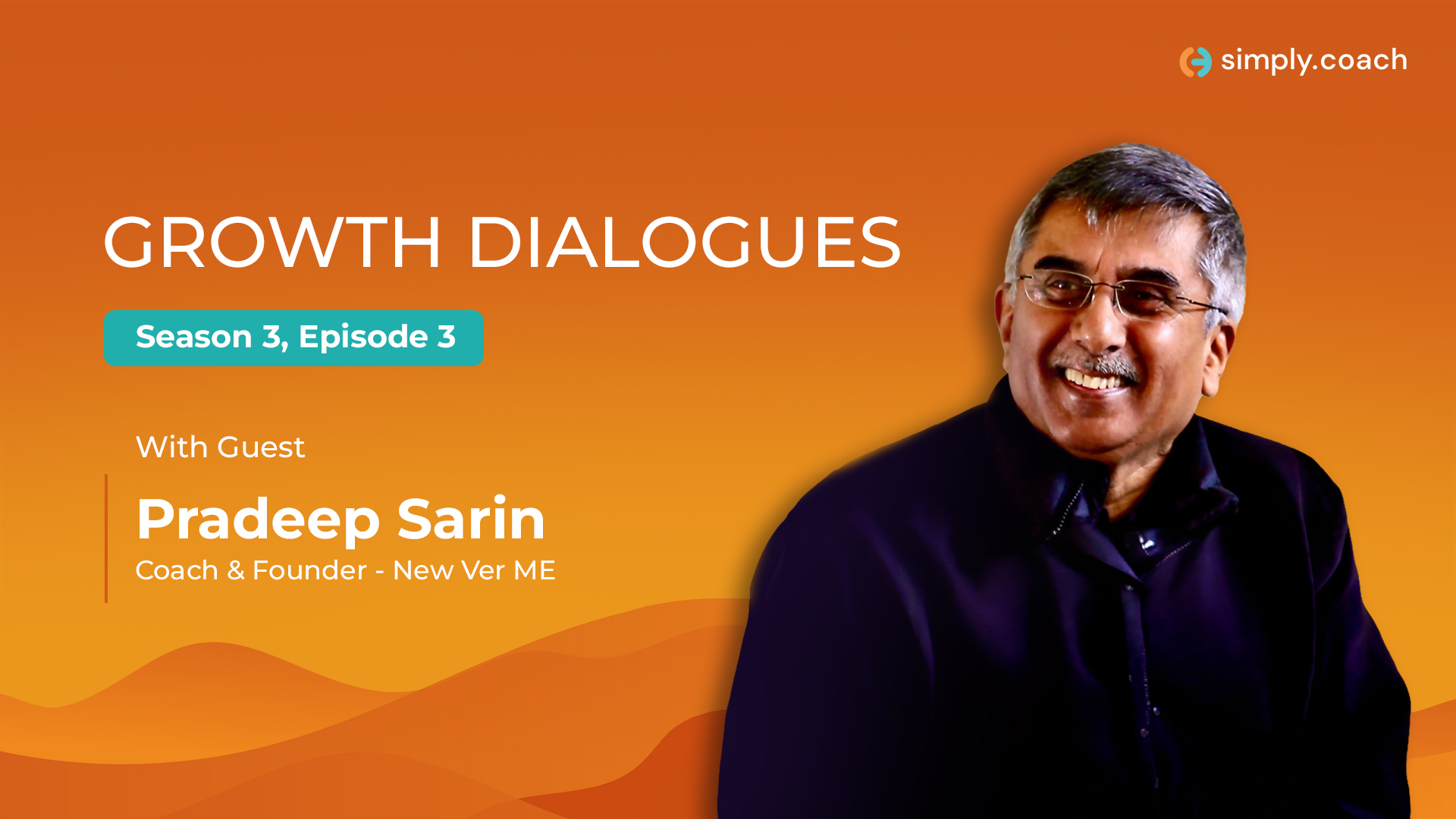
Five years ago, I told myself I’d try this for a year. No targets, no five-year plan, just an experiment: what happens if you make coaching affordable and accessible to the people who never get offered it: the new managers, the mid-career professionals, the people three or four levels below the C-suite who everyone agrees have potential but nobody budgets for. If nothing happened, I could always shut it down. Five years later, I still don’t know how to unplug myself, because it hasn’t stopped growing. But the more interesting story isn’t that it grew. It’s why we started New Ver ME, and what that says about who coaching is actually for.
It started with a resentment, not a mission
I came to coaching backwards. I was a banker, numbers-focused, and somewhere along the way my organization decided I needed a coach. I resented it. My coach didn’t know banking. My HR team barely understood coaching beyond “senior people are getting coaches, you’re getting one too.” And for my first two or three conversations, I’ll be honest, I was a jerk. Uncooperative. Why should I explain myself to a stranger who wasn’t part of my organization? What was wrong with me that they thought I needed this?
It took six months for that resentment to wear down. My coach just kept at it, two weeks at a time, until something shifted in my head. By the end of the engagement, my question to her wasn’t “are we done,” it was “how do I become a coach myself.” I realized I’d been doing a version of this instinctively, as someone leading a team, without ever naming it. Enabling others turned out to be one of my core values, something that had shown up in psychometric tests for years without my really registering it.
I parked that thought for a while, then certified as a coach in 2017. And from the start I knew I didn’t want to do this for a living. I’d moved past needing coaching to be a livelihood. What I wanted was to reach people who don’t know what coaching is, or can’t access it, or think it’s too expensive, which, for most people, it is.
Why free doesn’t work, and affordable does
The instinct when you’re not doing something for money is to just give it away. I tried that. It doesn’t work. Free means no skin in the game, and no skin in the game means people don’t show up, don’t take the sessions seriously, don’t do the work between sessions. So I changed the model: pay me whatever you think you can afford. I won’t challenge your economics. A senior, experienced coach costs a certain amount per hour; I wasn’t asking anywhere close to that. People threw out all kinds of numbers. Some said they couldn’t pay right now. Fine, I told them, but you still owe me. Can’t pay in cash, pay me with a cup of coffee. But pay me something.
What started as one-off, word-of-mouth coaching (coach my brother, coach my sister, coach my boss) kept growing until I couldn’t meet the demand alone. That’s when I understood I needed other coaches, and I needed a platform, which is where I found Simply.Coach. I didn’t have to build the technology to pursue what I was actually here for. That let me focus on the harder question: where do you find coaches willing to sign up for this?
The answer turned out to be values, not incentives. We went to the coach community with one line: affordable, accessible coaching for all. If that mission connects with you, give some of your time to a young or mid-career professional, keep your livelihood work with your senior clients elsewhere, and let this be your payback in a different currency. And that was the start of New Ver ME. Coaches came. More than we can actually place, in fact, because at New Ver ME we’ve never done any real marketing. Our social media is entirely about educating people on what coaching is, not selling anyone on us.
The gap nobody else was pricing for
Once this worked for individuals, we had a hunch it would work for companies too, so we started talking to people we knew. We set a floor on quality (ICF certification, ten to twelve years of work experience, at least two years of coaching experience) because the one thing that needed to be uniform was the experience itself, not which of our coaches you happened to get.
Pricing worked in reverse of how most coaching businesses operate. We didn’t hand companies a rate card. We asked what they could invest, and built the program around that, capped so it wouldn’t drift too far from what individuals paid. Sometimes that meant one workshop instead of two, seven sessions instead of eight. What stayed constant was a single principle: operate at breakeven. As long as our costs are covered, that’s all that matters. In five years we’ve never touched our pricing. Not once has anyone told us we’re too expensive. If anything, we’ve had the opposite complaint: people saying we’re priced too low, that they won’t hire below a certain rate. A good problem, and one we’ve simply declined to solve by raising prices.
Here’s the part that actually mattered: the people we coach are people organizations would never normally spend on coaching for. You can justify a coach for a CXO. Why would you justify one for a cohort of thirty or forty mid-level managers, unless the economics make that an easy decision rather than an agonizing one? That’s the gap we sit in. Tech, FMCG, banks, insurance, asset managers, alco-bev, media, manufacturing, support services… industry has never been the filter. The filter has always been: does this organization believe these people have potential, or are stagnating, or deserve a shot they wouldn’t otherwise get?
What we actually measure, since we can’t measure the obvious thing
Conventional coaching already struggles to prove its value. Coaching young and mid-career people at scale doesn’t make that easier. There’s no clean ROI number we can hand a CHRO. What we build instead is three data points. First, what the organization already believes about the person (be more strategic, stop micromanaging, learn to delegate). Second, and this matters to us, the individual gets to agree or disagree with that framing; it’s a transparent conversation, not an imposed one. Third, something we coined called KRA: keep, release, acquire (the habits, qualities, and behaviors someone wants to hold onto, let go of, or build). Goals get framed from there.
At the end, we build a report starting with the individual’s own words: what changed, how they’re sustaining it, what’s next. We take that back to HR and the manager alongside our own periodic check-ins on visible change. It isn’t scientific. You’re dealing with behavior, and behavior resists clean measurement. But it’s honest and it’s consistent, and it’s given companies enough confidence to come back with repeat cohorts, year after year, which is really the only proof that ends up mattering.
Why I think of this as the Adyar Anand Bhavan of coaching
I think of what we’ve built at New Ver ME as the Adyar Anand Bhavan of coaching. If you’re not familiar with the south Indian chain restaurant, think of it as McDonald’s. You walk in, you get what you came for, at a price you don’t have to think twice about, and it tastes the same every time. You could get the same idli at a five-star hotel for four times the price, and it might not even be as good. Coaches, understandably, gravitate toward the high end, because that’s where the per-unit economics look best. But stop thinking in price per session and start thinking in volume, and something changes: an umbrella organization with vetted coaches holding to one brand promise can carry far more volume, at a price point no solo practitioner could sustain, and still make it work.
I believe this is replicable well beyond us. It doesn’t have to be young or mid-career managers specifically. It could be homemakers, students, anyone who’s decided they want to change something and accepts that the change starts with them. The old B2C self-help world (the Tony Robbins, the Zig Ziglars) gave people a one-size-fits-all version of transformation: a book or a DVD you either took or left. What we’re offering is different. Still personal, still one qualified coach with one person, just priced for reach instead of exclusivity.
The audience nobody thinks to coach
The extension of this I didn’t expect is where it’s led. One of my co-founders, who has deep training experience alongside her coaching background, started a training offshoot that uses a coach approach with an audience nobody invests in this way: security guards, frontline staff, receptionists, maintenance teams. Classroom sessions blended with a purpose-built app, daily nudges, a leaderboard, peer recognition. Three months in, the company sponsoring it is already seeing a shift in behavior. It’s early, the economics still have to prove out, but I find this the most compelling audience of everything we do. A security guard standing in the sun for eight hours, supporting a family back home, under constant pressure, is bound to break somewhere, bound to come across as rude to someone who didn’t deserve it. Nobody has ever asked whether that person could use help managing that pressure. We’re trying to.
The same logic runs upward too. HR heads and managers are almost always the ones arranging coaching for everyone else (sales, strategy, leadership) and almost never getting it themselves, because the function is still seen as support rather than a candidate for development. Wherever we can, we offer to coach that person directly, even outside a formal cohort, because once someone has experienced the change themselves, they become the most credible person in the building to argue for bringing it to everyone else.
What this adds up to
None of this (the pay-what-you-can model, the reverse pricing with companies, the KRA framework, the Anand Bhavan economics, the security guards and the HR heads nobody thought to coach) was ever a strategy we sat down and designed. We simply aligned with our purpose and the team, the platform, the coaches, all came together to turn it into reality. But I could afford to build it this way because I’d already moved past needing coaching to pay my bills. Most coaches haven’t, and that’s a completely legitimate place to coach from. But know what you’re walking into: a crowded, high end of the market, full of experienced coaches with established relationships and every certification imaginable, all fighting for the same room.
So the question I’d leave any newly certified coach with isn’t how do you win that room. It’s where hasn’t anyone set up a stall at all. We chose to build another Anand Bhavan and compete on something other than price, hoping something in our rasam draws people in. But as a newer, less experienced coach, what are the honest odds my rasam beats the ones perfected over decades? Maybe the better question is where people have never tasted rasam at all: some place cold, where it can compete with what they already reach for out of habit. Same warmth, same relief, different shelf. That clarity, of where you fit rather than who you’re trying to out-compete, is worth having before you decide how to grow.
And then be patient with yourself. You are learning as a coach in every single session. None of us are the masters yet. There will always be something left to learn.