
As a trauma-informed coach, you’ve likely experienced the challenge of helping clients who struggle with emotional triggers, fear of vulnerability, or a lack of trust in the process. You may find that traditional coaching methods don’t always work for those affected by trauma, leaving you wondering how to create a truly supportive and healing environment. It’s frustrating when clients seem stuck, unable to make the progress they deserve. But, you don’t have to face this alone.
Trauma-informed coaching addresses these challenges by focusing on creating a safe, nurturing space where clients can feel heard and understood. It moves beyond just listening, it’s about respecting each client’s pace, honoring their boundaries, and understanding the impact of past experiences on their present lives. This approach fosters an environment where trust and empowerment thrive.
In this blog, we’ll dive into practical, trauma-informed coaching techniques that will help you not only connect with your clients but also guide them toward deeper healing and growth. These techniques will enable you to create lasting change by recognizing trauma’s impact and incorporating sensitive, effective strategies in your sessions. Let’s explore how you can transform your practice and better support your clients with trauma-informed methods.
Key Takeaways
- Trauma-informed coaching focuses on creating a safe, supportive space for clients to heal, respecting their boundaries and emotional well-being.
- Techniques like grounding, active listening, and trauma-sensitive language help clients process emotions and foster trust in the coaching relationship.
- Providing clients with autonomy through techniques like choice and control enhances empowerment, making them more engaged and motivated in their healing journey.
- Utilizing metaphors, self-compassion practices, and reflective exercises supports clients in reframing their experiences and cultivating emotional resilience.
- Simply.Coach tools, like customizable forms and automated reminders, help implement these techniques seamlessly, allowing coaches to focus more on client care.
What is Trauma-Informed Coaching and Why is it Necessary for Clients?
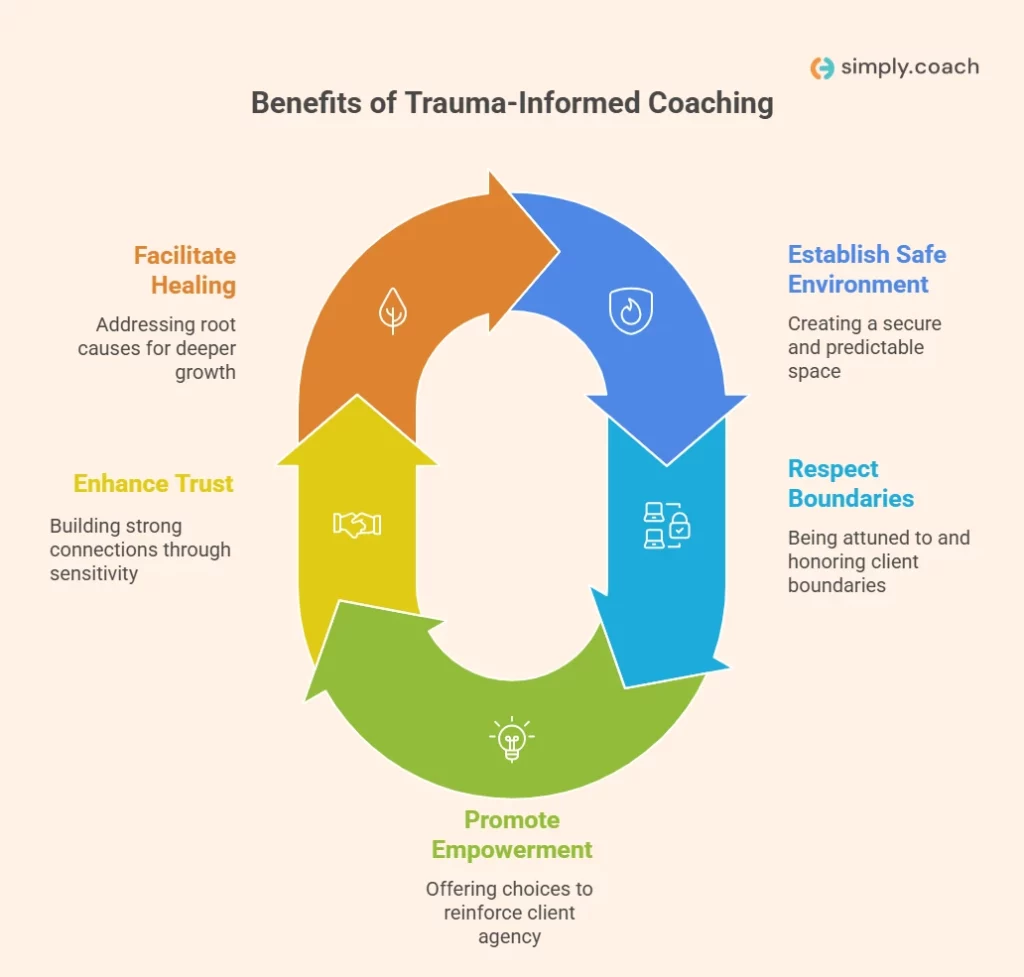
Trauma-informed coaching is not just about understanding the effects of trauma on a client’s life, it’s about implementing an approach that prioritizes safety, trust, and empowerment in every coaching interaction. For you as a coach, it’s a critical framework that allows you to engage with clients in a way that respects their emotional and psychological boundaries. It ensures that you’re not only addressing their goals but also protecting their emotional well-being throughout the coaching process.
Here’s why trauma-informed coaching is essential:
- Establishes a safe environment: Clients who have experienced trauma may feel unsafe or vulnerable in new situations. By creating a predictable and secure coaching space, you help them feel more comfortable and open to the coaching process.
- Respects individual boundaries: Trauma can make clients hyper-aware of their boundaries. Being attuned to these boundaries and allowing clients to maintain control over their participation ensures they feel respected and not re-traumatized.
- Promotes empowerment and choice: Offering clients choices in their coaching journey reinforces their sense of agency. Empowering them to make decisions about their goals and the pace of sessions fosters confidence and autonomy.
- Enhances trust and rapport: Building trust is crucial in any coaching relationship. Demonstrating understanding and sensitivity to a client’s past experiences helps in establishing a strong, trusting connection, which is foundational for effective coaching.
- Facilitates deeper healing and growth: Addressing the root causes of challenges, rather than just the symptoms, enables clients to heal more profoundly. Trauma-informed coaching supports clients in processing past experiences, leading to meaningful personal growth and transformation.
Incorporating trauma-informed principles into your coaching practice not only supports your clients’ healing journeys but also enhances the effectiveness of your coaching. By understanding and addressing the complexities of trauma, you can create a more impactful and compassionate coaching experience.
For a deeper exploration of trauma-informed coaching principles, refer to our comprehensive guide: Understanding Life and Trauma-Informed Coaching.
10 Effective Trauma-Informed Coaching Techniques
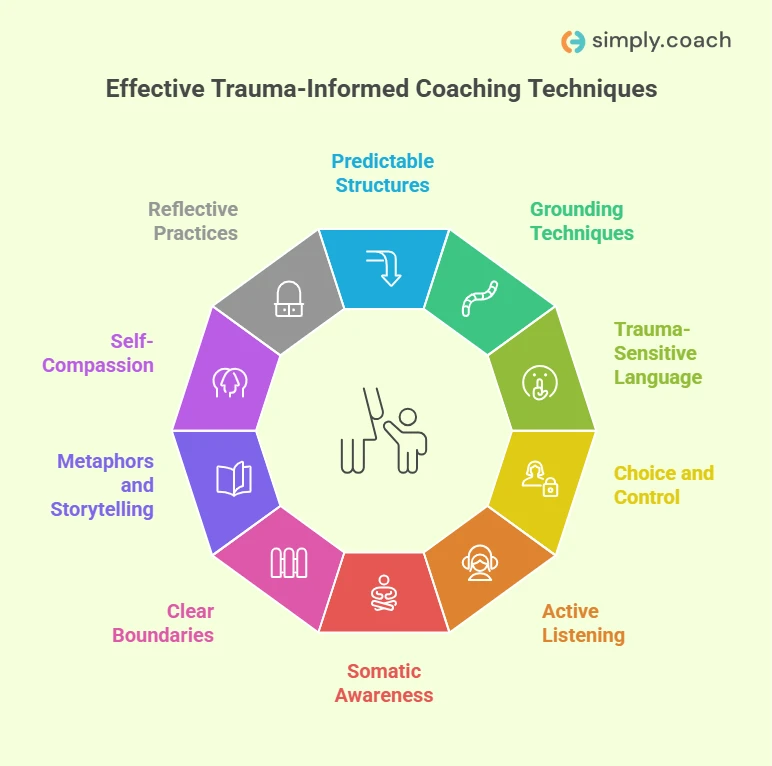
In trauma-informed coaching, the goal is to create an environment that fosters healing, safety, and progress. By implementing specific strategies and techniques, you can better support your clients in overcoming their trauma while promoting personal growth. Below are ten of the most effective and specific trauma-informed coaching techniques that can help you improve client engagement and outcomes.
1. Establishing predictable structures
Establishing predictable structures in coaching sessions creates a sense of safety and consistency for trauma-affected clients. By having a clear agenda and consistent session format, you reduce anxiety and provide a stable framework that clients can rely on throughout the coaching process.
- Clear session agenda: Define the topics and objectives at the start of each session to help clients feel prepared and engaged.
- Consistent timing: Stick to a regular session schedule so clients know when to expect coaching and can plan their emotional energy accordingly.
- Predictable flow: Create a routine that clients can depend on. For instance, always starting with a check-in before diving into new content ensures familiarity and comfort.
- Reduce overwhelm: Limiting unpredictability allows clients to focus on the coaching process rather than getting distracted by uncertainty or anxiety about what comes next.
- Reinforce control: Predictability gives clients more control over the process, which is empowering for those with a history of trauma.
2. Utilizing grounding techniques
Grounding techniques are powerful tools that help your clients stay present and connected to their bodies during coaching sessions. Methods like deep breathing and sensory awareness allow clients to manage overwhelming emotions and focus on the present moment. By incorporating these techniques, you help clients regain control and reduce feelings of anxiety or dissociation.
- Deep breathing exercises: Guide your clients to focus on their breath, encouraging slow, controlled inhales and exhales to calm their nervous system.
- Body scans: Help your clients perform a body scan from head to toe, reconnecting them with physical sensations and grounding them in the moment.
- Sensory awareness: Ask your clients to focus on sensory input, such as the feel of their feet on the ground, to help them stay anchored in the present.
- Tactile grounding objects: Encourage your clients to hold an object like a textured fabric or stress ball to direct their attention to sensory experience when feeling overwhelmed.
- Progressive muscle relaxation: Teach your clients how to tense and release muscle groups to reduce tension and promote calmness.
3. Employing trauma-sensitive language
When you use trauma-sensitive language, you create a safe, respectful, and empowering space for your clients. By choosing words that are neutral and non-triggering, you minimize the risk of re-traumatization and support your clients in their healing journey. This approach fosters trust and ensures that your clients feel heard and respected.
- Use non-judgmental language: Avoid terms that might imply blame or shame. Instead, use language that promotes understanding and compassion, ensuring your clients feel accepted
- Focus on empowerment: Frame language around your clients’ strengths, such as saying “you have the ability to overcome this,” instead of focusing on limitations.
- Be mindful of triggers: Stay aware of potential triggers and avoid language that could bring up traumatic memories. Adapt your words to ensure comfort and safety.
- Use inclusive language: Ensure your language is gender-neutral and culturally sensitive, making every client feel valued and understood.
- Validate emotions: Acknowledge your clients’ emotions by saying phrases like “I understand that this is difficult,” showing them that you truly hear and support them.
Also read: The Core Assumption in Coaching: Empowering Clients to Unlock Their Potential
4. Implementing choice and control
Allowing your clients to have autonomy in the coaching process is a core aspect of trauma-informed coaching. By giving clients the power to choose topics or set the pace of their sessions, you empower them to feel in control of their journey. This not only respects their boundaries but also fosters trust, as clients are more likely to engage in the coaching process when they feel they have a say in how it unfolds.
- Offer topic selection: Allow your clients to choose the subjects they’d like to explore during sessions, ensuring they are focused on what matters most to them.
- Adjust session pacing: Let your clients dictate the pace of the coaching process, moving more quickly or slowly based on their emotional comfort and readiness.
- Provide options for exercises: Give clients choices when introducing exercises, allowing them to select the activities they feel most comfortable with.
- Respect emotional boundaries: Empower clients to decide when to pause or revisit sensitive topics, giving them control over their emotional safety.
- Support decision-making: Encourage clients to take the lead in setting their own goals, promoting a sense of ownership and accountability in their progress.
5. Active listening with validation
Active listening and validation are essential techniques for building a strong, trusting relationship with your clients. By demonstrating empathy and understanding through reflective listening, you ensure that clients feel heard and valued. This approach not only helps clients feel more connected to the coaching process but also encourages them to open up and engage more deeply in the work.
- Reflective listening: Show your clients that you truly understand by summarizing their thoughts or feelings, helping them feel heard without judgment.
- Affirm their experiences: Use phrases like “I hear you,” or “That makes sense,” to validate their emotions and experiences, showing them that their feelings are legitimate.
- Avoid interrupting: Give your clients the space to fully express themselves before offering your input, allowing them to feel completely understood.
- Acknowledge emotional states: When clients express strong emotions, acknowledge those feelings with compassion, saying things like “I can see that this is really difficult for you.”
- Use non-verbal cues: Demonstrate active listening through body language, like nodding or maintaining eye contact, to show that you are fully engaged in the conversation.
Read: Three Levels of Coaching Listening: Unlock Deeper Connections & Client Success
6. Incorporating somatic awareness
Incorporating somatic awareness into your coaching practice allows clients to connect with their body’s sensations, facilitating the release of stored trauma and promoting emotional regulation. By guiding clients to notice physical sensations related to emotions, you help them develop a deeper understanding of their internal experiences, fostering healing and resilience.
- Body scans: Guide clients through a body scan, encouraging them to notice areas of tension or discomfort, helping them become aware of their physical state.
- Mindful movement: Introduce gentle movements or stretches to help clients release physical tension and reconnect with their bodies.
- Breathing exercises: Teach clients breathing techniques to regulate their nervous system and enhance their connection to bodily sensations.
- Grounding techniques: Encourage practices like feeling the feet on the ground or holding onto an object to anchor clients in the present moment.
- Sensory awareness: Help clients focus on sensory experiences, such as textures or sounds, to increase awareness of their body’s responses to emotions.
Know more: Becoming a Somatic Coach: Accredited Certification Programs
7. Setting clear boundaries
Establishing and maintaining clear boundaries is crucial in trauma-informed coaching to create a safe and respectful environment for clients. By defining the scope of your role and setting expectations, you help clients feel secure and understood, fostering trust and promoting effective coaching outcomes.
- Define your role: Clearly communicate the scope of your coaching services, ensuring clients understand the boundaries of your expertise.
- Establish session parameters: Set expectations regarding session length, frequency, and availability to create a structured environment.
- Maintain professional distance: Keep a professional demeanor and avoid becoming overly involved in clients’ personal lives to maintain objectivity.
- Respect client autonomy: Allow clients to make decisions about their coaching journey, empowering them to take ownership of their progress.
- Model healthy boundaries: Demonstrate appropriate boundaries in your interactions, serving as a model for clients to emulate in their own relationships.
8. Utilizing metaphors and storytelling
Metaphors and storytelling are powerful tools that can help you guide your clients through their trauma and personal growth. By using metaphors, you can help your clients reframe their experiences, making complex emotions and situations easier to understand. This approach allows clients to gain new perspectives, turning challenges into opportunities for healing.
- Reframe difficult experiences: Use metaphors to help your clients view their challenges from a new angle, transforming obstacles into opportunities for growth.
- Simplify complex emotions: Share metaphors that help clients process difficult emotions, making them feel more approachable and manageable.
- Engage clients with relatable stories: Use storytelling to create a connection with your clients, making the coaching process more relatable and engaging.
- Promote healing through symbolism: Introduce metaphors that symbolize the healing journey, such as a caterpillar transforming into a butterfly, to help clients visualize their own growth.
- Encourage self-insight: Ask your clients to come up with their own metaphors to represent their emotional journey, helping them develop deeper self-awareness.
9. Encouraging self-compassion practices
As a trauma-informed coach, helping your clients develop self-compassion is key to their emotional healing. Self-compassion allows them to treat themselves with kindness and understanding, rather than harsh self-criticism. By fostering this practice, you guide your clients toward healthier self-worth and emotional resilience.
- Teach mindful self-kindness: Encourage your clients to respond to their own struggles with patience and kindness, rather than judgment or self-blame.
- Normalize imperfection: Help your clients understand that mistakes and imperfections are part of the human experience and do not diminish their worth.
- Model self-compassion: Demonstrate how to practice self-compassion by acknowledging your own imperfections and treating yourself with care.
- Use affirmations: Guide your clients to practice positive affirmations like “I am enough” to reinforce self-compassion and self-worth.
- Encourage self-forgiveness: Support your clients in releasing guilt and shame by teaching them how to forgive themselves and move forward with compassion.
10. Integrating reflective practices
Reflective practices such as journaling and mindfulness exercises are essential tools in trauma-informed coaching. These practices promote self-awareness and help your clients process their emotions more deeply, allowing them to track their personal growth over time and develop a deeper understanding of their experiences.
- Journaling prompts: Provide your clients with reflective prompts to encourage them to explore their feelings and gain clarity on their emotional journey.
- Mindfulness exercises: Guide your clients through simple mindfulness exercises to increase their awareness of their thoughts, feelings, and physical sensations in the present moment.
- Daily reflection: Encourage your clients to take a few minutes each day to reflect on their progress and any insights they may have gained. Use the Simply.Coach self-reflection form to help them easily track their thoughts and emotions, allowing them to stay engaged and organized in their healing journey.
- Explore past patterns: Use reflection to help your clients identify recurring thoughts and behaviors, offering them insights into their emotional growth and challenges.
- Track emotional growth: Have your clients track changes in their emotional state over time, helping them recognize the positive shifts in their healing process.
For a deeper dive into integrating mindfulness practices
into your coaching for lasting transformation, listen to the Simply.Coach Growth Dialogues Podcast Episode: "Integrating Mindfulness in Coaching for Lasting Client Transformation with Coach Kevin Parker"

How Simply.Coach Tools Support Your Trauma-Informed Coaching Techniques
When you’re implementing trauma-informed coaching techniques, having the right tools is essential to ensure a seamless, supportive experience for your clients. Simply.Coach provides features specifically designed to complement trauma-informed practices, allowing you to stay focused on your clients’ needs while automating administrative tasks. These tools help enhance the core techniques you use, like fostering safety, empowerment, and emotional regulation, which are vital for clients healing from trauma.
- Customizable forms: You can create personalized forms that respect your clients’ boundaries and comfort levels. These forms are designed to help you gather relevant information without overwhelming your clients, ensuring the coaching process is client-centric.
- Automated reminders: Trauma survivors often struggle with consistency due to emotional or cognitive challenges. Simply.Coach’s automated reminders keep clients on track with minimal effort, ensuring they stay engaged without feeling burdened.
- Secure client workspaces: Create private, secure spaces where your clients can access coaching materials, notes, and reports. This tool gives clients control over their personal information, fostering trust and confidence in the process.
- Goal tracking and progress reports: Simply.Coach helps you set, track, and visualize goals with your clients. This functionality allows clients to see their progress over time, boosting their confidence and reinforcing a sense of achievement.
- Session notes and action plans: Document important insights and action steps directly within the platform, which clients can access at any time. This ensures that your coaching remains organized, transparent, and supportive, helping your clients feel more in control of their progress.
Conclusion
Trauma coaching techniques are essential for helping clients navigate their healing journey in a safe and effective way. These techniques, such as grounding practices, setting clear boundaries, and using trauma-sensitive language, allow you to create an environment where clients feel heard and supported. By addressing trauma in a thoughtful, structured way, you empower clients to process their experiences and foster long-lasting growth and healing.
Simply.Coach offers the tools you need to integrate these trauma coaching techniques into your practice seamlessly. With features like customizable forms that respect client boundaries, secure workspaces to store sensitive information, and automated reminders to keep clients on track, Simply.Coach helps you maintain focus on client outcomes, while managing the administrative load.