
If you’re like most coaches, you’ve seen teams make real progress in the room only to lose momentum once they’re back in day-to-day pressure. You improve trust, clarify roles, and strengthen communication, yet old patterns still return because you’re addressing symptoms, not the wider system shaping team behavior.
Traditional team coaching focuses mostly on what happens inside the team. But real constraints often exist outside the team, cross-functional demands, shifting priorities, stakeholder expectations, competing KPIs, hybrid work challenges, and organizational politics. When these forces stay hidden, coaching impact becomes limited and short-lived.
This blog introduces systemic team coaching, explains why modern teams need it, outlines its core principles, and provides models and tools to help you create sustainable performance in complex environments.
Key Takeaways
- Traditional team coaching is limited: Most team issues stem from the broader system, not just internal dynamics.
- Systemic team coaching (STC) is holistic: It addresses both internal team performance and external stakeholder/system influences.
- Five disciplines drive STC: Commissioning, Clarifying, Co-creating, Connecting, and Core Learning ensure teams are aligned, collaborative, and adaptive.
- Use STC when complexity is high: Ideal for leadership teams, cross-functional teams, teams in transformation, and organizations seeking sustainable change.
- Benefits for coaches and teams: Collective leadership, stakeholder alignment, continuous learning, and measurable, long-term results.
- Simply.Coach supports STC: Tools like 360° feedback, stakeholder integration, goal tracking, progress reports, client workspaces, and scheduling make systemic coaching practical and measurable.
What is Systemic Team Coaching (STC)?
Systemic team coaching is an ongoing, structured process where you coach a whole team, both together and individually, to improve how they work, make decisions, and deliver value. Instead of focusing only on communication or relationships inside the team, STC looks at how the team connects with customers, leaders, partners, and other external stakeholders who influence its success.
The philosophy behind STC is simple. A team is not just a group of people collaborating on tasks; it is a value-creating system operating inside a larger, complex network. STC helps a team build collective leadership, respond to systemic pressures, and maintain performance in fast-changing environments through continuous learning, reflection, and alignment with the broader organization.
Why coaches need systemic team coaching
Teams no longer struggle only with internal issues. Their biggest challenges often come from the system around them. STC helps you coach teams in a way that addresses real-world complexity rather than isolated behaviors.
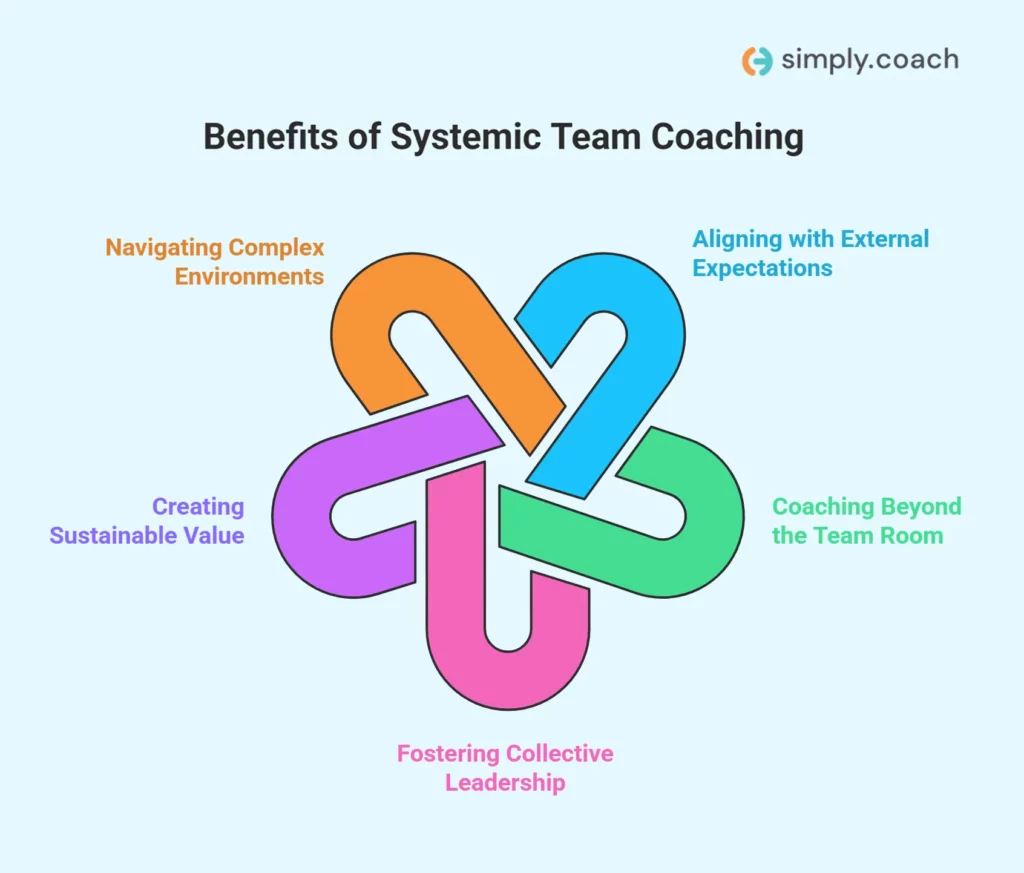
Here are the key benefits of STC
- Align teams with shifting external expectations: STC helps teams stay in sync with sponsors, customers, and cross-functional stakeholders whose needs change rapidly.
- Coach beyond the team room: Most challenges originate outside the team itself. STC equips you to address issues at the system level, ensuring your interventions have broader impact.
- Foster collective leadership: STC enables team members to move beyond individual roles and act as a unified leadership system, distributing responsibility and ownership across the team.
- Create sustainable, stakeholder-connected value: Instead of short-term fixes, STC drives long-term performance that benefits both the team and the broader organization.
- Navigate interdependent, complex work environments: Teams can manage hybrid work, matrix structures, and cross-functional complexity with clarity, alignment, and adaptability.
A systemic approach allows you to generate deeper, more durable results, transforming how a team performs both inside and outside the room.
Difference between systemic team coaching and group coaching
As a coach, you know that traditional group or team coaching often focuses only on internal dynamics and short-term issues. Systemic team coaching goes beyond the team to include stakeholders, organizational context, and continuous learning for lasting impact.
The key differences can be summarized in the table below:
| Group Coaching / Team Coaching | Systemic Team Coaching (STC) |
| Focus on internal dynamics, relationships, or tasks | Includes both internal dynamics and external stakeholder/system context |
| Short-term interventions such as workshops or retreats | Ongoing process with the team together and apart, continuous learning |
| Often leader-driven or leader-centric | Collective leadership; shared ownership by the whole team |
| Limited scope, focused only on the team | Broader scope including team, stakeholders, and organizational/system ecosystem |
| Limited follow-up | Emphasis on reflection, feedback, and adaptation over time |
Also read: How To Structure A Group Coaching Program (Step-By-Step)
When to Use Systemic Team Coaching: Use Cases and Signals
You turn to systemic team coaching when a team’s challenges are shaped by the wider organization and when their success depends on how effectively they engage with stakeholders, strategy, and change. At this point, traditional team coaching isn’t enough, and you need a broader, system-aware approach.
- Leadership teams making complex strategic decisions: Use systemic coaching when your leadership team’s decisions impact multiple stakeholders and you see them struggling to stay aligned or slipping back into fragmented thinking.
- Cross-functional teams struggling across boundaries: Use it when you notice collaboration breaking down at the interfaces between teams, departments, or regions, and the real issues originate outside the team you’re coaching.
- Teams navigating major change or transformation: Use it when your team is going through reorganizations, new leadership, or shifting strategy and you see confusion about identity, purpose, and alignment with the emerging context.
- Organizations aiming for long-term cultural or behavioral change: Use it when you’re helping a team build lasting habits such as reflection, collaboration, and systemic awareness that will influence the wider organization over time.
- When you want to expand into high-value systemic coaching: Use it when your role is expected to create impact beyond the team and you need a method that can address broader complexity and enterprise-level outcomes.
Whenever you notice that a team’s success depends on how well it engages with the larger ecosystem around it, systemic team coaching becomes the most effective and transformative approach you can bring.
Also read: 10 Effective Coaching Strategies to Enhance Team Performance
The Five Disciplines Model of Systemic Team Coaching
The five disciplines model expands your coaching lens from “team behaviors” to “team value creation inside a wider system.” These disciplines do not function in isolation; they interact, amplify, and expose systemic constraints that typical team coaching often misses.
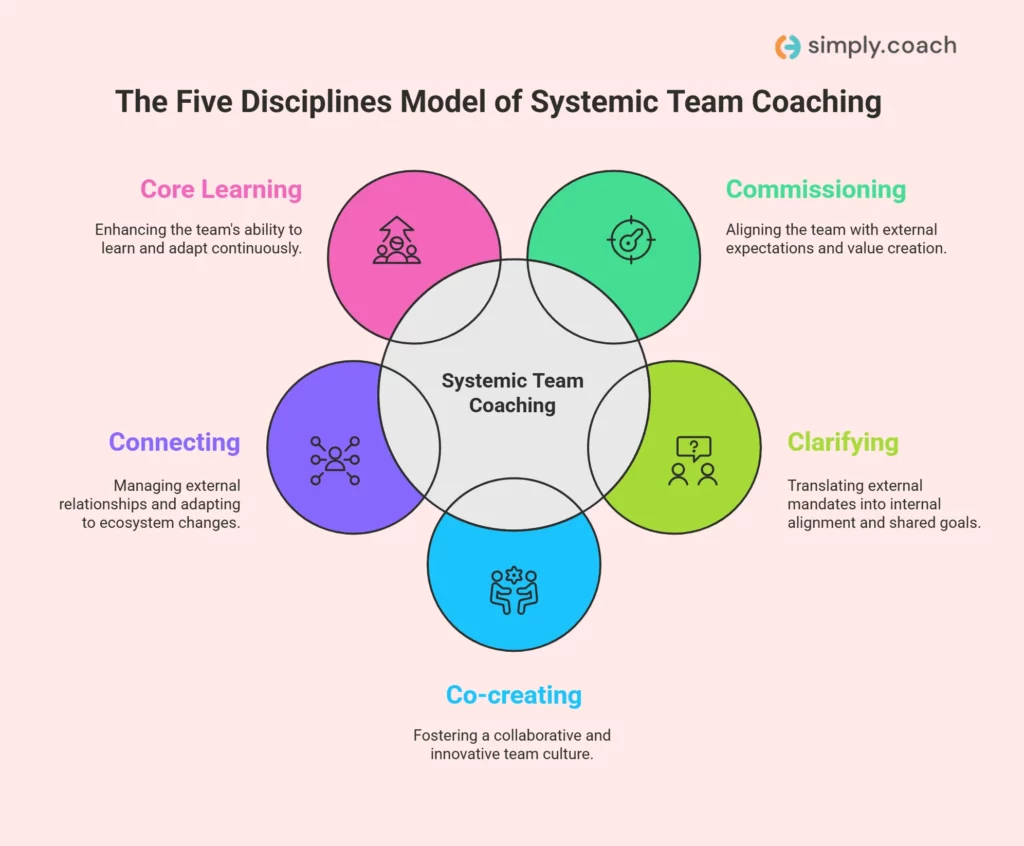
1. Commissioning
Commissioning is the process of aligning a team with the true expectations of the wider system. It is not just “purpose-setting” but mapping who the team exists for, how value flows in and out of the team, and what success means from a system perspective. This goes beyond initial scoping. It includes sponsors, customers, partners, regulators, cross-functional teams, and anyone whose expectations shape team performance.
Why it is critical:
Most teams are commissioned poorly or inconsistently. Mandates shift. Sponsors change. The team gets messages like “be more innovative” but the KPIs demand stability. Systemic misalignment creates chronic tension inside the team that no internal workshop can fix.
Key questions to explore as a coach:
- Who genuinely needs this team to exist?
- What value must this team deliver that no other team can?
- What expectations or pressures come from the system that the team has never articulated?
- What promises has leadership made on behalf of the team, explicitly or implicitly?
Coaching tip:
When a team says “we lack clarity,” do not start with purpose statements. Start with stakeholder interviews. Often the system is unclear, not the team.
2. Clarifying
Clarifying translates the external mandate into internal alignment. It involves codifying the team’s purpose, shared goals, success measures, decision-making boundaries, roles, interdependencies, and operating rhythms. This is where collective leadership becomes visible.
Why it is critical:
Teams fail not because people are unclear individually but because they are unclear collectively. Systemic complexity makes clarity decay faster than coaches expect. Clarifying requires continuous recalibration, not a one-time workshop.
Key questions to explore as a coach:
- What are the goals we own together vs. individually?
- Where does authority actually sit, not just on paper?
- How do we make decisions when goals conflict?
- What must each role start doing or stop doing to enable collective success?
Coaching tip:
Never accept “we already have roles defined” at face value. Ask for real situations where clarity broke. That is where the systemic gaps show up.
3. Co-creating
Co-creating is how the team thinks, collaborates, and solves problems together. It is not just interpersonal behavior. It is the team’s value-creation culture, the invisible rules that determine how ideas flow, how conflict is handled, how creativity happens, and how psychological safety is built or eroded.
Why it is critical:
Teams rarely fail due to lack of competence. They fail due to poor collective functioning. In systemic work, co-creating is not about harmony but effectiveness: does the team produce outcomes that exceed what individuals could achieve alone?
Key questions to explore as a coach:
- What conversations never happen here, and why?
- How does the team respond when pressure increases, do they collaborate or retreat into silos?
- What unspoken rules govern how people challenge, influence, or contribute?
- Do we create together, or do we negotiate between individual agendas?
Coaching tip:
Map the team’s interaction patterns, including who talks, who withdraws, who influences decisions informally. It reveals the real system far faster than surveys.
4. Connecting
Connecting is the discipline of managing external relationships intentionally. It includes stakeholders, internal partners, other teams, customers, and any group whose alignment is required for the team to succeed. Connecting also includes sensing changes in the ecosystem and adjusting accordingly.
Why it is critical:
Most team performance issues are systemic because performance depends on external partners. If those partners are misaligned, overloaded, or resistant, the team’s work stalls. Coaches who ignore external dynamics end up treating symptoms instead of the root causes.
Key questions to explore as a coach:
- Who are our critical allies, and how healthy are those relationships?
- Who feels the impact of this team’s decisions but has no voice?
- Where are the system bottlenecks we must influence, not just endure?
- How quickly do we detect and respond to changes in the external environment?
Coaching tip:
Use a stakeholder ecosystem map in sessions. This visual instantly shows where relationships support or choke performance.
5. Core learning
Core learning is the team’s capacity to learn, adapt, and evolve. It includes reflection habits, feedback loops, sense-making, experimentation, and the ability to update assumptions as the system changes.
Why it is critical:
In a complex system, the environment changes faster than behaviors. Without learning, teams remain stuck in outdated patterns that once worked but no longer serve them.
Key questions to explore as a coach:
- What feedback does the system give us, and how do we act on it?
- What patterns are repeating, and what do they signal?
- How do we create space for reflection when we are under pressure?
- What experiments could help us solve persistent problems differently?
Coaching tip:
Introduce micro-reflection rituals, for example 5-minute pauses after key interactions. These shift learning from event-based to continuous.
A team that strengthens all five disciplines becomes adaptive, aligned, externally connected, and genuinely value-creating, not just better behaved.
Also read: 8 Guiding Principles for Impactful Leadership Coaching
How to Incorporate Systemic Team Coaching in Your Practice
As a coach, integrating systemic team coaching into your practice requires both strategic thinking and structured methods. STC is not just about improving internal team dynamics; it is about connecting the team to its broader system and helping it generate sustainable value. Here are practical steps and tips to bring STC into your coaching work.
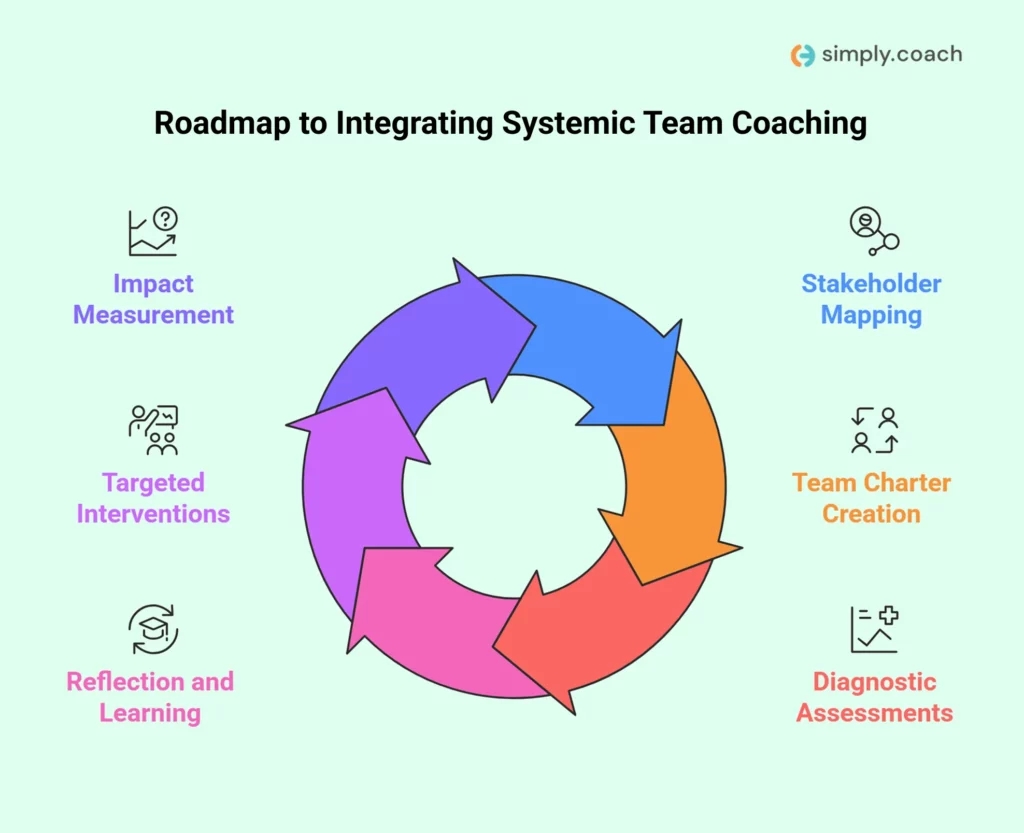
- Start with stakeholder mapping and commissioning: Clarify the team’s purpose, identify key stakeholders, understand commitments, and define the expectations of the broader system.
- Facilitate a team charter or team commission: Work with the team and stakeholders to define roles, responsibilities, expectations, and delivery commitments, creating a shared agreement for collaboration.
- Use diagnostic tools and assessments: Leverage 360-degree feedback, stakeholder surveys, or team effectiveness assessments to understand where the team stands across the five disciplines.
- Embed regular reflection and learning cycles (Core Learning): Schedule retrospectives, feedback sessions, and milestone reflections to ensure continuous learning and adaptation.
- Design targeted interventions: Plan team-coaching sessions, stakeholder-inclusion workshops, co-creation activities, role clarification discussions, and collaboration protocols to address gaps and strengthen the system.
- Measure impact at multiple levels: Assess results not only in terms of internal team dynamics but also stakeholder satisfaction, systemic value creation, and overall outcomes for the organization.
By following these steps, you can systematically incorporate STC into your coaching practice, creating a structured approach that drives both team effectiveness and system-level impact.
Also read: How to Scale a Coaching Program Across Global Teams
How Simply.Coach Supports Systemic Team Coaching in Practice
When you work with systemic team coaching, the right tools determine whether your engagement creates short-term improvement or lasting system-level change. Simply.Coach gives you an integrated toolkit that aligns directly with STC disciplines, helping you design, deliver, and measure coaching that connects teams with their wider organizational ecosystem.
- 360° feedback forms: Collect insights from team members, leaders, peers, and partners to reveal dynamics, expectations, and alignment gaps. This supports commissioning and connecting.
- Stakeholder integration tools: Engage sponsors and key stakeholders through automated reminders, communication loops, and structured input to maintain systemic alignment throughout the journey.
- Goal and action planning: Create SMART goals, assign tasks, and track commitments at both individual and team levels so learning translates into measurable real-world impact.
- Progress reports and ROI tracking: Generate automated reports on engagement, performance trends, and stakeholder sentiment to demonstrate impact and highlight meaningful behavioral change.
- Team-level journey templates: Use Journey Builder to create structured team programs with phases, stakeholder touchpoints, feedback loops, and follow-up actions, ideal for scaling STC engagements.
With Simply.Coach, you avoid juggling separate tools for surveys, scheduling, reporting, and documentation. Everything sits in one secure platform so you can focus on delivering high-value systemic team coaching.
For more insights read: Running Successful Online Group Coaching Programs with Simply.Coach
Conclusion
Systemic team coaching helps you move beyond traditional team work and address the real-world complexity that shapes performance. By applying the five disciplines, you guide teams to align with stakeholders, strengthen collective leadership, and create sustainable value. This approach turns teams into adaptive, high-performing units that can navigate interdependence and deliver long-lasting impact across the organization.
Simply.Coach makes systemic team coaching easier to implement by giving you one platform for 360-degree feedback, stakeholder input, goal tracking, progress reports, client workspaces, and scheduling. With everything in one secure system, you can deliver structured, high-quality coaching without managing multiple tools, ensuring consistency, clarity, and measurable outcomes for every team you support.
FAQs
1. What types of teams benefit most from systemic team coaching?
STC works best for teams with complex stakeholder interactions: leadership teams, cross‑functional teams, matrix teams, or teams undergoing change. It’s especially useful when the team’s success depends on external alignment, not just internal collaboration.
2. How long does a systemic team coaching engagement usually last?
Unlike short workshops, STC engagements often span several months. This allows time for stakeholder engagement, feedback loops, learning cycles and sustainable behavioral change rather than quick fixes.
3. Is systemic team coaching suitable for small or newly formed teams
Yes, especially when their environment is complex or uncertain. Even small or new teams benefit from clarity on purpose, stakeholder context, and systemic alignment, which STC helps establish up front.
4. Can STC be done virtually for remote or distributed teams?
Absolutely. STC focuses on systems and relationships, not just physical proximity. As long as stakeholders and team members can engage (via video, surveys, remote sessions), the systemic coaching process remains valid. Many STC practitioners work with remote or hybrid teams.
5. How is STC different from executive coaching or individual coaching?
Individual coaching targets personal growth of a leader or team member. STC, by contrast, works with the entire team (or multiple stakeholders) to improve collective leadership, processes, stakeholder engagement, and system-level performance.
6. Does systemic team coaching guarantee measurable ROI or organizational change?
While no coaching can guarantee outcomes, STC increases the likelihood of measurable impact since it aligns team goals with stakeholder needs, embeds continuous learning, and focuses on systemic value creation, making long-term change and ROI more visible and defensible.