
Did you know that 82% of educators believe mental health support in schools has become more critical since the pandemic began? As a school counselor, your role is more vital than ever in shaping how students navigate academic pressure, emotional challenges, and social development throughout their school years.
The school counseling theories you rely on influence far more than immediate interventions; they shape how students interpret their experiences, develop resilience, and build lifelong coping strategies. Whether you are addressing behavioral concerns, academic stress, or social dynamics, the theoretical frameworks guiding your practice play a critical role in determining how effectively you support student growth.
In this blog, we explore several foundational and contemporary school counseling theories and examine how counselors can apply them in modern school environments. Alongside these frameworks, we’ll also discuss practical strategies and techniques that help translate theory into meaningful student support and long-term developmental outcomes.
Key takeaways
- School counseling theories provide the foundation for effective student support, helping counselors interpret behavior, emotional responses, and social dynamics in school environments.
- Major counseling frameworks, including cognitive, behavioral, psychodynamic, humanistic, and systemic approaches, offer different lenses for understanding student challenges and guiding interventions.
- Modern school counseling often uses an integrative approach, combining insights from multiple theories to address academic, emotional, and social development simultaneously.
- Humanistic and person-centered approaches help create safe counseling environments, encouraging self-awareness, resilience, and personal growth among students.
- Contemporary approaches such as narrative therapy, systemic counseling, and reality therapy help counselors address complex influences, including family systems, peer relationships, and personal identity development.
- Applying counseling theories effectively requires translating them into practical strategies, such as goal setting, skill-building workshops, and collaborative support with teachers and families.
- Structured tools and platforms like Simply.Coach help counselors organize session notes, student goals, and progress insights, making it easier to manage counseling programs and track student development over time.
Overview of Major School Counseling Theories
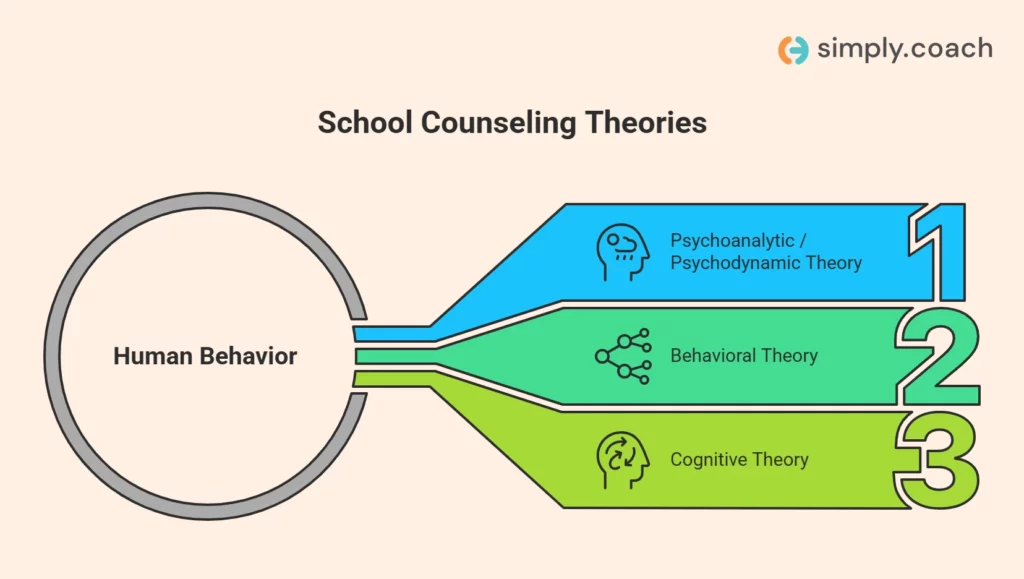
As a school counselor, your understanding of school counseling theories plays a critical role in how effectively you interpret student behavior and guide interventions. These theories provide more than abstract concepts, serving as practical frameworks that help counselors assess emotional patterns, identify underlying challenges, and design appropriate support strategies for students.
In modern school environments, counselors rarely rely on a single theoretical perspective. Instead, they often integrate insights from multiple approaches to address academic, behavioral, and emotional needs within a broader student support system.
When applied thoughtfully, counseling theories help you move beyond surface-level behaviors to understand the deeper cognitive, emotional, and environmental factors shaping a student’s experience.
Psychoanalytic/Psychodynamic theory
Psychoanalytic theory, pioneered by Sigmund Freud, explores the role of the unconscious mind in shaping human behavior. According to this perspective, many emotional difficulties and behavioral patterns originate from unresolved internal conflicts or early developmental experiences that influence how individuals interpret relationships and challenges.
In school counseling settings, psychodynamic insights can help explain patterns such as recurring anxiety, persistent behavioral responses, or strong emotional reactions to authority figures or peers.
While traditional psychoanalysis is less common in school environments due to time constraints, elements of the theory remain useful for recognizing deeper emotional dynamics influencing student behavior.
Techniques you can use:
- Free association: Encourage students to share thoughts freely without censorship. This can reveal underlying emotional themes or concerns that may not emerge through structured questioning.
- Dream analysis: While used selectively in school counseling, discussing dreams or symbolic experiences may provide insight into a student’s emotional state or internal conflicts.
- Transference: Recognizing when students project feelings associated with parents, teachers, or other authority figures onto the counselor can help uncover unresolved emotional dynamics influencing their responses in school.
Understanding these unconscious influences allows counselors to respond with greater empathy and awareness when addressing student behavior and emotional concerns.
Behavioral theory
Behavioral theory, developed through the work of Ivan Pavlov and later expanded by B.F. Skinner, focuses on the idea that behavior is learned through interaction with the environment. According to this framework, behaviors are shaped through conditioning, reinforcement, and consequences.
This approach is particularly valuable in school counseling because it translates easily into structured behavioral interventions, classroom management strategies, and school-wide support systems such as PBIS (Positive Behavioral Interventions and Supports).
Behavioral techniques help counselors work collaboratively with teachers and administrators to reinforce positive behaviors and reduce disruptive patterns.
Key concepts to apply:
- Classical conditioning (Pavlov): Help students associate positive outcomes with constructive behaviors or gradually reduce negative emotional responses through controlled exposure and reinforcement.
- Operant conditioning (Skinner): Reinforce desirable behaviors with recognition, rewards, or privileges while applying appropriate consequences to discourage negative behaviors.
When combined with goal-setting strategies and consistent reinforcement systems, behavioral interventions can significantly improve classroom engagement and student self-regulation.
Cognitive theory
Cognitive theory, developed by Aaron Beck, emphasizes how thought patterns influence emotional responses and behavior. From this perspective, difficulties such as anxiety, low self-esteem, or academic disengagement often stem from distorted or unhelpful thinking patterns.
For school counselors, cognitive theory provides a practical framework for helping students recognize how their beliefs and interpretations shape their experiences in school. By addressing these thought patterns, counselors can support students in developing healthier perspectives and stronger coping strategies.
Practical applications:
- Problem-solving strategies: Guide students through structured thinking processes that help them analyze challenges, identify options, and make constructive decisions.
- Cognitive restructuring: Teach students how to identify negative automatic thoughts and replace them with more balanced and realistic interpretations.
These strategies are particularly effective for students dealing with academic stress, social pressures, or self-doubt. Over time, helping students reshape their thinking patterns can improve both emotional well-being and academic engagement.
By integrating insights from psychodynamic, behavioral, and cognitive theories, school counselors gain a broader toolkit for understanding student behavior and tailoring interventions.
Rather than applying a single rigid framework, effective counseling practice often involves selecting elements from multiple theories to address the unique developmental, emotional, and environmental needs of each student.
These foundational theories continue to inform modern school counseling practices, providing a strong base for more integrative and student-centered approaches.
Humanistic and Person-Centered Approaches for School Counseling
Humanistic and person-centered approaches in school counseling emphasize the importance of creating an environment where students feel understood, respected, and capable of growth.
Rather than focusing solely on problems or behavioral correction, these approaches prioritize the student’s internal experience, helping them develop self-awareness, emotional resilience, and confidence in their ability to navigate challenges.
In school environments where students face academic pressure, social dynamics, and identity development, humanistic counseling frameworks can be particularly valuable. By emphasizing empathy, acceptance, and authentic communication, counselors can foster a safe space where students feel comfortable exploring their thoughts and emotions while developing stronger self-regulation and decision-making skills.
Carl Rogers’ client-centered therapy
Understanding and applying Carl Rogers’ client-centered therapy can provide school counselors with a compassionate framework for supporting student development. Rogers’ approach is grounded in the belief that individuals possess an inherent capacity for personal growth and self-actualization, provided they are supported within an environment of empathy, authenticity, and unconditional positive regard.
In school counseling settings, this means shifting the focus away from directive advice toward facilitating meaningful dialogue that allows students to explore their own experiences.
When students feel genuinely heard and understood, they are more likely to develop insight into their challenges and begin identifying constructive solutions themselves.
At the core of Rogers’ approach are three essential counselor attitudes:
- Empathy: The ability to deeply understand and reflect the student’s emotional experience.
- Congruence: Authenticity in the counselor’s responses and interactions.
- Unconditional positive regard: Accepting students without judgment, regardless of their struggles or behaviors.
Together, these elements create a therapeutic environment where students feel psychologically safe enough to examine difficult emotions and experiences.
Application in school counseling settings
Person-centered counseling translates effectively into daily school counseling practice, particularly when supporting students dealing with anxiety, peer conflicts, identity development, or academic pressure.
Empathetic understanding: By demonstrating genuine empathy and active listening, counselors help students feel valued and respected. This validation often reduces defensiveness and encourages students to engage more openly in conversations about their challenges.
Non-directive dialogue: Rather than immediately offering solutions, counselors allow students to guide the conversation. This approach encourages reflection and promotes autonomy, helping students build confidence in their ability to make thoughtful decisions.
Supporting social-emotional development: Person-centered approaches align closely with social-emotional learning (SEL) frameworks, which emphasize skills such as self-awareness, emotional regulation, and responsible decision-making.
By integrating these principles into counseling sessions, counselors can help students strengthen both emotional insight and interpersonal competence.
Exploring other humanistic approaches
In addition to Rogers’ work, several other humanistic therapies contribute valuable perspectives to school counseling practice. These approaches focus on present-moment awareness, personal responsibility, and meaning-making, concepts that are particularly relevant for adolescents navigating identity and life transitions.
Gestalt therapy: Gestalt therapy emphasizes awareness of present experiences—how students think, feel, and behave in the moment. In school counseling, this can help students become more conscious of emotional reactions during peer interactions, classroom situations, or moments of stress. By increasing awareness of these experiences, students can begin to understand how their thoughts and feelings influence behavior.
Existential therapy: Existential therapy explores deeper questions related to meaning, responsibility, and personal choice. While traditionally associated with adult counseling, elements of this approach can be powerful for older students who are beginning to explore identity, purpose, and future aspirations. Encouraging students to reflect on their values and decisions can strengthen their sense of agency and responsibility for their actions.
Humanistic approaches remain highly relevant in modern school counseling because they emphasize student voice, emotional safety, and authentic connection.
By combining empathy-driven dialogue with strategies that promote self-awareness and resilience, counselors can help students build the emotional foundation necessary for both academic success and long-term personal development.
Also read: How to Build an Effective Personal Development Coaching Program That Works
Contemporary and Integrative Approaches for School Counseling
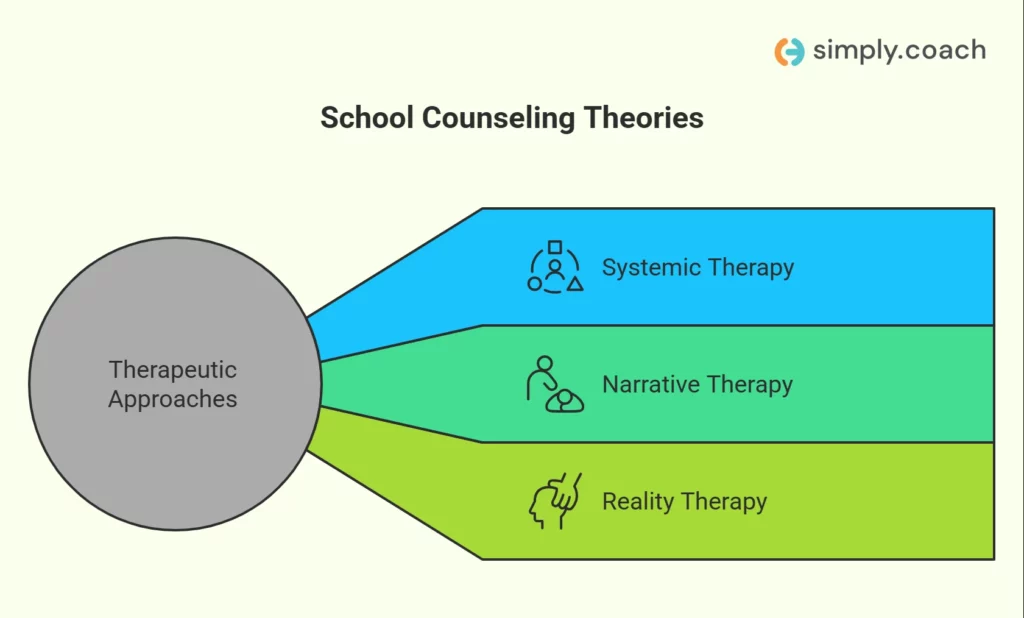
Contemporary and integrative approaches in school counseling recognize that student development is influenced by a complex interaction of personal, social, and environmental factors.
Rather than relying on a single theoretical model, these approaches combine insights from multiple counseling traditions to address the multifaceted challenges students face in modern school environments. Today’s school counselors often work within broader support systems that include teachers, families, administrators, and community resources.
Integrative counseling approaches help counselors examine how these systems influence student behavior, emotional well-being, and academic engagement, allowing interventions to address both individual needs and the wider context in which students develop.
Systemic therapy
Systemic therapy focuses on understanding the interconnected systems that shape a student’s experiences. These systems include family relationships, peer groups, classroom environments, and broader cultural influences. From a systemic perspective, a student’s behavior cannot be viewed in isolation, it often reflects patterns within the systems surrounding them.
In school counseling, systemic thinking helps counselors move beyond individual behavior and consider how family expectations, classroom dynamics, or social pressures may influence a student’s emotional responses and actions.
This perspective is particularly valuable when addressing recurring behavioral challenges, peer conflicts, or family-related stress.
Key techniques:
- Mapping family systems: Using tools such as genograms or eco-maps, counselors can visually explore family structures, relationships, and external influences affecting the student. These tools help identify patterns that may contribute to emotional or behavioral challenges.
- Circular questioning: Circular questions invite students to consider how different individuals in their lives perceive or respond to a situation. This technique encourages broader perspective-taking and often reveals relational patterns that may otherwise go unnoticed.
By understanding how different systems interact, counselors can develop more comprehensive interventions that involve collaboration with families, teachers, and support staff.
Narrative therapy
Narrative therapy encourages students to examine the stories they tell about themselves and their experiences. Many students develop limiting narratives based on academic struggles, social difficulties, or past experiences. These narratives can shape their identity and influence how they interpret new challenges.
Through narrative counseling techniques, students are guided to recognize that their problems do not define them. Instead, they can reinterpret their experiences and identify strengths that may have been overlooked.
Key techniques:
- Externalization: Externalization helps students separate themselves from their problems. For example, instead of saying “I am bad at school,” the problem can be reframed as “the challenge with concentration.” This shift reduces self-blame and allows students to approach the issue more constructively.
- Re-authoring: Re-authoring conversations help students reconstruct their personal narratives by identifying moments of resilience, competence, and growth. Highlighting these experiences strengthens students’ sense of agency and helps them develop more empowering self-perceptions.
Narrative therapy is particularly effective in school counseling when working with students struggling with self-esteem, identity development, or social challenges.
Reality therapy
Reality therapy, developed by William Glasser, focuses on personal responsibility, choice, and goal-oriented behavior. Rather than focusing primarily on past experiences, this approach emphasizes what students can do in the present to improve their circumstances.
In school counseling contexts, reality therapy helps students recognize the connection between their behaviors, choices, and outcomes. By focusing on practical decision-making, counselors can help students develop stronger self-regulation skills and greater ownership of their actions.
Key techniques:
WDEP system: The WDEP framework (Wants, Doing, Evaluation, Planning) provides a structured method for guiding counseling conversations:
- Wants: What does the student want to achieve?
- Doing: What actions are they currently taking?
- Evaluation: Are these actions helping them reach their goals?
- Planning: What changes can they make moving forward?
This framework helps students reflect on their behavior and identify realistic steps toward improvement.
Success identity: Reality therapy also focuses on helping students build a success identity, a sense that they are capable of making positive choices and influencing their outcomes. Achieving small, attainable goals can reinforce this belief and motivate continued effort.
By integrating systemic, narrative, and reality-based approaches, school counselors gain a broader set of tools for supporting students in complex environments.
These contemporary frameworks help counselors address not only individual emotional challenges but also the relational and social contexts that shape student behavior and well-being.
Also read:Coaching the Growth Mindset: A Mindful Approach to Unlocking Leadership Potential
Application of Counseling Theories in School Settings
As a school counselor, integrating counseling theories into daily practice allows you to move beyond abstract concepts and apply structured approaches to real student challenges.
These theories provide a foundation for understanding how students think, behave, and respond to their environments, helping counselors design interventions that support both emotional well-being and academic development.
In practice, effective school counseling rarely relies on a single theoretical framework. Instead, counselors often combine elements from behavioral, cognitive, humanistic, and systemic approaches to respond to the diverse needs of students.
By translating theory into practical strategies, you can create counseling interventions that are both developmentally appropriate and aligned with broader school support systems.
Here are several ways counseling theories can be applied effectively in school environments:
1. Addressing underlying issues: Use theoretical frameworks to explore the deeper factors influencing student behavior. This may involve examining family dynamics, academic pressures, peer relationships, or unresolved emotional conflicts. Understanding these influences allows counselors to move beyond surface-level behaviors and guide students toward more meaningful change.
2. Creating a supportive environment: Establish a counseling space built on trust, empathy, and psychological safety. Humanistic approaches emphasize the importance of allowing students to feel heard and accepted, which encourages open dialogue and supports emotional development.
3. Empowering personal narratives: Drawing from narrative therapy principles, counselors can help students reshape how they interpret their experiences. Encouraging students to recognize resilience, strengths, and past successes can strengthen their self-confidence and foster a more constructive self-image.
4. Coordinated support across the school system: Systemic counseling approaches highlight the importance of collaboration. Working closely with teachers, administrators, and families allows counselors to create a more comprehensive support network that addresses academic, emotional, and social challenges simultaneously.
5. Skill-building workshops and group counseling: School counselors often facilitate workshops or group sessions that help students develop practical life skills. These may include stress management, conflict resolution, emotional regulation, and decision-making. These are skills that contribute to both academic performance and personal well-being.
6. Goal setting and structured planning: Behavioral and cognitive counseling approaches can help students set realistic goals and develop actionable plans to achieve them. Teaching students how to break larger challenges into manageable steps strengthens problem-solving abilities and encourages personal accountability.
7. Enhancing social and interpersonal skills: Through guided discussions and group counseling activities, counselors can help students develop stronger communication skills, empathy, and collaboration. These skills play a crucial role in helping students navigate peer relationships and classroom interactions.
You may also find this resource helpful: Integrating Technology into the School Guidance Counselor Role, which explores how digital tools can support counseling interventions and student engagement.
By applying counseling theories through these practical strategies, school counselors can create interventions that support the student academically, socially, and emotionally.
This holistic approach not only helps students overcome current challenges but also equips them with the resilience and skills needed to navigate future transitions.
Case Studies and Real-world Applications of Counseling Theories
As you continue to refine your skills in school counseling, examining real-world case studies can be incredibly valuable. While counseling theories provide essential frameworks, practical application often requires adapting those theories to the unique emotional, social, and academic contexts students face.
Real-world examples allow counselors to see how different theoretical approaches can be applied to everyday challenges in schools, ranging from academic anxiety and behavioral concerns to peer conflicts and family-related stress. Studying these cases can help counselors develop stronger clinical judgment and expand the range of strategies they use to support students effectively.
Below are a few examples that illustrate how counseling theories can translate into practical school interventions:
Case example: Supporting a student with academic anxiety
A middle school student repeatedly avoids participating in class discussions and reports feeling overwhelmed before exams. The counselor identifies patterns of negative self-talk and catastrophic thinking about academic performance.
Using cognitive counseling techniques, the counselor helps the student identify distorted thoughts such as “If I fail one test, my future is ruined.” Through cognitive restructuring exercises, the student learns to challenge these beliefs and replace them with more balanced thinking patterns.
The counselor also introduces structured study planning and small performance goals to help the student gradually rebuild academic confidence.
Case example: Addressing behavioral challenges in the classroom
A student frequently disrupts class and receives repeated disciplinary referrals. Instead of focusing solely on the behavior itself, the counselor uses behavioral theory principles to examine the environmental factors reinforcing the behavior.
Through collaboration with teachers, the counselor introduces a positive reinforcement system that rewards constructive classroom participation. Over time, the student begins associating positive attention and recognition with appropriate classroom behavior, leading to measurable improvements.
Case example: Strengthening student identity and confidence
A high school student expresses feelings of isolation and low self-esteem following peer conflicts. The counselor applies narrative therapy techniques, encouraging the student to reflect on personal strengths and moments of resilience that had previously been overlooked.
Through re-authoring conversations, the student begins to reinterpret their experiences and recognize positive qualities such as leadership, empathy, and persistence. This shift in personal narrative helps improve the student’s self-confidence and willingness to engage with peers.
Recommended case study resources for school counselors
In addition to practical counseling experience, reviewing structured case studies can further strengthen your counseling practice. The following resources offer deeper insights into applying counseling theories in school environments.
- Contemporary case studies in school counseling: This collection explores real scenarios that school counselors frequently encounter. The cases highlight both the challenges and strategies used to support students, providing valuable perspectives on how counseling theories can be adapted to real educational environments.
- Child and adolescent counseling case studies: This resource focuses specifically on counseling interventions for children and adolescents in school contexts. It includes examples addressing academic stress, emotional development, family dynamics, and social challenges, demonstrating how different therapeutic approaches can be implemented effectively.
Examining real-world applications of counseling theories not only strengthens theoretical understanding but also enhances practical counseling skills.
By analyzing these examples and reflecting on similar situations in your own practice, you can continue refining your approach to support students’ emotional well-being, academic development, and long-term resilience.
How Simply.Coach Supports Structured School Counseling Programs
Applying school counseling theories effectively often involves more than conducting individual conversations with students. Counselors frequently manage multiple responsibilities at once, tracking student goals, documenting session reflections, coordinating with educators or families, and monitoring progress across several counseling sessions.
When these insights are scattered across notebooks, spreadsheets, or disconnected tools, it becomes difficult to maintain a clear view of a student’s development over time.
Simply.Coach, the leading digital coaching platform, helps counselors manage student counseling journeys in a more structured and organized way. By centralizing session documentation, progress tracking, and engagement management, the platform allows counselors to focus on meaningful student interactions while maintaining clear visibility into student growth and outcomes.
Key features that support structured counseling programs include:
- Client workspaces → Maintain a dedicated workspace for each student where session notes, reflections, shared resources, and progress updates can be stored and reviewed across sessions.
- Goal and progress tracking → Define developmental or behavioral goals and monitor student progress over time, helping ensure counseling sessions remain focused on meaningful outcomes.
- Action plans → Translate counseling insights into clear next steps, allowing counselors to track how students apply coping strategies or behavioral changes between sessions.
- Forms and reflection tools → Use built-in forms and questionnaires to gather reflections, assessments, or feedback before or after sessions, supporting more structured counseling documentation.
- Integrated scheduling → Manage session bookings, reminders, and calendar coordination while keeping counseling engagements organized in one place.
- Session and engagement management → Organize one-to-one counseling sessions, small group counseling programs, or broader student support initiatives while keeping all session records connected.
By bringing session documentation, student goals, reflections, and action plans into one structured environment, Simply.Coach helps counselors maintain organized counseling programs and track student development more effectively over time.
Conclusion
School counseling theories provide a foundation for understanding student behavior, emotional development, and the complex social environments students navigate every day. By drawing on approaches such as cognitive, behavioral, humanistic, and systemic counseling, school counselors can design interventions that support both immediate student concerns and long-term personal growth.
At the same time, effective counseling programs require more than thoughtful conversations. Tracking student progress, documenting session insights, and coordinating support across multiple interactions are essential parts of professional practice. Simply.Coach, the leading digital coaching platform, helps counselors keep session notes, goals, reflections, and action plans organized in one place—making it easier to manage structured counseling programs while focusing on meaningful student development.
See how Simply.Coach fits your practice.
FAQs
1. What theories do school counselors commonly use?
School counselors often draw from several counseling theories depending on student needs and the context of the issue. Common approaches include cognitive behavioral theory, person-centered therapy, behavioral theory, systemic counseling, narrative therapy, and reality therapy. Rather than relying on a single framework, many counselors use an integrative approach, combining techniques from multiple theories to address academic, emotional, and social challenges.
2. What are the five major theories of counseling used in schools?
While different sources categorize counseling theories differently, five widely used frameworks in school counseling include:
- Psychodynamic theory – explores unconscious influences on behavior
- Behavioral theory – focuses on learned behaviors and reinforcement
- Cognitive theory – addresses thought patterns that influence emotions and behavior
- Humanistic/person-centered theory – emphasizes empathy, self-awareness, and growth
- Systemic theory – examines family, school, and social systems affecting students
Together, these approaches provide counselors with diverse strategies for supporting student development.
3. What are the six major counseling theories?
Many counseling programs identify six major theoretical traditions that influence modern practice:
- Psychodynamic theory
- Behavioral theory
- Cognitive theory
- Humanistic theory
- Existential theory
- Systemic or family systems theory
School counselors often adapt concepts from several of these frameworks to address students’ emotional, social, and academic concerns.
4. What are the four pillars of school counseling?
The four pillars of school counseling often align with the framework promoted by the ASCA National Model (American School Counselor Association). These pillars focus on supporting students in four key developmental areas:
- Academic development
- Career development
- Social development
- Emotional development
School counseling theories and interventions are typically applied within these domains to help students succeed both inside and outside the classroom.
5. Are there frameworks or models that guide school counseling practice?
Yes. In addition to counseling theories, many schools use structured models to guide counseling programs. Examples include the ASCA National Model, multi-tiered systems of support (MTSS), and social-emotional learning (SEL) frameworks. These models help counselors apply theoretical approaches within organized support systems that address prevention, intervention, and student development.
6. How do school counselors choose the right theory for a student?
Counselors typically select theoretical approaches based on factors such as the student’s developmental stage, presenting challenges, family context, and school environment. For example, cognitive approaches may be effective for addressing anxiety or negative thinking patterns, while behavioral strategies may be used for classroom behavior concerns. Experienced counselors often combine multiple frameworks to create interventions tailored to each student.
7. Where can counselors find resources or charts explaining school counseling theories?
Many counselor training programs and professional organizations provide school counseling theory charts, guides, and downloadable resources that summarize key theorists, principles, and techniques. These resources help practitioners compare frameworks such as cognitive, behavioral, and humanistic counseling and understand how each approach can be applied in educational settings.