
Have you ever had a potential client ask you, “So, are you a personal coach or a life coach?” and found yourself struggling to give a clear answer? This is a common issue many coaches face. It can be difficult to define your role when the lines between personal coaching and life coaching are often blurry. When your services aren’t clearly defined, it’s harder for potential clients to understand exactly what you offer.
Getting this right is crucial for your coaching business. When you have a clear definition of your coaching style, you stand out in a crowded market. It becomes easier to attract the right clients, those who resonate with your approach and are more likely to trust you. A well-defined coaching role also helps you get better referrals, as your current clients will be able to explain exactly what you do to others.
In this post, you’ll get a clear, simple guide to understanding the key differences between personal coach vs life coach. We’ll help you decide which path, personal coaching or life coaching, aligns with your strengths and your business goals. By the end, you’ll know how to position yourself in a way that attracts your ideal clients, allowing you to work more efficiently and grow your practice with confidence.
Key Takeaways
- Life coaches focus on holistic life transformation, helping clients achieve long-term goals like happiness, life purpose, and balance.
- Personal coaches specialize in helping clients achieve specific, measurable goals like career advancement, skill improvement, or business growth.
- Life coaching is often a long-term journey, while personal coaching focuses on short-term, specific results.
- Both coaching paths require a clear niche to attract the right clients and grow your practice effectively.
- Defining your coaching role helps potential clients easily find and trust you, leading to better client engagement and referrals.
- Understanding whether you’re a life coach or a personal coach helps tailor your approach, marketing, and client relationships.
- Choosing your coaching path is crucial for positioning yourself as a specialist and standing out in the coaching market.
Understanding the Role of a Life Coach
As a life coach, you work with clients to improve their overall life. Your focus is on helping them achieve big-picture goals like happiness, life purpose, and personal balance. Rather than diving into specific tasks or skills, you guide clients through the process of creating a fulfilling life across all areas.
What does a life coach do?
As a life coach you help clients identify and achieve their goals by providing guidance and support by assisting them in a variety of areas, including careers, relationships, and personal development. You support clients who may be experiencing uncertainty or feeling stuck by helping them get over their problems such as:
- “I feel stuck, but I’m not sure why.”
- “I want to be happier but don’t know where to start.”
- “My career is good, but my relationships are a mess.”
In these cases your role is to help these clients understand the deeper issues affecting their lives and assist them in moving forward. The work you do is all about helping them rediscover their sense of purpose and find balance in their personal and professional lives.
Read to know in detail What Is Life Coaching and What Does a Life Coach Do?
What happens during a life coaching session?
In your sessions, you focus on uncovering your client’s core values, long-term goals, and the vision they have for their future. You guide them to explore areas like their motivations, relationships, and emotional well-being. Your life coaching sessions aim for long-term transformation, not just quick fixes. You help clients shift their mindset and set the stage for sustainable personal growth.
Who do life coaches work with?
You typically work with clients (such as individuals, professionals, students, families/couples) who are going through significant life transitions, such as changing careers, academic stress, experiencing a breakup, or dealing with personal loss. You also help individuals who seek holistic improvement in their lives, such as achieving better work-life balance or finding more purpose in everyday activities.
Example: Imagine you’re working with a client who feels lost after a job change. They feel disconnected from their purpose and unsure of their next steps. You, as a life coach, would help this client rediscover their purpose, set clear and meaningful goals, and create a path to restore balance in their life, both personally and professionally.
Take your life coaching journey to the next level
If you’re ready to deepen your skills and expand your practice as a life coach, Simply.Coach offers a Life Coaching Track designed to guide you through the essential steps of becoming a successful life coach. This track includes actionable content to help you:Fully understand the professionGet certified as a life coachStart your life coaching businessGet clients and growBe a better life coachEquip yourself with tools & technologyThis guided path will equip you to provide the best service to your clients while growing your coaching business.

Understanding the Role of a Personal Coach
As a personal coach, your role is to help clients achieve specific, measurable goals. Whether it’s improving a skill, advancing in their career, or reaching a business milestone, you guide them through a clear path to success. The value you provide lies in your ability to create actionable plans and keep clients accountable for results.
What does a personal coach do?
As a personal coach, you work with clients who already have a defined goal in mind. These clients come to you for direction, support, and strategy. They might approach you saying things like:
- “I need to give a great presentation next month.”
- “I want to be a better leader at my company.”
- “I’m starting a business and need a plan.”
Your role is to help them develop a clear, actionable strategy that breaks down these goals into small, achievable steps. You’ll provide the structure and encouragement needed to ensure they stay focused on the end result.
Also read: Goal Setting in Coaching: How to Help Clients Set Goals They Can Achieve
What happens during a personal coaching session?
A personal coaching session is all about action. It’s about setting clear, tangible goals, breaking them down into smaller tasks, and measuring progress. You create a step-by-step plan that keeps your client moving forward. You’ll hold them accountable and ensure they are on track with every milestone.
The sessions aren’t just about talking, they’re about getting things done. Whether your client is preparing for an important presentation or working to grow their business, each session is structured to drive results. The focus is short-term and specific, with a clear path to completion.
Who do personal coaches work with?
You typically work with clients who have a clear vision of what they want to achieve. These clients are focused and ready to act, but they need someone to help them execute their plans. They know the “what” but need your expertise to figure out the “how.”
Personal coaches help clients who may be:
- Looking to advance their career and need a solid action plan.
- Starting or growing a business which requires a structured approach to achieving key milestones.
- Seeking to enhance a specific skill, such as public speaking, leadership, or time management.
Example: Let’s say you’re working with a startup owner who is trying to develop a sales strategy. They have great ideas but need structure. As a personal coach, you help them break their goal into manageable pieces:
- Define target markets
- Create a customer outreach plan
- Develop a sales script
- Set sales goals and track progress
By the end of the coaching sessions, they not only have a clear sales strategy but also the confidence to execute it. Your structured approach directly impacts their success.
Understanding the Key Differences Between Life Coaching and Personal Coaching
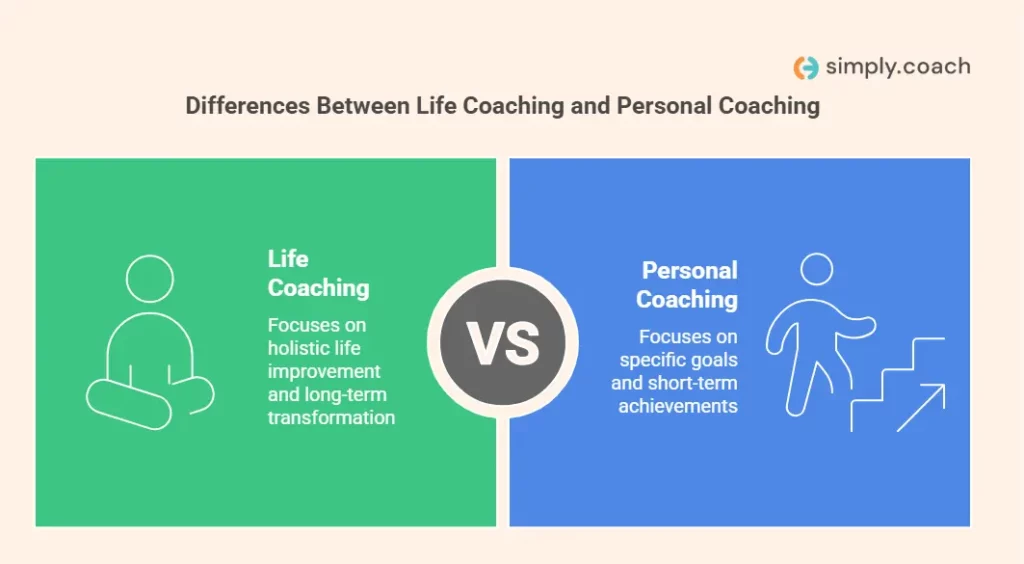
As a coach, understanding the distinction between life coaching and personal coaching is essential for defining your expertise and attracting the right clients. Whether you focus on holistic life transformation or guiding clients to achieve a specific goal, this comparison will help you clearly identify where you can make the most impact in your practice. Let’s break down the critical differences, so you can confidently choose your path.
| Aspect | Life Coach | Personal Coach |
| Focus | A comprehensive approach to overall life improvement | A targeted approach focused on specific goals |
| Goal | Happiness, balance, finding life purpose, personal growth | Achieving specific results like career promotions or skill improvements |
| How they work | Explore feelings, beliefs, long-term vision, and mindset | Create actionable steps, set clear objectives, and track progress |
| Timeline | Long-term journey (could last months or years) | Short-term project (typically weeks to months) |
| Client engagement | Help clients see the big picture of their life and future | Help clients reach a specific milestone (like completing a project) |
| Scope of coaching | Holistic, focusing on multiple areas of life (career, relationships, health) | Specific and goal-oriented (e.g., leadership, confidence, business growth) |
| Client type | Individuals seeking deep, transformative change, dealing with life transitions | Individuals with clear goals, often career-driven or skill-based |
| Approach | Supportive, empathetic, focus on mindset and beliefs | Action-oriented, structured, results-focused |
| Techniques used | Guided self-discovery, deep questioning, long-term planning | Goal setting, time management, skill development |
| Typical sessions | Focus on reflection and personal growth | Focus on strategy and practical steps |
| Typical outcomes | Improved overall well-being, life satisfaction, personal fulfillment | Achievement of specific goals (e.g., business launch, public speaking confidence) |
| Tools and resources | Journals, meditation, life vision tools, motivational practices | Action plans, progress trackers, performance metrics |
| Common challenges faced | Overcoming self-doubt, finding purpose, work-life balance | Lack of clarity, procrastination, focus on results |
| Ideal clients | People in life transitions or looking for long-term personal growth | Individuals looking to accomplish a specific goal in a short time |
Key insight:
- A life coach is to help clients navigate big-picture challenges and explore long-term goals. You guide them through holistic changes and transformations in their personal and professional lives. The focus is often on their overall well-being and future vision.
- A personal coach is to help clients achieve specific, measurable outcomes within a defined period. You focus on creating action plans that lead to achieving a particular result, like career advancement or skill mastery.
Also read: Steps in the Coaching Process for Effective Outcomes
Why Defining Your Coaching Niche Is Crucial for Business Growth
Clarifying whether you’re a life coach or a personal coach is key to building a successful coaching practice. Defining your role clearly will help you stand out, attract the right clients, and build trust. By focusing on your specific strengths, you can tailor your services to meet client expectations and grow your business with a targeted approach.
Why this matters
When potential clients search for coaches, they do so with specific needs in mind. If your role isn’t clear, you may lose out on clients who need exactly what you offer. Here’s how defining your coaching path can make a difference:
- “Career coach” or “leadership coach” = personal coach
- “How to find purpose” or “improve my life balance” = life coach
Your clients are looking for specialized guidance, and when you can clearly define your niche, you increase your chances of being found online. When clients know exactly what you offer, they’re more likely to trust you and take the next step toward booking your services.
Read more on Why You Should Choose a Coaching Niche
How to choose your coaching path
To determine if you’re a personal coach or a life coach, ask yourself a few simple questions:
- Do you love helping people achieve specific, measurable outcomes, like boosting leadership skills, improving time management, or growing a business? If so, you’re likely a personal coach.
- Do you thrive in helping people discover purpose, restore balance, and create a fulfilling life across multiple areas like relationships, career, and health? Then, you’re probably a life coach.
This distinction is crucial, as it shapes how you approach your clients, market your services, and structure your coaching programs.
Next steps for defining your coaching role

Once you’ve decided which path aligns with your skills and passion, it’s time to take action. Here are some steps to refine your coaching practice and attract the right clients:
- Update your website: Make sure your website clearly communicates what you do. Use specific language that defines whether you’re a life coach or a personal coach. Clients want clarity, and a well-defined service offering increases the likelihood they will engage.
- Create a clear bio: Write a concise bio that highlights who you help and the specific outcomes they can expect from working with you. A bio that clearly outlines your expertise and approach builds trust and credibility with potential clients.
- Stop confusing people: A simple, direct message helps establish trust. Clients are more likely to choose a coach who has a clear and consistent message, as it helps them immediately understand how you can help them solve their challenges.
Also read: How to Write a Compelling Coaching Bio (+ Examples and Tips)
Conclusion
To conclude, understanding the differences between personal coach vs life coach is essential for clearly defining your coaching niche. Whether you specialize in life coaching, focusing on holistic transformations and long-term goals, or as a personal coach, helping clients achieve specific, measurable outcomes, knowing your role will help you attract the right clients. A well-defined approach allows you to offer targeted services that directly address the unique needs of your clients.
If you’re looking to enhance your coaching practice, Simply.Coach provides a tailored platform for both life coaches and personal coaches. With Simply.Coach, you can streamline client management, track goals, automate reminders, and access valuable insights to improve client engagement. Whether you’re working on holistic life transformations or helping clients hit specific milestones, Simply.Coach is designed to support your success every step of the way.
FAQs
1. What is the main difference between a life coach and a personal coach?
A life coach focuses on holistic personal development, helping clients achieve long-term life satisfaction. A personal coach specializes in guiding clients to achieve specific, measurable goals, often within a defined timeframe.
2. Can a life coach assist with career-related goals?
Yes, many life coaches specialize in career coaching, helping clients navigate career transitions, set professional goals, and improve work-life balance. Their approach is holistic, considering personal values and long-term aspirations.
3. Is personal coaching suitable for someone looking to improve a specific skill?
Absolutely. Personal coaching is ideal for individuals aiming to enhance specific skills, such as public speaking or time management, by creating targeted action plans and providing accountability.
4. Do life coaches provide therapy or counseling services?
No, life coaches do not offer therapy or counseling. They focus on helping clients set and achieve personal or professional goals. For mental health issues, it’s advisable to consult a licensed therapist or counselor.
5. Can someone be both a life coach and a personal coach?
Yes, many coaches choose to specialize in both areas, offering a comprehensive approach that addresses both holistic personal development and specific goal achievement.
6. How do I choose between a life coach and a personal coach?
Consider your goals: choose a life coach if you’re seeking overall personal growth and fulfillment, and a personal coach if you have specific, measurable objectives you wish to achieve.