
Professional coaches may follow similar best practices, but the coaching process itself rarely looks identical from one engagement to another. Each client brings different goals, motivations and challenges, so coaches balance structured methods with the flexibility to adapt in real time. For practitioners moving from academic training into real-world coaching, that shift from theory to guiding client-centered change is significant.
A well-defined coaching process provides the structure that keeps coaching engagements focused and measurable. It helps coaches clarify goals, guide reflective conversations, track progress, and maintain accountability across multiple sessions. Below, you will see how the professional coaching process works, the stages that guide an engagement and when to let intuition lead.
TL;DR
The coaching process is the structured sequence a coach and client follow to turn reflection into measurable progress. Most engagements move through seven stages: a discovery conversation, goal clarification, understanding the client’s current reality, exploring options, action planning, implementation with accountability between sessions, and a review of what has changed. The structure keeps sessions purposeful and progress visible across weeks, while intuition tells the coach when to slow down, explore an emerging insight or adjust the plan. New coaches benefit from following the stages closely; experienced coaches use the same structure as a flexible guide. Tracking goals, notes and actions in one place makes each review faster and keeps the engagement aligned with what the client wanted at the start.
Why Following a Coaching Process Is Essential
Experienced coaches rarely approach sessions as a rigid sequence of steps. Over time, many develop their own rhythm, drawing on intuition, experience, and the nuances of each client’s situation.
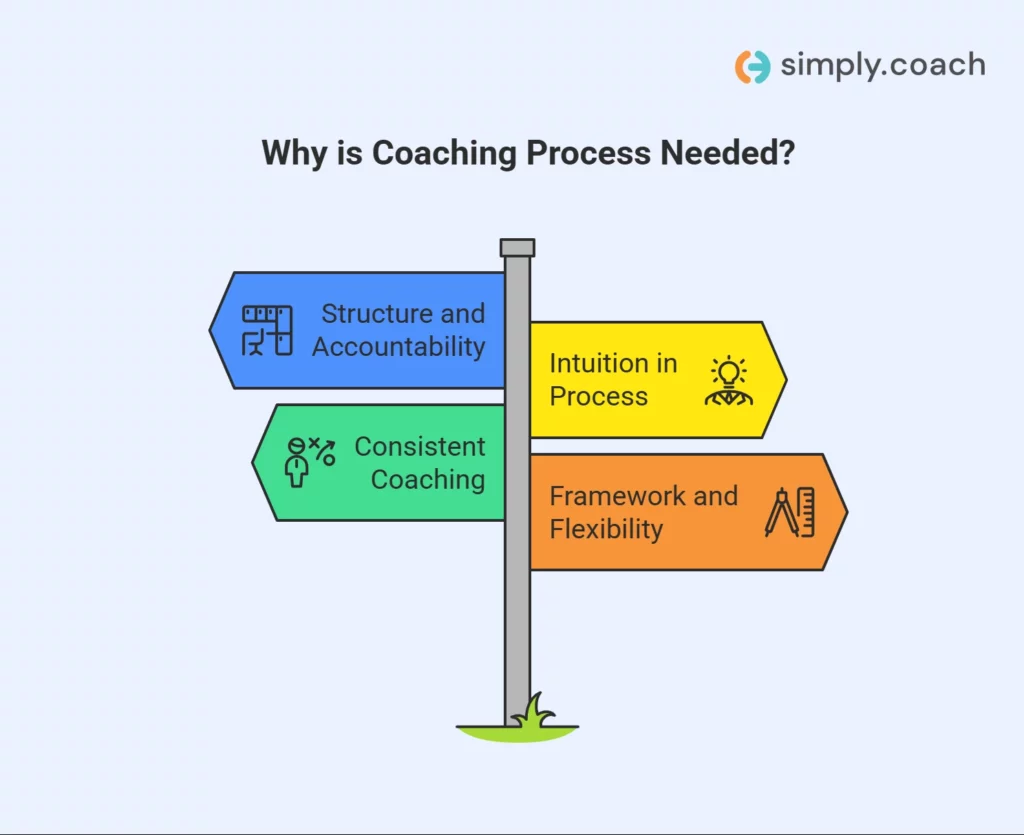
Yet even the most adaptive coaching styles tend to rely on a core process that anchors the engagement. Without that structural backbone, coaching risks becoming a series of insightful conversations that never translate into measurable change.
A defined coaching process provides what many practitioners describe as the “spine” of the engagement. It creates continuity across sessions, ensuring that conversations move from exploration to insight and eventually to action.
While the specific tools or models may differ, from GROW or CLEAR to a coach’s own customized framework, most effective coaching processes share common elements: clarifying goals, examining the client’s current reality, identifying options, and translating insights into practical commitments.
1. Structure creates direction and accountability
For clients, a coaching process offers clarity. It signals that the engagement is not simply reflective dialogue but a structured path toward specific outcomes. By establishing a clear progression, from discovery and goal-setting to action and review, coaches help clients understand how each session contributes to their broader development.
This structure also supports accountability. When a process is in place, progress can be tracked across sessions rather than relying on memory or loosely defined intentions.
2. Process enables intuition to work effectively
Interestingly, having a structured framework often makes it easier for intuition to play a role in coaching. When the overall direction of the engagement is clear, coaches can focus their attention on the subtleties of the conversation, including tone, hesitation, emotional shifts, or emerging patterns in the client’s thinking.
In these moments, intuition acts as a guide within the broader process. A coach may choose to explore a topic more deeply, shift the focus of a session, or challenge an assumption that surfaces unexpectedly. The underlying framework ensures that even these intuitive adjustments remain connected to the client’s long-term objectives.
3. A process creates consistency without rigidity
Another advantage of a defined coaching process is that it allows coaches to maintain consistency while still adapting to individual clients. No two engagements unfold in exactly the same way. Some clients move quickly from insight to action, while others require extended reflection before committing to change.
A well-designed process accommodates these differences. It offers shared principles and stages, while leaving space for coaches to adjust the pacing, questions, and interventions based on the client’s needs.
4. Balancing framework and flexibility
Ultimately, the most effective coaching practices strike a balance between structured methodology and responsive intuition. The framework provides direction and accountability, while intuition helps the coach recognize when to pause, probe deeper, or shift the conversation.
For new practitioners, learning to follow a coaching process builds confidence and clarity. For experienced coaches, that same structure becomes a flexible guide, supporting conversations that are both intentional and responsive to the complexity of real client engagements.
The Coaching Process: Structure Behind Effective Counseling
For practitioners moving from academic training into real-world practice, one of the most important realizations is that effective coaching or counseling rarely unfolds as an unstructured conversation. While each client engagement evolves differently, experienced professionals rely on a clear coaching process that helps move clients from reflection to meaningful change.
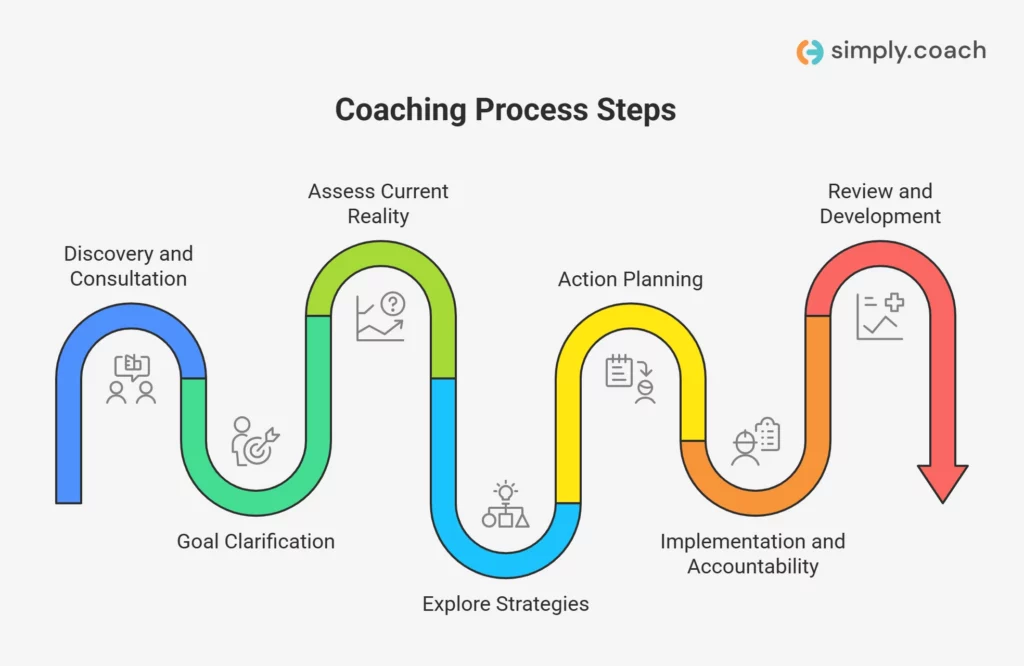
A structured process ensures that each session contributes to a broader plan for development rather than becoming a series of disconnected conversations. It also helps practitioners maintain focus, track progress, and guide clients toward outcomes that matter to them.
Below is a common step-by-step structure that many professional coaches and counselors adapt in their practice. The table gives the seven stages at a glance before each one is explained.
| Stage | What happens | What it produces |
|---|---|---|
| 1. Discovery | Coach and client test the fit and agree how the work will run | Agreed scope, confidentiality and expectations |
| 2. Goal clarification | Broad aims become specific outcomes | Goals that can be measured over time |
| 3. Current reality | Habits, beliefs and circumstances are explored | A clear starting point |
| 4. Options | The client generates possible strategies | Choices the client owns |
| 5. Action planning | Insights become concrete steps | Commitments with dates |
| 6. Implementation | The client acts between sessions and reports back | Momentum and lessons from practice |
| 7. Review | Coach and client look at what changed | Progress against the goals and next areas to develop |
1. Discovery and initial consultation
The coaching process typically begins with an initial conversation where the practitioner and client explore whether the engagement is the right fit. This stage helps clarify the client’s goals, expectations, and the areas they want to work on.
During this stage, practitioners may:
- discuss the client’s current challenges or aspirations
- explain the scope and structure of the coaching engagement
- establish expectations around confidentiality, communication, and outcomes
This step lays the foundation for a productive coaching relationship.
2. Goal clarification
Once the engagement begins, the next step involves defining clear and meaningful goals. Rather than focusing only on broad ambitions, practitioners help clients translate their aspirations into outcomes that can be explored and measured over time.
For example, a client may initially say they want to “become a better leader.” Through structured discussion, this might evolve into goals such as improving communication with team members or managing workplace stress more effectively.
Clear goals provide direction for the coaching process. Writing them into a coaching outcome template at the start gives you a fixed point to review against later.
3. Understanding the client’s current reality
After establishing goals, the practitioner works with the client to explore their current situation. This stage involves identifying behaviors, beliefs, or environmental factors that influence the client’s ability to achieve their objectives.
Common areas explored during this phase include:
- current habits or patterns affecting the client’s situation
- internal beliefs or assumptions shaping decision-making
- external circumstances influencing progress
Understanding the client’s present reality allows practitioners to identify where meaningful change can occur.
4. Exploring options and strategies
With greater clarity about the client’s situation, the next step involves exploring potential strategies or new perspectives. Rather than prescribing solutions, practitioners guide clients in generating their own ideas and possibilities.
This stage encourages clients to consider:
- alternative approaches to existing challenges
- new behaviors that could support their goals
- resources or support systems available to them
By actively participating in this process, clients develop greater ownership of their decisions.
5. Action planning
Once potential strategies have been identified, the practitioner and client translate insights into specific action steps. These actions should be realistic, achievable, and connected to the client’s broader goals.
Examples may include:
- practicing a new communication approach at work
- applying a stress management technique in daily routines
- scheduling conversations or activities that support the client’s progress
Clear action plans help ensure that insights from coaching sessions lead to practical change.

6. Implementation and accountability
Between sessions, clients begin implementing the agreed-upon actions in their daily lives. During this phase, the practitioner is central to maintaining accountability and supporting reflection.
Follow-up discussions often explore:
- what worked well and what felt challenging
- new insights that emerged from applying the actions
- adjustments needed for future steps
This stage helps maintain momentum throughout the coaching engagement.
7. Review and continuous development
The final stage of the coaching process involves reviewing the client’s progress and reflecting on what has been learned. This review may happen periodically during the engagement or at its conclusion.
Together, the practitioner and client evaluate:
- how the client’s situation has evolved
- which strategies proved most effective
- what future development areas the client may want to explore
For many clients, this stage marks the transition from guided coaching to ongoing personal or professional growth. The review is quicker when goals, notes and actions sit in one dated record, which is the job of coaching tracking tools.
While each practitioner adapts the process to their own style and client needs, following a structured sequence like this helps ensure that coaching conversations remain focused, intentional, and outcome-oriented. The same seven stages are the backbone of any personal development coaching program you design.
When to Follow the Coaching Process, and When to Trust Your Intuition
Even the most carefully designed coaching process cannot anticipate every direction a conversation may take. Clients bring evolving emotions, new insights, and unexpected challenges into each session.
As a result, coaches often need to decide whether to continue moving through the structured stages of the process or pause to explore an emerging issue more deeply. For practitioners early in their careers, following the coaching process closely helps maintain clarity and ensures that sessions move toward defined goals.
However, as experience grows, coaches learn that effective sessions sometimes require adjusting the pace or focus of the conversation. The key is recognizing when structure should lead the session and when professional intuition should guide it.
1. When it’s best to follow the coaching process
There are many situations where adhering to the structured coaching process helps maintain focus and accountability.
- When goals need clarification: Early in an engagement, clients may struggle to articulate what they want to achieve. Following the process ensures that sufficient time is spent defining clear goals before moving into deeper exploration.
- When sessions risk becoming unfocused conversations: Clients sometimes bring multiple concerns into a session. The coaching framework helps keep the discussion aligned with the client’s priorities and long-term objectives.
- When tracking measurable progress is important: A structured process makes it easier to review progress, revisit previous commitments, and evaluate how the client’s situation is evolving across sessions.
- When working with clients who prefer clear guidance: Some clients feel more comfortable when sessions follow a predictable structure, helping them understand how each conversation contributes to their development.
In these situations, the coaching process provides the discipline and direction needed to sustain progress.
2. When intuition should guide the conversation
At other times, experienced coaches recognize signals that suggest the conversation may benefit from a more exploratory approach.
- When an unexpected insight emerges: Clients may reveal new perspectives or realizations that were not part of the original session plan. Exploring these insights can deepen self-awareness and lead to more meaningful change.
- When emotional barriers appear: A client may struggle to move forward with action steps due to fear, doubt, or unresolved experiences. In such cases, spending additional time understanding the emotional context may be more valuable than immediately progressing to the next stage.
- When recurring patterns become visible: As conversations unfold, coaches may notice repeated behaviors or assumptions that influence the client’s decisions. Intuition can guide the coach to pause and examine these patterns more closely.
- When the client’s priorities shift during the session: Clients sometimes arrive with new developments that require immediate attention. Allowing the session to adapt ensures that coaching remains relevant to the client’s current reality.
These moments often represent opportunities where deeper reflection can lead to more meaningful progress than strictly following the planned sequence.
3. Integrating both approaches
Rather than viewing structure and intuition as opposing forces, effective coaching integrates both. The coaching process provides the overall direction of the engagement, ensuring that conversations ultimately lead to insight, action, and measurable outcomes.
Intuition, on the other hand, allows the coach to respond thoughtfully to the complexity of each client’s experience.
Over time, practitioners develop the ability to move fluidly between these approaches, using the coaching process to maintain momentum while allowing intuition to guide deeper exploration when the moment calls for it. That balance matters most in growth mindset coaching, where the structure keeps the work moving and intuition finds the beliefs behind it.
How Simply.Coach Supports a Structured Coaching Process
Following a professional coaching process often involves more than guiding meaningful conversations during sessions. Coaches also need to track goals, document insights, review client progress, and manage multiple engagements over time.
When this information is scattered across notebooks, spreadsheets, or disconnected digital tools, it becomes difficult to maintain a clear view of how a client’s development is evolving. It is one of the reasons coaches move to dedicated software for coaches as a practice grows.
Simply.Coach, a digital coaching platform, helps coaches manage the entire coaching engagement in a more structured and organized way. By bringing session notes, client goals, action plans, and scheduling into one centralized environment, the platform allows coaches to focus on leading impactful conversations while maintaining clarity across the coaching process.
Key features that support the professional coaching process include:
- Client workspaces: Maintain a dedicated workspace for each client where session notes, reflections, shared resources, and progress updates can be stored and reviewed across engagements.
- Goal and progress tracking: Define coaching goals and track how client progress evolves over time, helping ensure sessions remain aligned with the client’s broader objectives.
- Action plans: Translate insights from coaching conversations into clear action steps, allowing coaches to monitor how clients apply strategies between sessions.
- Forms and reflection tools: Use structured forms and questionnaires to gather client reflections, assessments, or feedback before or after sessions.
- Integrated scheduling: Manage session bookings, reminders, and calendar coordination in one place, reducing administrative complexity.
- Session and engagement management: Organize one-to-one coaching engagements, leadership development programs, or group coaching sessions while keeping all records and insights connected.
By keeping session documentation, client goals, reflections, and action steps connected within a single system, the platform helps coaches apply a structured coaching process more effectively, making it easier to track client progress and support meaningful development over time.
Conclusion
A well-defined coaching process provides the structure that helps coaching engagements move from reflection to measurable progress. By guiding clients through stages such as goal clarification, exploration, action planning, and review, coaches create a clear pathway for development. While every coach adapts the process to their own style, a structured framework keeps conversations focused and aligned with the client’s long-term goals.
At the same time, managing a professional coaching practice involves more than running sessions. Simply.Coach helps coaches keep session notes, goals, reflections, and action plans organized in one place, so you can focus on the client’s development.
Key Takeaways
- Structure turns talk into progress. The coaching process guides clients from reflection and insight to measurable progress over time.
- Every stage has a job. Discovery sets the terms, goals give direction, and review shows what changed.
- Purpose in every session. A clear process keeps sessions focused on practical changes in behavior and decisions, not only conversation.
- Intuition has a place. Coaches adapt the process when new insights or emotional barriers appear during a session.
- Accountability keeps momentum. Action steps and follow-up discussions carry the work between sessions.
- Track what changes. Notes, reflections and goal tracking keep the engagement aligned with the client’s objectives.
- Keep the record together. Session notes, goals and action plans in one place support long-term client development.
If your session notes, goals and action plans sit in different tools, keeping a coaching process on track takes more effort than it should. Simply.Coach is coaching and mentoring software that keeps every stage of an engagement in one place. See how Simply.Coach fits your practice.
Frequently Asked Questions (FAQs)
What is the coaching process?
The coaching process is a structured partnership between a coach and a client designed to help the client reach specific personal or professional goals. It usually moves through clarifying goals, exploring the current situation, identifying options, taking action and reviewing progress, so conversations lead to measurable development.
What are the 5 steps in the coaching process?
While frameworks vary, many coaches follow five steps: goal setting, assessing the client's current reality, exploring options, action planning, and review with accountability. These steps keep the engagement focused and results-oriented, and many coaches add a discovery conversation before them.
What are the 7 stages of coaching?
Some frameworks expand the process into seven stages: discovery or initial consultation, clarifying goals and expectations, assessing the current reality, identifying obstacles and opportunities, developing strategies and action plans, implementation and accountability, and reviewing progress. They guide long engagements while leaving room for each client's needs.
What is the 70/30 rule in coaching?
It refers to the balance between listening and speaking. In many coaching approaches the client speaks about 70 percent of the time and the coach about 30 percent, so the client stays the main source of insights and solutions while the coach guides reflection with questions.
How long does the coaching process usually take?
It depends on the client's goals and the complexity of the challenge. Many engagements last three to six months, while others run for a year or more. Sessions are often weekly or every two weeks, which gives clients time to apply insights and actions between meetings.
What happens in a coaching session?
A typical session reviews the previous action steps, explores the client's current challenges or progress, identifies insights or patterns and agrees new actions for the coming weeks. The conversation is reflective, but it ends with practical steps the client can take toward their goals.
How do coaches track client progress during the coaching process?
Coaches track progress through goal tracking, session notes, reflections and follow-up discussions across sessions. Documenting key insights and reviewing earlier commitments shows patterns in the client's development and tells the coach when to adjust the approach.
What are the 5 R's of coaching?
Different coaching schools use different sets of five R-words to describe the coaching relationship, and there is no single standard list. Treat any version as a reminder of the qualities a good engagement needs, rather than as a sequence of stages to follow.