
You are not just helping lawyers improve their skills, you are helping them build a book of business in an environment where that was never part of their training.
Most lawyers you work with understand that business development matters. The challenge is translating that awareness into consistent action. Outreach feels unnatural, visibility is inconsistent, and relationship-building is often reactive rather than structured. At the same time, AI and legal technology are reducing the value of routine work, shifting the focus toward relationships, positioning, and long-term client value.
This is where your role becomes critical. Business development coaching helps lawyers move from passive reliance on firm-driven work to building their own pipeline through structured, repeatable systems. It is not about teaching sales tactics, but about helping them develop habits, visibility, and relationship-driven growth that align with how legal services are delivered.
This guide breaks down how you can approach business development coaching in a law firm context, what challenges you need to address, and how to structure programs that drive consistent, measurable outcomes.
At a Glance
- Business development is now a core responsibility for lawyers, not just partners, as firms expect contribution to client growth and revenue generation.
- Traditional legal expertise alone is no longer sufficient; relationship-building and visibility are critical differentiators in 2026.
- Many lawyers struggle with business development due to lack of training, time constraints, and discomfort with outreach.
- Coaching helps lawyers shift from reactive work dependency to proactive pipeline building through structured systems and habits.
- Effective business development is relationship-driven, not sales-driven, focusing on trust, credibility, and long-term engagement.
- Consistent activities such as speaking, content creation, and targeted networking help lawyers stay top of mind with clients and prospects.
- A structured approach supported by platforms like Simply.Coach enables lawyers to track progress, maintain accountability, and drive sustainable growth.
What Is Business Development Coaching for Lawyers?
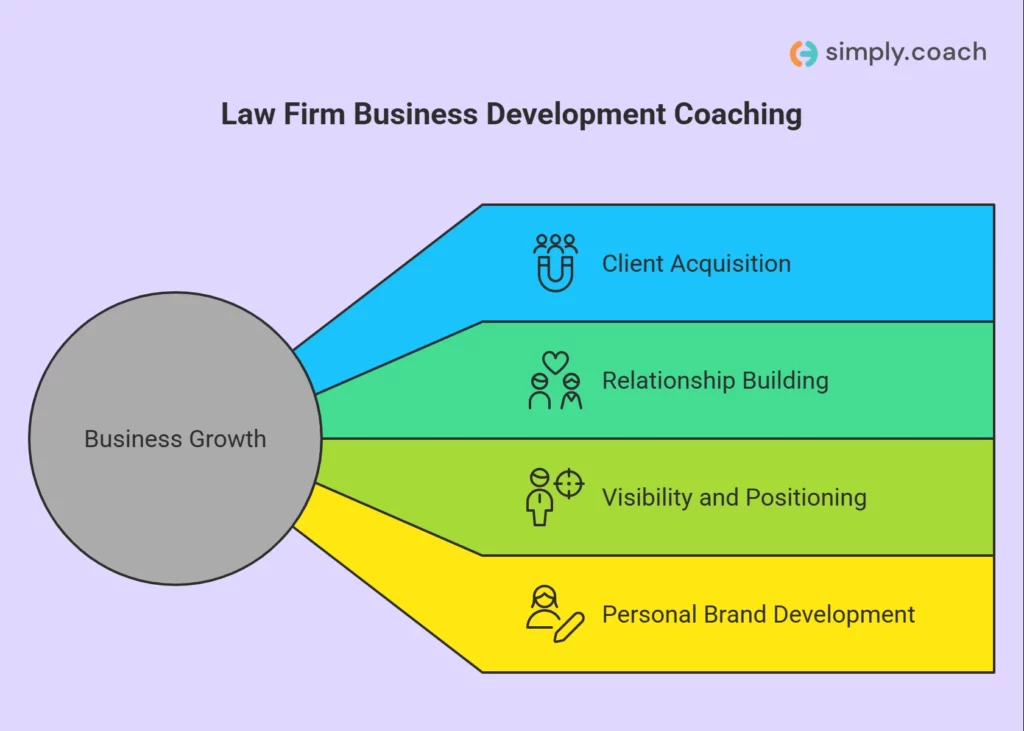
Law firm business development coaching focuses on helping lawyers build the skills required to attract, retain, and grow client relationships. Unlike traditional legal training, which emphasizes technical expertise, business development coaching equips lawyers to take a more proactive role in generating opportunities and contributing to firm growth.
In a legal context, business development coaching is not about selling in a conventional sense. Instead, it centers on building credibility, strengthening relationships, and positioning lawyers as trusted advisors. The goal is to help lawyers develop a consistent and authentic approach to growing their practice.
Key activities include:
- Speaking engagements: Present at industry events, client seminars, or conferences to build authority and generate high-quality conversations.
- Writing and thought leadership: Publish articles, insights, or legal updates that demonstrate expertise and keep you visible to clients and prospects.
- Strategic networking (online and offline): Build relationships through targeted events, industry groups, and digital platforms rather than broad, unfocused networking.
- Client relationship expansion: Proactively identify additional needs within existing clients and deepen engagement across multiple matters or practice areas.
- Cross-selling within the firm: Collaborate with colleagues to introduce complementary services, strengthening client relationships and increasing overall value.
- Media and industry visibility: Contribute to publications, podcasts, or panels to enhance credibility and reach a wider audience.
- Content repurposing: Turn one piece of content into multiple formats like articles, LinkedIn posts, presentations to maximise reach and consistency.
2026 focus areas:
- LinkedIn authority building through consistent, insight-driven content
- Webinars and virtual events to engage clients at scale
- Niche positioning to stand out in increasingly competitive and specialised markets
For experienced lawyers, the goal is not to do everything, but to build a focused set of activities that consistently reinforce expertise, maintain visibility, and convert relationships into long-term client work.
What makes business development coaching for lawyers different
Business development in law does not follow traditional sales models, and coaching needs to reflect that.
- Relationship-driven, not transactional: Work is generated through trust and long-term engagement, not short-term selling tactics.
- Integrated with client work, not separate from it: Business development happens alongside delivery, through conversations, follow-ups, and ongoing visibility.
- Based on consistency, not intensity: Sporadic effort rarely works. Small, repeatable actions over time are what build a sustainable pipeline.
- Aligned with professional identity: Lawyers need approaches that feel credible and authentic, not scripted or sales-driven.
Unlike generic sales coaching, which often relies on scripts or transactional techniques, law firm business development coaching is relationship-driven. It aligns with how legal services are delivered, where trust, credibility, and long-term relationships play a central role in winning and retaining clients.
Also Read: 9 Essential Leadership Coaching Tools Every Executive Coach Needs in 2026
Why Business Development Is Still a Challenge for Lawyers
Despite its importance, business development remains a consistent challenge for many lawyers. Most legal professionals are trained to focus on technical expertise, case strategy, and client delivery, not on how to build a pipeline or grow relationships.
Several factors contribute to this gap:
- Lack of formal training: Lawyers rarely receive structured guidance on how to build a practice
- Discomfort with “selling”: Many lawyers associate business development with sales tactics
- Over-reliance on the firm: Work is often expected to come from partners or the firm’s reputation
- Time constraints: Billable hour targets leave limited time for consistent business development
- Inconsistent efforts: Without a structured approach, outreach and networking become sporadic
Over time, this creates a gap between technical excellence and business growth, one that coaching is designed to address.
Also Read: The 7 Best Career Coaching Software Platforms & Tools
The Shift in 2026: Why Business Development Coaching for Lawyers Matters More Than Ever
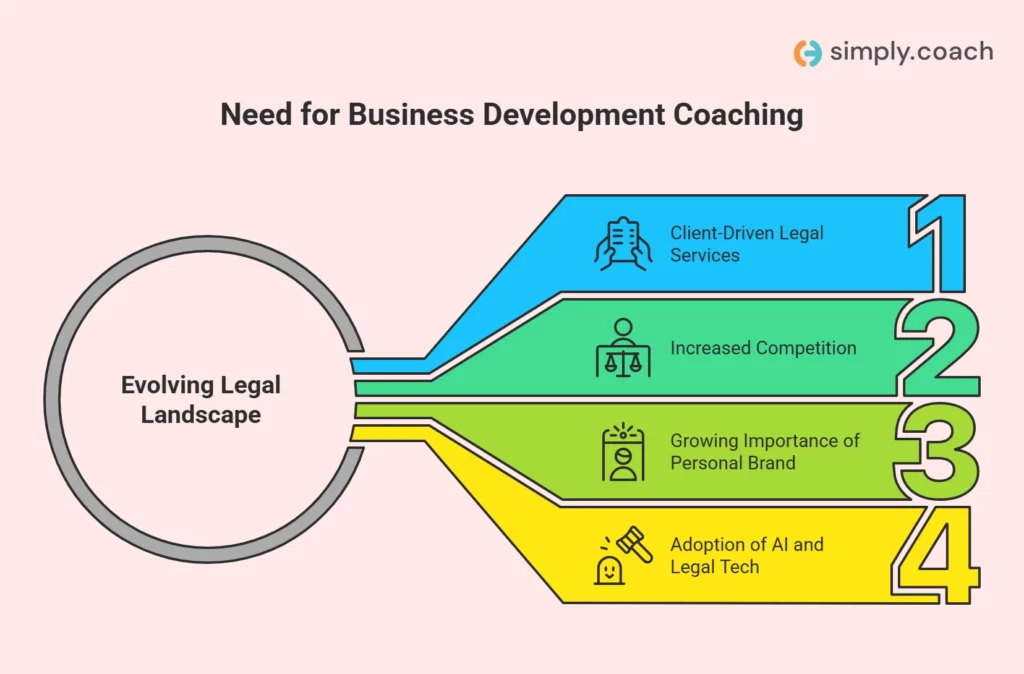
Business development has always mattered in law, but in 2026, it has become a defining factor for long-term success. The legal industry is shifting toward a more client-driven model, where relationships, responsiveness, and perceived value often outweigh pure technical expertise.
Several forces are accelerating this shift:
Client expectations have moved beyond legal expertise
Clients now expect responsiveness, commercial awareness, and ongoing engagement, not just technical advice.
What this changes:
- Legal expertise alone is not enough to retain clients
- Relationship quality directly influences repeat work
- Visibility between matters becomes important
This shifts your focus toward building consistent client engagement habits, not just improving delivery.
Competition is more specialized and more visible
Boutique firms and niche practitioners are competing through focused expertise and stronger positioning.
What this changes:
- Generalist positioning becomes harder to sustain
- Clear niche and authority matter more
- Clients compare more actively across options
This shifts your focus toward helping lawyers define positioning and build authority in a specific area, rather than encouraging broad networking.
Personal visibility is now a growth lever
Lawyers are increasingly building visibility through content, speaking, and industry participation.
What this changes:
- Opportunities are influenced by consistent presence
- Inbound interest depends on staying top of mind
- Individual reputation complements firm brand
This shifts your focus toward building repeatable visibility systems, not one-off efforts.
AI and legal tech are reducing the value of routine work
As more standardized work becomes automated, differentiation shifts toward judgment, context, and relationships.
What this changes:
- Technical execution becomes less of a differentiator
- Strategic thinking and advisory roles gain importance
- Client trust becomes central to winning work
This shifts your focus toward helping lawyers strengthen advisory relationships and stay relevant over time.
Business development is shifting from reactive to system-driven
Traditional reliance on referrals or internal allocation is becoming less reliable.
What this changes:
- Passive approaches create long-term risk
- Inconsistent effort leads to inconsistent pipeline
- Growth depends on structured, repeatable activity
This shifts your focus toward building clear, repeatable systems for outreach, follow-ups, and relationship management.
At a practical level, business development coaching in 2026 is less about improving individual tactics and more about helping lawyers operate with consistency and clarity. The shift is not in whether business development matters, but in how deliberately it is executed.
Also Read: How to Set and Raise Your Consulting Rates Successfully
What Business Development Coaching Helps Lawyers Do
Business development coaching helps lawyers move from ad hoc efforts to a structured, repeatable approach to growing their practice. Instead of relying on referrals or firm-driven work, lawyers learn how to consistently create opportunities, strengthen relationships, and convert those relationships into long-term client engagements.
Key outcomes include:
- Build a book of business: Develop the ability to generate and manage a steady pipeline of clients rather than depending solely on internal referrals.
- Create a repeatable business development system: Establish routines for outreach, follow-ups, networking, and visibility that can be sustained alongside billable work.
- Improve client conversations: Learn how to ask better questions, understand client needs, and position legal expertise in a way that resonates with business priorities.
- Stay top of mind with prospects: Build consistent visibility through touchpoints such as content, check-ins, and industry engagement.
- Turn relationships into revenue: Identify opportunities within existing networks and convert them into meaningful work without relying on traditional sales tactics.
For example, a lawyer who consistently speaks at industry events uses those interactions to initiate follow-up conversations, build relationships, and convert visibility into new client engagements.
Similarly, a partner working with an existing client identifies unmet needs across different practice areas and introduces relevant services, expanding the relationship and increasing overall client value.
Also Read: 23 Consulting Niches That Actually Make Money (And How to Choose Yours)
Who Needs Business Development Coaching in a Law Firm?
Business development is no longer a skill reserved for senior partners. In today’s legal environment, lawyers at every stage of their career are expected to contribute to client relationships, visibility, and growth.
As a result, business development coaching is relevant across the entire firm, not just for those already responsible for revenue.
Different roles benefit in different ways:
- Junior associates → Early awareness: Learn how business development works within a law firm, build visibility early, and start developing relationship-building habits that compound over time.
- Senior associates → Partner track readiness: Shift from execution to ownership by developing client relationships, building credibility in a niche, and preparing to bring in work independently.
- New partners → Building a pipeline: Focus on creating a consistent flow of opportunities, strengthening networks, and transitioning from delivery-focused work to growth-oriented responsibilities.
- Senior partners → Repositioning and growth: Refine positioning, expand into new markets or practice areas, and strengthen high-value client relationships to drive sustained growth.
- Entire firms and practice groups → Collective impact: Align teams around shared business development strategies, improve cross-selling, and build a culture where relationship-building and client engagement are consistent across the firm.
No stage is exempt. Whether a lawyer is just starting out or leading a practice, business development skills directly influence long-term career progression, client retention, and overall firm growth.
Also Read: 10 Best Coaching Tools for Tracking Progress in 2026
What a Business Development Coaching Program Looks Like
A business development coaching program for lawyers is designed to move beyond theory and create measurable growth outcomes.
For experienced professionals, the focus is on building a repeatable system that integrates seamlessly with existing client work and practice responsibilities.
Most programs follow a structured framework:
Step 1: Define goals and revenue targets
Establish clear, measurable business development objectives tied to revenue and client growth. This may include building a $500K–$1M book of business, expanding relationships with top clients, or entering a new industry vertical. Goals should be specific enough to guide action and prioritisation.
For example, a senior associate sets a target to originate two new mid-sized clients within 12 months while increasing revenue from existing clients by 20%.
Step 2: Assess current business development habits
Evaluate how work is currently generated, including referrals, internal allocation, or personal relationships, and identify gaps. Review client concentration, visibility efforts, and consistency of outreach. This step highlights where opportunities are being missed.
For example, a partner realises that 80% of their work comes from two clients and that they have limited external visibility, creating a concentration risk.
Step 3: Create a personalised business development plan
Develop a focused strategy aligned with your strengths, network, and practice area. This may include defining a niche, mapping key relationships, and selecting a small number of high-impact visibility channels.
For example, a lawyer specialising in fintech positions themselves as a niche expert by publishing insights on regulatory updates and targeting startup founders and investors.
Step 4: Take consistent, targeted action
Translate strategy into repeatable weekly or monthly activities such as outreach, content publishing, or client check-ins. Consistency is critical to building momentum and staying visible over time.
For example, a lawyer commits to two client touchpoints per week, one LinkedIn post, and one industry interaction to maintain ongoing engagement.
Step 5: Review progress and refine your approach
Track outcomes such as new conversations, opportunities generated, and revenue growth. Use these insights to adjust your strategy, double down on what works, and eliminate low-impact activities.
For example, after reviewing results, a lawyer shifts focus from broad networking events to targeted industry roundtables that generate higher-quality leads.
Typically, these programs run for 6 to 12 months, with ongoing coaching sessions and accountability loops that ensure consistent execution. The emphasis is not just on planning, but on sustained action and measurable progress.
Also Read: Differences: Executive Coaching vs Business Coaching
How Simply.Coach Supports Business Development Coaching for Lawyers
Business development coaching for lawyers breaks down when it stays at the level of advice. The real challenge is not knowing what to do, it is executing consistently across weeks and months while tracking relationships, opportunities, and follow-ups.
In most cases, this work is spread across emails, spreadsheets, and personal notes. As a result, visibility drops, follow-ups are missed, and it becomes difficult to measure whether coaching is actually driving outcomes.
Simply.Coach helps bring structure to this process. It allows you to manage business development coaching as an ongoing system, not a series of conversations.
Where Simply.Coach supports business development coaching in practice:
- Client and relationship workspaces (track relationship development over time): Capture client interactions, notes, follow-ups, and relationship context in one place. This helps you and the lawyer track how relationships evolve and where opportunities exist.
- Goals and pipeline tracking (connect coaching to revenue outcomes): Set clear targets such as new clients, meetings, or revenue goals, and track progress over time. This creates visibility into whether business development efforts are actually converting.
- Action plans and accountability (drive consistent execution): Define specific activities like outreach, follow-ups, or content, and track completion. This helps shift lawyers from intention to consistent action.
- Coaching journeys (structure BD coaching programs): Build structured coaching programs for associates, partners, or practice groups with clear milestones, ensuring consistency across engagements.
- Session notes and progress tracking (maintain continuity across sessions): Capture insights from each coaching session and track behavioral changes over time, so progress is not lost between conversations.
- Scheduling and engagement management (keep everything organized): Manage sessions, check-ins, and follow-ups in one place, reducing fragmentation and making it easier to maintain momentum.
What this changes in your coaching approach
When business development coaching is structured:
- relationship-building becomes trackable, not assumed
- follow-ups and outreach become consistent, not reactive
- progress is measured against real outcomes, not activity
- coaching shifts from advice to execution
Simply.Coach does not replace your coaching approach. It helps you operationalize it, so business development becomes consistent, measurable, and scalable across lawyers and teams.
Conclusion
Business development is no longer optional for lawyers. It is a core part of how they build sustainable practices, strengthen client relationships, and grow within their firms. The challenge is not awareness, it is consistency. Without structure, business development remains reactive, fragmented, and difficult to sustain alongside billable work.
Business development coaching addresses this by helping lawyers build clear systems, develop repeatable habits, and move from occasional effort to ongoing execution.
This is where your role becomes critical. You are not just guiding strategy, you are helping lawyers build a way of working that supports long-term growth.
Simply.Coach supports this by bringing structure to business development coaching, helping you track relationships, monitor progress, and maintain accountability across engagements.
See how Simply.Coach supports structured, outcome-driven business development coaching.
FAQs
1. How do lawyers generate new clients without selling?
Lawyers generate clients by building trust and visibility over time. This includes sharing insights, staying in touch with contacts, and demonstrating expertise in specific areas so that clients approach them when a need arises.
2. What makes some lawyers consistently win more work?
Lawyers who win more work tend to have a clear niche, strong professional relationships, and consistent visibility. They are proactive in staying connected with clients and are often top of mind when opportunities arise.
3. How can lawyers build credibility in a specific industry?
Credibility is built by focusing on a niche and consistently contributing value, through articles, speaking engagements, client insights, and participation in industry discussions.
4. Why do many lawyers struggle to build a pipeline?
A common reason is the lack of a structured approach. Without defined activities, tracking, and follow-ups, efforts remain inconsistent, making it difficult to create a steady flow of opportunities.
5. How can lawyers expand work from existing clients?
By understanding the client’s broader business needs and proactively identifying areas where additional legal support may be required. This often involves regular check-ins and deeper relationship engagement.
6. What role does visibility play in legal business development?
Visibility ensures that lawyers are recognised for their expertise. Consistent presence, through content, events, or industry participation, helps lawyers stay relevant and increases inbound opportunities.
7. How do lawyers build long-term client relationships?
By maintaining regular communication, delivering consistent value, and understanding the client’s evolving needs. Strong relationships are built over time through trust, reliability, and relevance.