
As a coach working in organizational settings, you’ve likely seen how often performance challenges are not about skills, but behavior. Two leaders with the same experience can deliver completely different outcomes based on how they handle pressure, make decisions, or interact with their teams. Relying only on observation or self-reported insights can limit how precisely you diagnose these patterns.
That’s where structured personality assessment becomes critical. When you can access objective data on how your clients operate, both at their best and under stress, your coaching becomes more targeted, measurable, and impactful. Instead of working at the surface level, you begin to address the underlying behavioral drivers that shape leadership effectiveness and team dynamics.
The Hogan Assessment System is one of the most widely used tools for this purpose. Designed specifically for workplace application, it helps you evaluate personality strengths, derailment risks, core motivations, reasoning ability, and decision-making patterns. In this guide, you’ll learn how the Hogan system works, how to interpret its components, and how to apply it effectively in your coaching practice to drive real organizational outcomes.
Key Takeaways
- Hogan Assessments are a research-backed suite of tools (HPI, HDS, MVPI, HBRI, JUD) for predicting workplace performance, leadership potential, and cultural fit.
- The system measures personality traits, stress-related derailers, motivations, cognitive reasoning, and decision-making style for objective talent insights.
- It supports structured hiring, executive coaching, employee development, team optimization, and succession planning.
- Coaches can implement Hogan by selecting assessments, administering them, analyzing results, applying insights in sessions, and tracking growth over time.
- The insights reduce bias, align talent with roles and organizational culture, and enable measurable coaching outcomes.
- Hogan is ideal for recruitment, leadership development, executive coaching, and accelerating high-potential employees.
- Limitations include casual career exploration and the need for trained professionals to interpret results accurately.
- Simply.Coach helps you manage assessments, track progress, organize development plans, and generate reports seamlessly in one platform.
What Is the Hogan Assessment System?
The Hogan Assessment System is a suite of evidence-based psychometric tools designed to help you predict workplace performance with a high degree of accuracy. Developed by industrial-organizational psychologists Drs. Robert and Joyce Hogan, it is specifically built for organizational use, not general personality insight. The focus is on how individuals actually behave at work and how those behaviors impact leadership, team dynamics, and long-term success.
What makes Hogan particularly valuable in coaching is its multi-dimensional approach. Instead of giving you a single personality profile, it helps you understand three critical layers: how your client typically shows up in day-to-day work, how their behavior shifts under pressure or stress, and what underlying values and motivations drive their decisions. This allows you to move beyond surface-level observations and work with deeper, predictive patterns.
In practice, this means you can identify not just strengths, but also potential derailers that may limit your client’s effectiveness as they take on more complex roles. Because the assessments are standardized and backed by decades of workplace research, you can use the data to support coaching conversations, align development plans with business goals, and provide objective insights that resonate with both individuals and organizational stakeholders.
How Organizations Use the Hogan Assessment System in Practice
As a coach working in organizational settings, your impact increases when assessment data is applied within structured talent processes rather than treated as a one-time report. Hogan insights become most valuable when you use them to guide hiring decisions, shape development plans, and inform long-term talent strategy.
1. Talent acquisition
In hiring, Hogan helps you move beyond intuition and interviews to structured, data-backed decision-making. You can support organizations in selecting candidates who are not only capable but also behaviorally aligned with role demands.
- Role benchmarking: Define success profiles using Hogan data and compare candidates against proven performance patterns.
- Objective comparison: Use standardized behavioral metrics to reduce bias and evaluate candidates consistently.
- Risk identification: Flag potential derailers early, such as low stress tolerance or interpersonal risks, before hiring decisions are made.
- Leadership signals: Identify early indicators of leadership potential, including ambition, learning orientation, and reasoning ability.
2. Employee development
Hogan data allows you to design highly targeted development plans instead of relying on generic coaching frameworks. It helps you focus on the specific behaviors that directly impact performance and leadership effectiveness.
- Targeted development: Translate assessment insights into specific, behavior-focused development plans instead of generic training.
- Coaching precision: Use Hogan data to address blind spots, pressure behaviors, and interpersonal patterns in your coaching sessions.
- Team alignment: Help leaders balance team strengths, communication styles, and work preferences to reduce friction.
- High-potential growth: Support accelerated development by aligning strengths with stretch roles while managing derailment risks.
3. Workforce strategy
At a strategic level, Hogan enables you to contribute beyond individual coaching and influence organizational decisions. You can use assessment data to guide long-term talent planning and leadership pipeline development.
- Succession planning: Evaluate leadership readiness based on behavioral fit and future potential, not just past performance.
- Culture alignment: Use values data to assess whether emerging leaders align with organizational direction and culture.
- Integrated analytics: Combine Hogan insights with performance data to inform strategic talent decisions.
- Retention strategy: Identify motivation drivers and disengagement risks to improve long-term retention outcomes.
Used consistently, Hogan assessments allow you to shift from reactive coaching to a more strategic role, where your insights directly influence hiring quality, leadership development, and organizational performance.
Benefits of Using Hogan Assessments
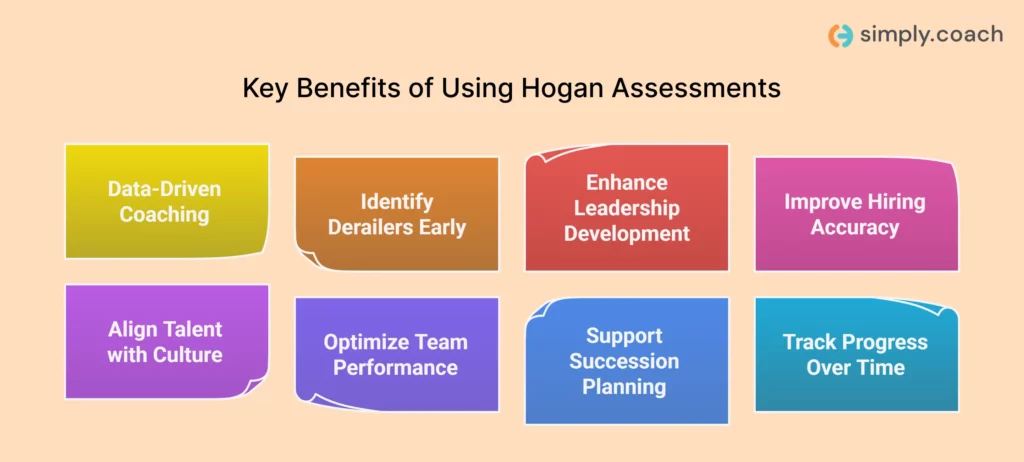
Hogan assessments offer actionable, evidence-based insights that help coaches and organizations make smarter talent decisions and drive measurable growth. Key benefits include:
- Data-driven coaching: Provides objective insights into personality, motivations, and reasoning to guide personalized coaching sessions.
- Identify derailers early: Highlights potential stress-related or counterproductive behaviors before they impact performance.
- Enhance leadership development: Pinpoints strengths and gaps to accelerate high-potential leaders’ growth.
- Improve hiring accuracy: Supports structured candidate comparisons and reduces bias in recruitment decisions.
- Align talent with culture: Reveals motivational drivers and values to ensure better fit and long-term engagement.
- Optimize team performance: Helps balance strengths and working styles, improving collaboration and reducing friction.
- Support succession planning: Offers predictive insights for future leadership readiness and role alignment.
- Track progress over time: Enables re-assessment and measurement of behavioral changes and development outcomes.
By integrating Hogan assessments into your coaching practice, you can make informed decisions that strengthen individual, team, and organizational performance.
Core Hogan Assessments Explained for Coaches
The Hogan Assessment System is built around five complementary tools, each designed to give you a different lens on your client’s workplace behavior. As a coach, the real value comes from integrating these insights to understand not just how your client performs, but why they succeed, where they may struggle, and how they can grow.
1. Hogan Personality Inventory (HPI)
The HPI helps you understand how your client shows up in day-to-day work when they are at their best. It reflects “bright-side” personality traits that influence leadership style, team interactions, and overall performance.
- Measures everyday behavior: Covers areas like emotional stability, ambition, sociability, and learning orientation.
- Predicts leadership style: Helps you identify how your client leads, communicates, and drives results.
- Highlights strengths and gaps: High or low scores on traits like Prudence or Sociability can indicate both strengths and potential overuse.
- Coaching application: Use HPI data to reinforce strengths while preventing overextension, such as perfectionism or over-dominance.
Key HPI scales interpretation
| Scale | Low score tendency | High score tendency |
| Adjustment | Self-critical, reactive to stress | Calm under pressure, may resist feedback |
| Ambition | Collaborative, avoids leadership | Competitive, driven, may dominate |
| Sociability | Reserved, independent | Outgoing, attention-seeking |
| Interpersonal Sensitivity | Direct, blunt | Warm, conflict-avoidant |
| Prudence | Flexible, impulsive | Organized, rigid, perfectionist |
| Inquisitive | Practical, conventional | Creative, may lack execution focus |
| Learning Approach | Hands-on, less theory-driven | Curious, knowledge-focused |
Coaching insight: Extreme scores, not just low or high, often indicate where strengths can turn into liabilities.
2. Hogan Development Survey (HDS)
The HDS focuses on how your client’s behavior may shift under stress, pressure, or fatigue. These are “dark-side” tendencies that can derail performance if not managed effectively.
- Identifies derailers: Traits like skepticism, boldness, or cautiousness that can become problematic under pressure.
- Reveals risk patterns: Helps you anticipate behaviors such as micromanagement, avoidance, or overconfidence.
- Context-dependent impact: These traits are not inherently negative but become risks when overused.
- Coaching application: Use HDS insights to build self-awareness and create strategies to manage triggers and high-pressure responses.
Key HDS scales interpretation
| Scale | Low score tendency | High score risk |
| Excitable | Stable, calm | Moody, emotionally volatile |
| Skeptical | Trusting | Cynical, distrustful |
| Cautious | Risk-taking | Fearful, avoids decisions |
| Reserved | People-oriented | Detached, unapproachable |
| Leisurely | Easygoing | Passive-aggressive |
| Bold | Humble | Overconfident, entitled |
| Mischievous | Rule-following | Impulsive, risk-prone |
| Colorful | Modest | Attention-seeking |
| Imaginative | Practical | Eccentric, unpredictable |
| Diligent | Delegates easily | Micromanages |
| Dutiful | Independent | Overly compliant |
Coaching insight: HDS is where most leadership breakdowns occur. Managing derailers is often more critical than building strengths.
3. Motives, Values, Preferences Inventory (MVPI)
The MVPI helps you understand what drives your client internally, including their values, motivations, and preferred work environment. This is key to long-term engagement and role alignment.
- Uncovers core drivers: Identifies motivations such as power, recognition, security, or affiliation.
- Predicts culture fit: Shows whether your client will thrive in a specific organizational environment.
- Explains engagement levels: Misalignment between values and role often leads to disengagement, even in high performers.
- Coaching application: Use MVPI data to align career goals, leadership roles, and organizational culture with intrinsic motivators.
Key MVPI scales interpretation
| Scale | Low score tendency | High score tendency |
| Recognition | Avoids spotlight | Seeks visibility and recognition |
| Power | Avoids authority | Driven to lead and influence |
| Hedonism | Formal, structured | Enjoys fun, flexible environments |
| Altruistic | Task-focused | People-focused, service-driven |
| Affiliation | Independent | Social, relationship-oriented |
| Tradition | Challenges norms | Values structure and beliefs |
| Security | Risk-taking | Prefers stability and predictability |
| Commerce | Values relationships | Profit and results-driven |
| Aesthetics | Practical | Creative, design-focused |
| Science | Intuitive | Analytical, data-driven |
Coaching insight: Misalignment between MVPI values and role environment is one of the biggest causes of disengagement.
4. Hogan Business Reasoning Inventory (HBRI)
The HBRI measures how your client processes information, solves problems, and makes decisions in business contexts. It focuses on cognitive style rather than personality.
- Assesses problem-solving style: Differentiates between tactical (practical) and strategic (big-picture) thinking.
- Evaluates reasoning ability: Includes verbal, numerical, and logical reasoning tasks.
- Identifies decision patterns: Highlights how your client approaches complexity and avoids cognitive errors.
- Coaching application: Use HBRI insights to develop decision-making skills and align roles with cognitive strengths.
5. Judgment (JUD)
The Judgment assessment evaluates how your client makes decisions and, more importantly, how they respond after those decisions. It focuses on learning agility and openness to feedback.
- Measures decision quality: Assesses how effectively your client evaluates options and chooses actions.
- Evaluates feedback response: Reveals openness to feedback and ability to adjust after mistakes.
- Highlights learning agility: Strong judgment is not just about decisions but about improving over time.
- Coaching application: Use JUD insights to strengthen reflection, feedback integration, and adaptive leadership behavior.
When you combine all five assessments, you move from isolated personality insights to a complete performance model. This allows you to coach with precision, linking behavior, risk, motivation, and decision-making into a single, actionable development strategy.
Also read:Systemic Team Coaching: Five Disciplines Model for High-Performing and Adaptive Teams
Sample Question Types Across the Hogan Assessments
Each Hogan assessment uses a distinct question format to capture how your client behaves, thinks, and makes decisions in real workplace situations. Understanding these patterns helps you interpret results more effectively and translate them into actionable coaching insights.
1. HPI (everyday behavior – agreement scale)
The HPI uses agreement-based statements to capture consistent, day-to-day behavior patterns.
- Sample questions:
- “I like to take charge in group situations.”
- “I follow rules even when no one is watching.”
- “I enjoy meeting new people and networking.”
- What it measures: Leadership tendency, discipline, sociability, and reliability.
- How to interpret: High agreement often reflects strengths, but extreme patterns may signal overuse such as dominance, rigidity, or attention-seeking.
2. HDS (stress behavior – frequency scale)
The HDS focuses on how frequently certain behaviors show up under stress or pressure.
- Sample questions:
- “I get frustrated when others do not meet my standards.”
- “I tend to question others’ intentions.”
- “I prefer to avoid taking risks, even when necessary.”
- What it measures: Emotional reactivity, trust levels, risk tolerance, and derailment tendencies.
- How to interpret: Higher frequency responses indicate potential derailers that may impact leadership effectiveness under pressure.
3. MVPI (values and motivation – preference scale)
The MVPI explores what motivates your client and the environments they are naturally drawn to.
- Sample questions:
- “Being recognized publicly for my work is important to me.”
- “I prefer working in structured and predictable environments.”
- “Helping others succeed is more important than personal achievement.”
- What it measures: Core drivers such as recognition, security, altruism, and work preferences.
- How to interpret: Misalignment between these values and the work environment often leads to disengagement or burnout.
4. HBRI (cognitive ability – reasoning problems)
The HBRI uses logic-based questions to evaluate how your client processes information and solves problems.
- Sample questions:
- “If all managers are leaders and some leaders are strategic, are all managers strategic?”
- “What is the next number in the sequence: 2, 6, 18, 54?”
- “Which conclusion best follows from the given data set?”
- What it measures: Logical reasoning, pattern recognition, and problem-solving ability.
- How to interpret: Errors often reflect reasoning style gaps rather than intelligence, which is critical for coaching decision-making skills.
5. JUD (decision-making – scenario-based)
The Judgment assessment presents real-world workplace scenarios to evaluate decision-making and feedback response.
- Sample questions:
- “Your manager rejects your idea. Do you defend it, adapt it, or abandon it?”
- “You receive negative feedback on a project. How do you respond?”
- “A team member disagrees with your decision publicly. What do you do?”
- What it measures: Decision quality, openness to feedback, and adaptability.
- How to interpret: Balanced responses indicate strong judgment, while extremes suggest rigidity, defensiveness, or over-compliance.
For you as a coach, these questions are more than assessment items. They reveal consistent patterns in how your client thinks, reacts, and makes decisions, giving you a clear starting point for targeted development conversations.
Also read:Coaching the Growth Mindset: A Mindful Approach to Unlocking Leadership Potential
How to Implement Hogan Assessments in Coaching Practice
Using Hogan assessments effectively is not just about administering tests. As a coach working in organizational settings, your role is to translate assessment data into meaningful behavioral change, leadership growth, and better talent decisions.
1. Prepare and define assessment goals
Before you begin, you need absolute clarity on why the assessment is being used and what outcomes you want to drive.
- Identify the use case: Leadership development, hiring, succession planning, or team effectiveness.
- Define success criteria: What does “high performance” look like in this role or context?
- Select the right tools: Choose from HPI, HDS, MVPI, HBRI, or JUD based on your objective.
- Align stakeholders: Ensure HR, leadership, and the client understand the purpose and expected outcomes.
Tip: Avoid running full assessment suites by default. Be intentional and select only what directly supports your coaching or business goal.
2. Administer assessments with clarity
How you position the assessment directly impacts the quality of responses and client trust.
- Set clear expectations: Explain that there are no right or wrong answers, only patterns.
- Ensure a distraction-free environment: Especially important for HBRI and JUD.
- Address client concerns: Reduce anxiety around “being judged” or “passing the test.”
- Maintain consistency: Use standardized instructions across individuals or teams.
Tip: Frame the assessment as a development tool, not an evaluation. This increases honesty and reduces response bias.
3. Analyze and integrate results
The real value comes from connecting insights across multiple assessments rather than reviewing them in isolation.
- Look for patterns: Align HPI strengths with HDS risks and MVPI drivers.
- Identify contradictions: For example, high ambition with low sociability may impact leadership style.
- Connect to role demands: Map results against what the job actually requires.
- Prioritize key insights: Focus on 2 to 3 critical development themes instead of overwhelming the client.
Tip: Always interpret results in context. Personality data without role or environment context can lead to misleading conclusions.
4. Translate insights into coaching action
Assessment data only creates value when it is turned into clear, actionable development strategies.
- Build targeted development plans: Focus on specific behaviors, not abstract traits.
- Address derailers proactively: Create strategies to manage stress-triggered behaviors.
- Align with motivation: Use MVPI insights to design goals that sustain engagement.
- Integrate into coaching sessions: Use results as a foundation for ongoing discussions and progress tracking.
Tip: Avoid labeling clients based on scores. Instead, frame insights as patterns they can learn to manage and leverage.
5. Review progress and reassess
Behavioral change takes time, and ongoing measurement helps you track real progress.
- Track behavioral shifts: Use feedback, performance data, and coaching reflections.
- Revisit key risks: Monitor whether derailers are being managed effectively.
- Reassess when needed: Especially during role transitions or leadership changes.
- Adjust development plans: Keep them aligned with evolving goals and context.
Tip: Reassessment is most valuable when tied to a clear milestone, such as a promotion or major role shift.
When implemented strategically, Hogan assessments become more than diagnostic tools. They become a structured framework for driving measurable leadership growth, improving decision-making, and aligning talent with organizational goals.
When to Use Hogan Assessments
To get maximum ROI from Hogan assessments, you need to be intentional about when and where you apply them. Used in the right context, they provide powerful, data-driven insights. Used incorrectly, they can lead to overanalysis or misinterpretation.
| Ideal use cases | Limitations / Contraindications |
| Leadership development: When you need to build self-awareness, manage derailers, and accelerate leadership capability. | Low-stakes roles: Overkill for roles that do not require behavioral or leadership complexity. |
| Executive coaching: To provide structured insights into behavior, motivation, and decision-making patterns. | Lack of coaching support: Results without proper debriefing can be misunderstood or ignored. |
| Succession planning: To evaluate future leadership potential beyond current performance. | Used as a standalone tool: Decisions based only on Hogan without interviews or context can be misleading. |
| Hiring for critical roles: To assess culture fit, risk factors, and long-term alignment. | Time-constrained hiring: May slow down decisions when speed is the priority. |
| Team effectiveness: To understand team dynamics, reduce friction, and improve collaboration. | Poor stakeholder alignment: If leaders do not buy in, insights are rarely implemented. |
| Role transitions: When individuals move into new leadership or high-pressure roles. | Misinterpretation of scores: Treating scores as labels rather than behavioral tendencies. |
| High-potential identification: To spot leadership capability early and develop it strategically. | Resistance from participants: If individuals are not open, response quality and impact drop significantly. |
As a coach, the effectiveness of Hogan assessments depends less on the tool itself and more on how intentionally you apply it within the right context, with the right interpretation, and with a clear path to action.
Conclusion
The Hogan Assessment System gives you a scientifically rigorous way to understand workplace behavior, motivations, reasoning, and potential derailers. By combining multiple tools like HPI, HDS, MVPI, HBRI, and JUD, you can help your organizational clients make better hiring decisions, accelerate leadership development, align talent with culture, and build data‑driven succession strategies. Hogan’s multi‑dimensional insights allow you to move beyond intuition into measurable behavioral precision—making your coaching more effective and your interventions more impactful.
How Simply.Coach Helps You Implement Hogan Assessments
Simply.Coach is an all‑in‑one digital coaching platform built to help you manage every aspect of your coaching practice and turn Hogan assessment insights into structured implementation and measurable growth. It supports you to:
- Centralize client journeys: Manage goals, development plans, and progress tracking in one place.
- Digitize assessments & forms: Collect and store assessment data securely for analysis and interpretation.
- Schedule & manage sessions: Handle appointments, calendar integrations, and reminders for both 1:1 and team coaching.
- Generate progress reports: Create structured reports that show client growth and behavioral change over time.
- Share resources: Upload tools, worksheets, and action plans that align with Hogan insights.
With robust client management, secure data handling (SOC2, HIPAA, GDPR compliance), and tools designed for both individual and team engagements, Simply.Coach lets you focus on delivering high‑impact coaching rather than managing administrative tasks.
FAQs
1. What is the Hogan Assessment System?
The Hogan Assessment System is a suite of evidence-based psychometric tools designed to predict workplace performance. It measures normal personality traits, potential derailers under stress, core values and motivations, cognitive reasoning ability, and judgment in decision-making situations.
2. How do you pass a Hogan Assessment?
There is no traditional “pass” or “fail.” Hogan assessments are not knowledge tests; they measure personality patterns, motivations, and reasoning style. The most effective approach is to answer honestly and consistently rather than attempting to guess what the organisation wants to see.
3. Is the Hogan Assessment difficult?
The personality components (HPI, HDS, MVPI) are not difficult, as they involve rating behavioural or value-based statements. The cognitive portion (HBRI) may feel more challenging because it includes logic and reasoning questions similar to aptitude tests.
4. How long does the Hogan Assessment take?
Depending on which assessments are included, the full suite typically takes between 45 and 90 minutes to complete. Some organisations administer only selected components based on role requirements.
5. How is the Hogan Assessment used in hiring?
Employers use Hogan data to compare candidates against role benchmarks, identify leadership potential, flag potential derailers, and evaluate cultural alignment. It supports structured, bias-reduced hiring decisions.
6. Can Hogan results change over time?
Core personality traits tend to remain relatively stable over time. However, self-awareness, coaching, and experience can help individuals manage derailers more effectively and strengthen leadership capabilities.