
Many coaching conversations begin with a familiar challenge: clients feel something in their lives is out of balance, but they cannot clearly identify which areas need attention. Without a structured way to evaluate different aspects of life, goal-setting often becomes vague, and progress can stall despite good intentions.
This is where the Wheel of Life assessment becomes one of the most practical tools in a coach’s toolkit. Widely used in life coaching, leadership coaching, and personal development programs, the Wheel of Life helps clients visualize their satisfaction across key life domains such as health, relationships, career, finances, and personal growth.
For coaches, the value of the Wheel of Life lies not just in reflection but in turning insight into structured action. When used correctly, it becomes a starting point for deeper coaching conversations, measurable goal-setting, and long-term progress tracking.
In this guide, you’ll learn how the Wheel of Life works, how to select the right life categories, and how to apply a structured 7-step coaching process, along with a free downloadable template and practical guidance for using it in coaching sessions.
Key takeaways
- The Wheel of Life is a widely used coaching tool that helps clients assess satisfaction across multiple life areas and identify where change is needed.
- By visualizing life balance through a simple scoring system, the exercise turns abstract feelings about dissatisfaction into clear, actionable insights.
- Coaches can customize Wheel of Life categories, such as health, career, relationships, finances, and personal growth, to reflect each client’s unique priorities.
- Using a structured 7-step process helps transform the assessment from a reflection exercise into a practical framework for goal-setting and personal development.
- The tool is most effective when revisited periodically, allowing clients to track improvements and adjust priorities over time.
- Avoiding common mistakes, such as including too many categories or skipping the reflection stage, helps ensure the exercise produces deeper insights.
- Platforms like Simply.Coach help coaches manage Wheel of Life assessments, client reflections, goals, and progress tracking within a single organized system.
Free Wheel of Life Template (Downloadable)
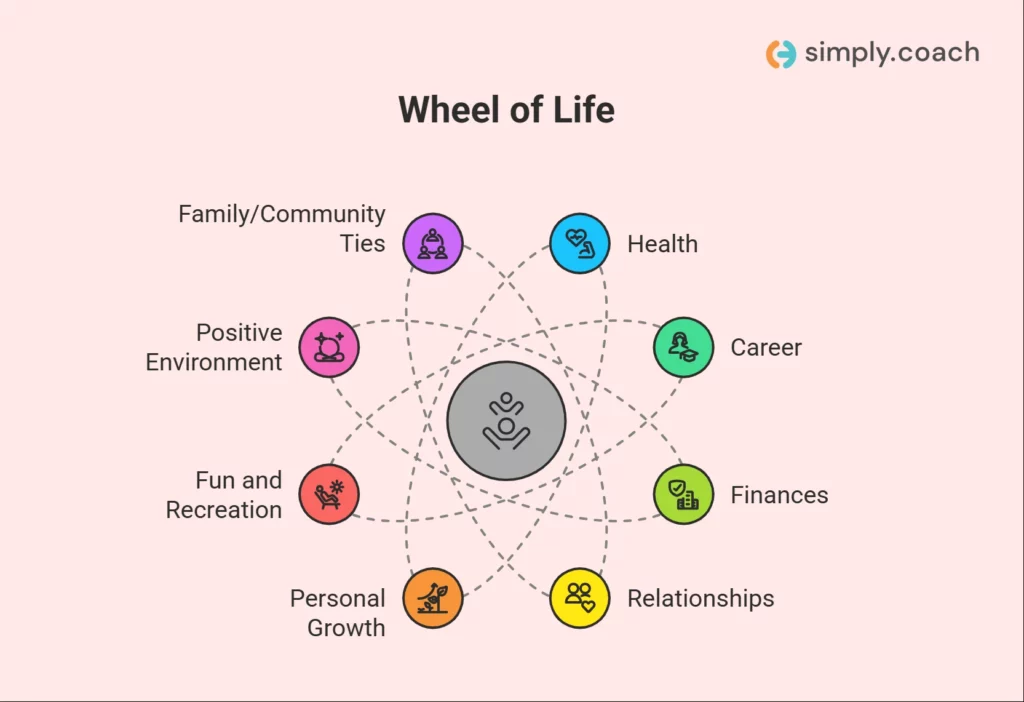
To make the Wheel of Life exercise practical in coaching sessions, it helps to have a ready-to-use template that clients can easily complete and revisit over time.
The classic Wheel of Life template is the most commonly used version in coaching. It divides life into eight core categories and asks clients to rate their satisfaction in each area on a scale from 1 to 10.
Typical categories include:
- Health
- Career
- Finances
- Relationships
- Personal growth
- Fun and recreation
- Environment
- Family or community
Clients shade each segment based on their score, creating a visual “wheel.” When the wheel appears uneven, it often reveals which areas require attention.
Coaches frequently use this version during initial discovery sessions to establish a baseline understanding of a client’s life balance.
Best for: first coaching sessions, life balance reviews, and goal-setting conversations.
Help your clients visualize their life balance
Help your clients visualize their life balance and uncover areas that need focus with this ready-to-use Wheel of Life Template.Designed by the leading digital coaching platform, this tool makes goal-setting, reflection, and progress tracking simple and impactful.

Whether you’re conducting a first-session assessment or revisiting goals during a progress review, this template provides a clear visual framework that helps clients identify priorities and take meaningful action.
What is the Wheel of Life and Why It Still Matters in 2026
In 2026, coaching conversations are increasingly shaped by complex life realities like hybrid work environments, constant digital connectivity, shifting career paths, and rising concerns around burnout and mental wellbeing. Many clients struggle not because they lack ambition, but because their attention is spread across too many competing priorities.
In this context, the Wheel of Life remains one of the most practical tools for helping clients step back and evaluate their overall life balance.Unlike traditional goal-setting exercises that focus on a single outcome, the Wheel of Life encourages clients to examine multiple life domains simultaneously.
This holistic perspective is particularly valuable today, when challenges in one area, such as work stress or financial pressure, often spill over into relationships, health, and personal growth. By visualizing these connections, clients can identify patterns they might otherwise overlook.
Why coaches continue to use it:
- Holistic assessment of modern life demands: Clients today juggle professional responsibilities, personal development, relationships, and wellbeing simultaneously. The Wheel of Life provides a simple framework for evaluating how these areas interact and where imbalances may exist.
- Supports reflective coaching conversations: Rather than jumping immediately into solutions, the wheel encourages deeper reflection. The visual format helps clients articulate concerns that may be difficult to express through conversation alone.
- Adapts easily to different coaching contexts: Whether used in life coaching, executive coaching, career transitions, or leadership development, the Wheel of Life can be customized to reflect the client’s priorities. Coaches often adapt categories to include areas such as leadership impact, work-life integration, or emotional wellbeing.
- Encourages measurable progress over time: Because clients rate each life domain numerically, the exercise can be repeated periodically to track improvements. This creates a clear visual record of progress and helps maintain accountability between coaching sessions.
- A bridge between reflection and action: Perhaps the most enduring strength of the Wheel of Life is its ability to connect self-awareness with structured goal setting. In a coaching landscape that increasingly emphasizes measurable outcomes, the tool offers a practical way to translate reflection into concrete priorities. By revisiting the wheel regularly, coaches and clients can monitor progress, adjust goals, and maintain focus on what truly matters.
Even as coaching methodologies evolve, the Wheel of Life continues to remain relevant because it addresses a timeless challenge, helping individuals see the bigger picture of their lives before deciding what needs to change.
Wheel of Life Assessment Example
While the Wheel of Life is simple to complete, the real value of the exercise comes from interpreting the results and identifying meaningful priorities for change. The example below illustrates how a coach might analyze a client’s scores during a session.
Example: A mid-career professional experiencing burnout and feeling uncertain about long-term direction.
Wheel of Life ratings (1–10 scale):
- Health: 4
- Career: 6
- Finances: 5
- Relationships: 8
- Personal growth: 3
- Recreation: 2
- Environment: 6
- Contribution / Purpose: 4
When plotted on the wheel, the scores create an uneven shape, revealing clear imbalances across life domains.
Interpreting the results:
- Low scores highlight potential priority areas: The lowest ratings, Recreation (2) and Personal Growth (3), suggest the client may be heavily focused on professional responsibilities while neglecting activities that support creativity, learning, or relaxation. This pattern is common among professionals experiencing early signs of burnout.
- Moderate scores often signal hidden friction: Areas such as Health (4) and Contribution (4) may not feel like urgent problems, but they often represent areas where clients feel something is missing. In coaching conversations, these scores might reveal limited exercise routines, lack of purpose in daily work, or insufficient time for reflection.
- Higher scores provide important strengths: The strong Relationships score (8) indicates that the client likely has supportive personal connections. Coaches often use these higher-scoring areas as sources of motivation and support while working on weaker domains.
- Turning Insights Into Coaching Goals: Once the scores are interpreted, the conversation shifts toward prioritization and action planning. Instead of trying to improve every category simultaneously, coaches typically focus on two or three areas that will create the most meaningful improvement.
For this client, the coaching discussion might explore goals such as:
- Reintroducing recreation or hobbies to reduce burnout
- Creating a personal development plan for learning or skill growth
- Establishing small health routines, such as regular exercise or improved sleep habits
Over time, revisiting the Wheel of Life allows both the coach and client to track progress visually. As scores improve and the wheel becomes more balanced, clients often experience increased clarity, motivation, and overall life satisfaction.
This example illustrates why the Wheel of Life remains one of the most widely used tools in coaching; it transforms abstract feelings about life balance into clear insights and actionable priorities.
Read: A 6-Step Template to Deliver a Powerful Life Coaching Session
Choosing the Right Categories for a Customized Wheel of Life
One of the strengths of the Wheel of Life is its flexibility. While the traditional version uses a fixed set of life areas, effective coaches often customize the categories to match the client’s goals, life stage, and coaching objectives. Tailoring the wheel ensures the assessment reflects the client’s real priorities rather than forcing them into generic life domains.
For example, a corporate professional might focus on career growth, leadership development, and financial stability, while a life coaching client may prioritize relationships, personal growth, and wellbeing.
By selecting categories that align with the client’s current challenges and aspirations, the Wheel of Life becomes a more meaningful diagnostic tool and a stronger foundation for goal-setting.
Aligning categories with coaching objectives
When selecting categories, coaches should consider what the client is trying to achieve through coaching. The goal is not to evaluate every possible life domain but to focus on the areas that most influence the client’s sense of balance and fulfillment.
Common factors coaches consider when defining Wheel of Life categories include:
- the client’s current life stage or career phase
- the primary reason for seeking coaching
- areas where the client feels dissatisfied or stuck
- domains that influence long-term wellbeing and performance
Aligning the categories with these objectives ensures the exercise produces insights that directly support the coaching process.
11 key categories commonly used in Wheel of Life coaching
While categories can vary, many coaching programs use a combination of the following life areas to create a well-rounded assessment.
1. Health: This category evaluates physical wellbeing, including exercise habits, nutrition, sleep, and overall energy levels. Many coaching conversations reveal that physical health significantly influences productivity, emotional resilience, and motivation.
2. Career and business: Clients assess their level of satisfaction with their professional path, career growth, and work-life integration. This category often surfaces issues related to career transitions, leadership development, or workplace stress.
3. Relationships: This domain focuses on the quality of personal relationships, including family, friendships, and romantic partnerships. Strong relationships often act as a key source of emotional support and fulfillment.
4. Personal growth: Personal development involves learning, self-awareness, and skill-building. Coaches use this category to explore whether clients feel intellectually and emotionally challenged in ways that support long-term growth.
5. Finances: Financial wellbeing includes income stability, savings, investments, and financial confidence. For many clients, improving financial clarity can reduce stress and support broader life goals.
6. Fun and recreation: Leisure, hobbies, and recreational activities play an important role in maintaining balance and preventing burnout. This category often reveals whether clients are allowing enough time for enjoyment and creativity.
7. Spirituality or purpose: For some clients, a sense of purpose or spiritual connection provides meaning beyond daily responsibilities. This category can include personal values, mindfulness practices, or broader life purpose.
8. Environment: A client’s living and working environment can significantly influence productivity, mood, and wellbeing. This category examines whether their surroundings support or hinder their goals.
9. Social impact or contribution: Many individuals seek opportunities to contribute to their community or create a positive impact. Exploring this category can help clients connect their personal goals with broader values.
10. Family: While related to relationships, this category specifically focuses on family responsibilities, dynamics, and the balance between family commitments and other life priorities.
11. Mental health and emotional wellbeing: Emotional resilience, stress management, and psychological wellbeing are increasingly important areas in modern coaching conversations. This category helps clients reflect on how effectively they manage pressure, uncertainty, and emotional challenges.
Creating a balanced assessment
Not every Wheel of Life needs all eleven categories. In practice, most coaches select six to eight key areas that best represent the client’s priorities. The goal is to create a wheel that provides a clear visual overview of life balance without overwhelming the client with too many dimensions.
By thoughtfully selecting the right categories, coaches ensure that the Wheel of Life exercise produces insights that are both meaningful and actionable—helping clients identify where change will have the greatest impact on their overall satisfaction and growth.
Also read: How to Build an Effective Personal Development Coaching Program That Works
The 7 Steps to Effectively Use the Wheel of Life Exercise
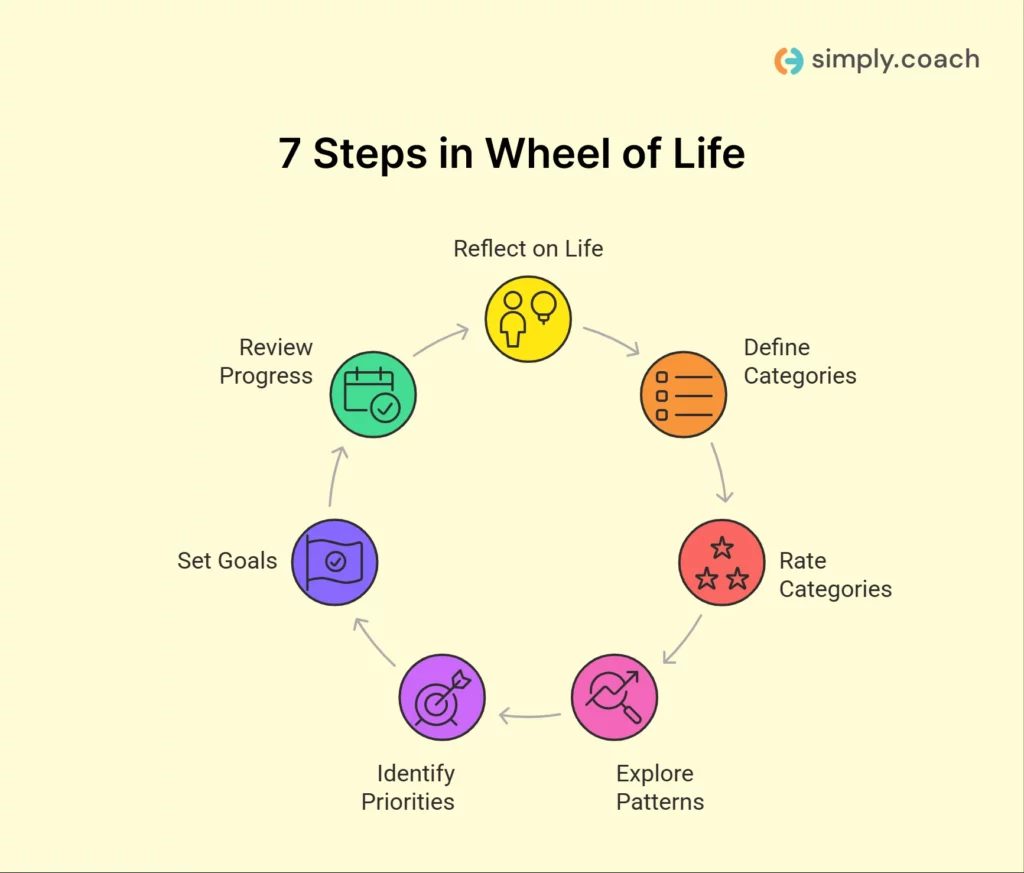
The Wheel of Life is most powerful when it moves beyond simple scoring and becomes part of a structured coaching conversation. While the visual assessment helps clients identify imbalances, the real value emerges when coaches guide clients through reflection, interpretation, and action planning.
The following seven-step process helps transform the Wheel of Life from a basic self-assessment tool into a practical framework for goal-setting and progress tracking. When applied consistently, it helps clients clarify priorities, identify areas for improvement, and create meaningful changes over time.
Step 1: Begin with reflection
Before introducing the wheel itself, encourage clients to pause and reflect on their current life situation. This short reflective moment helps clients approach the exercise with greater awareness rather than rushing through the ratings.
Ask questions such as:
- Which areas of your life currently feel most fulfilling?
- Where do you feel tension, stress, or dissatisfaction?
- If you could improve one area of life right now, what would it be?
Coaching tip: Some coaches ask clients to write a few sentences about their current life balance before completing the wheel. This often reveals insights that make the scoring process more meaningful.
Step 2: Define the right life categories
Next, work with the client to select the life areas that will appear on the wheel. While common categories include health, career, relationships, and finances, the most effective wheels are often customized to reflect the client’s priorities.
For example:
- A senior executive may include leadership impact or strategic influence
- A parent returning to work may prioritize family balance
- An entrepreneur might focus on business growth and creativity
Coaching tip: Limiting the wheel to 6–8 categories often creates a clearer visual picture and prevents the exercise from becoming overwhelming.
Step 3: Rate each category on a scale of 1–10
Clients then rate their satisfaction in each category using a scale from 1 (very dissatisfied) to 10 (fully satisfied). These ratings are plotted on the wheel and connected to create a visual shape representing their current life balance.
Encourage clients to score each area honestly based on their current experience, rather than what they feel it “should” be.
Coaching tip: Remind clients that the wheel is not a performance evaluation, it is simply a snapshot of their present reality.
Step 4: Explore the patterns and imbalances
Once the wheel is complete, the discussion shifts toward interpreting the results. The shape of the wheel often reveals patterns that might not have been obvious before.
Key questions to explore include:
- Which areas received the lowest scores?
- Which areas feel most satisfying?
- Are there connections between certain categories?
For example, a low score in health or recreation may be directly connected to a demanding work schedule.
Coaching tip: Encourage clients to look at the wheel holistically rather than focusing on just one category.
Step 5: Identify priority areas for improvement
Rather than attempting to improve every category at once, the next step is to select two or three focus areas that would create the greatest positive impact.
These areas often include the lowest-scoring segments or categories where improvement would influence multiple parts of life.
Coaching tip: Ask clients: “If this area improved by two points on the wheel, how would it change your life overall?”
This question helps clients identify the most meaningful priorities.
Step 6: Translate insights into actionable goals
Once priority areas are selected, the coach and client work together to define clear, realistic goals. Effective goals are typically structured using the SMART framework (Specific, Measurable, Achievable, Relevant, Time-bound).
For example:
Instead of: “I want to get healthier.”
A clearer goal might be: “I will walk or exercise for 30 minutes three times a week over the next month.”
Coaching tip: Breaking larger goals into small, achievable actions helps clients build early momentum and confidence.
Step 7: Review progress and reassess the wheel
The Wheel of Life is most valuable when it is revisited periodically. Coaches often repeat the exercise every few months to evaluate progress and adjust priorities.
During follow-up sessions, clients can:
- update their scores
- review completed action steps
- identify new focus areas
Over time, the wheel often becomes more balanced and aligned with the client’s goals, providing a clear visual record of growth.
Coaching tip: Encourage clients to treat the wheel as an evolving tool rather than a one-time exercise.
By guiding clients through these seven steps, coaches transform the Wheel of Life from a simple reflection exercise into a structured coaching framework that supports long-term personal and professional development.
Preparing the Wheel of Life and Applying It Effectively in Coaching
While the Wheel of Life is a simple assessment tool, its effectiveness depends largely on how well the exercise is prepared, facilitated, and revisited over time. Proper preparation helps clients approach the exercise with clarity and honesty, while thoughtful facilitation ensures the insights gained translate into meaningful coaching outcomes.
The following considerations help coaches create the right conditions for the exercise and integrate it effectively into ongoing coaching sessions.
Preparing clients for the exercise
Before beginning the Wheel of Life assessment, it is important to ensure that clients approach the exercise with the right environment, time commitment, and mindset. These elements help clients reflect more deeply and produce more accurate insights.
- Create a focused environment: Encourage clients to complete the exercise in a calm, distraction-free space. Eliminating interruptions, such as phone notifications or background noise, helps them concentrate on evaluating their life areas thoughtfully.
- Allow sufficient time for reflection: The Wheel of Life should not be rushed. Ideally, clients should dedicate 30–60 minutes to the exercise so they can carefully consider each life category. Taking the time to reflect often leads to deeper insights and more honest scoring.
- Encourage a non-judgmental mindset: Remind clients that the purpose of the exercise is awareness, not self-criticism. The wheel represents a snapshot of their current situation, not a measure of success or failure. Approaching the exercise with curiosity and openness helps produce more meaningful results.
- Integrating the Wheel of Life into coaching sessions: Once clients complete the assessment, the wheel becomes a valuable framework for coaching conversations. Coaches can use it at different stages of the coaching journey to guide reflection, identify priorities, and structure goal-setting discussions.
- Use it during discovery sessions: Many coaches introduce the Wheel of Life in early sessions to gain a holistic understanding of the client’s life situation. The exercise helps identify areas where the client feels most satisfied and where additional support or focus may be needed.
- Apply it in group coaching environments: In group coaching programs, the Wheel of Life can encourage participants to reflect on their life balance and share insights with peers. These discussions often lead to shared learning and provide participants with diverse perspectives on common challenges.
- Use it for mid-program reflection: Coaches may also revisit the wheel midway through a coaching engagement. This allows clients to reassess their priorities and identify areas where progress has occurred or where additional adjustments may be needed.
Maintaining engagement and accountability
To ensure the Wheel of Life leads to real change, coaches should guide clients beyond the initial assessment toward actionable insights and consistent follow-up.
- Review the wheel regularly: During follow-up sessions, encourage clients to revisit their original scores and reflect on any changes. This keeps the exercise dynamic and reinforces the connection between coaching conversations and real-life progress.
- Translate insights into concrete goals: After identifying lower-scoring life areas, work with clients to define clear and achievable goals. Actionable steps help clients move from awareness to meaningful behavioral change.
- Encourage accountability and reflection: Regular check-ins help clients stay motivated and maintain momentum. If certain life areas remain unchanged, this can signal the need to revisit strategies or explore deeper underlying challenges.
- Tracking progress over time: The Wheel of Life also serves as a visual progress-tracking tool throughout the coaching journey. By periodically repeating the exercise, clients can observe how their scores evolve across different life domains.
Documenting these changes allows both coach and client to:
- monitor improvements in life satisfaction
- adjust coaching strategies when progress stalls
- identify new areas of focus as priorities evolve
Celebrating improvements, even small ones, helps reinforce motivation and strengthens the client’s commitment to ongoing growth.
When prepared and applied thoughtfully, the Wheel of Life becomes more than a diagnostic tool. It becomes a structured framework for reflection, goal setting, and continuous progress throughout the coaching process.
Also read:Coaching the Growth Mindset: A Mindful Approach to Unlocking Leadership Potential
Common Mistakes When Using the Wheel of Life (and How to Avoid Them)
Although the Wheel of Life is widely used in coaching, its effectiveness depends on how thoughtfully it is facilitated. When used incorrectly, the exercise can produce superficial insights or lead clients toward unrealistic expectations.
Understanding common pitfalls helps coaches ensure the assessment generates meaningful reflection and actionable outcomes.
1. Treating the wheel as a one-time exercise
One of the most common mistakes is using the Wheel of Life only once during an introductory session and never revisiting it. When treated as a one-off activity, the exercise may create awareness but fails to support long-term progress.
How to avoid it: Encourage clients to revisit the wheel periodically, such as every three to six months, to evaluate how their priorities and satisfaction levels evolve over time. This turns the wheel into a progress-tracking tool rather than a single reflection exercise.
2. Choosing too many categories
While it may be tempting to include numerous life domains, adding too many segments can make the wheel confusing and dilute its focus. Clients may struggle to interpret the results if the assessment becomes overly complex.
How to avoid it: Limit the wheel to six to eight key life areas that reflect the client’s most important priorities. This creates a clearer visual representation and helps focus coaching conversations on the most impactful areas.
3. Rating categories based on expectations rather than reality
Some clients rate their life areas according to how they believe things should be rather than how they actually feel. This can lead to scores that do not accurately reflect their true level of satisfaction.
How to avoid it: Remind clients that the wheel is not about performance or judgment. Encourage them to score each category based on their current experience and feelings, not social expectations or perceived standards.
4. Trying to improve every category at once
After completing the assessment, clients may feel motivated to improve all areas simultaneously. While this enthusiasm is understandable, spreading effort across too many goals often leads to overwhelm and inconsistent progress.
How to avoid it: Focus on two or three priority areas that would have the greatest positive impact on overall life balance. Concentrating on a smaller number of goals helps clients maintain momentum and achieve meaningful improvements.
5. Skipping the reflection and discussion phase
Another common mistake occurs when coaches move too quickly from scoring the wheel to setting goals. Without deeper reflection, the numbers themselves may not reveal the underlying reasons for dissatisfaction.
How to avoid it: Spend time exploring the patterns behind the scores. Ask questions such as:
- Why did you give this area its current rating?
- What would a higher score look like?
- How might improvements in this area affect other parts of your life?
This reflective discussion often leads to more insightful and sustainable coaching goals.
6. Failing to connect insights with actionable steps
Finally, some coaching sessions stop at awareness without translating insights into concrete action. While the wheel provides clarity, lasting change only occurs when clients take practical steps toward improvement.
How to avoid it: After identifying priority areas, guide clients in defining specific and measurable action steps. Breaking goals into manageable tasks helps transform reflection into real progress.
When used thoughtfully, the Wheel of Life can become a powerful framework for self-awareness and goal-setting.
By avoiding these common mistakes, coaches can ensure the exercise leads to deeper insights, focused priorities, and meaningful improvements in their clients’ lives.
How Simply.Coach Supports Coaches Using the Wheel of Life
Using the Wheel of Life in coaching often extends beyond a single reflection exercise. Coaches frequently revisit the tool across multiple sessions, helping clients reassess their life balance, track improvements in different life domains, and refine goals as priorities evolve.
Over time, this process generates valuable insights about the client’s development. However, when notes, scores, and action plans are stored across notebooks, spreadsheets, or different digital tools, it can become difficult to maintain a clear view of progress.
Simply.Coach, the leading digital coaching platform, helps coaches manage these ongoing coaching conversations in a more structured and organized way. By bringing session documentation, client reflections, and goal tracking into one centralized environment, the platform makes it easier to monitor how a client’s Wheel of Life evolves over time while keeping coaching engagements streamlined.
Key features that support structured coaching tools like the Wheel of Life include:
- Client workspaces → Maintain a dedicated space for each client where session notes, reflections, and Wheel of Life assessments can be recorded and revisited across multiple sessions.
- Goal and progress tracking → Convert insights from the Wheel of Life exercise into measurable coaching goals and monitor improvements in specific life areas over time.
- Action plans → Translate the priorities identified during the Wheel of Life assessment into clear, trackable action steps that help clients move toward better balance.
- Forms and reflection tools → Use structured forms or questionnaires to collect client reflections before or after sessions, making it easier to reassess life satisfaction categories during future reviews.
- Integrated scheduling → Manage coaching sessions, reminders, and follow-up conversations while keeping the client’s development journey organized in one place.
- Session and engagement management → Track one-to-one coaching engagements or group coaching programs while maintaining a clear record of assessments, insights, and action plans.
By keeping Wheel of Life assessments, coaching reflections, goals, and action steps connected within a single system, Simply.Coach helps coaches turn life balance insights into structured, measurable progress across the entire coaching journey.
Conclusion
The Wheel of Life remains one of the most practical tools coaches can use to help clients evaluate life balance and identify meaningful priorities for change. By visually mapping satisfaction across key life areas, the exercise encourages deeper reflection and supports clearer goal-setting during coaching conversations.
At the same time, applying tools like the Wheel of Life across multiple sessions requires consistent tracking of insights, goals, and progress. Simply.Coach, the leading digital coaching platform, helps coaches keep session notes, client reflections, and action plans organized in one place, making it easier to guide clients through structured, measurable development.
See how Simply.Coach fits your practice.
FAQs
1. What are the 10 categories of a Wheel of Life template?
While the traditional Wheel of Life typically includes eight life areas, some coaches expand the template to ten categories for a more detailed assessment. Common categories include health, career, finances, relationships, personal growth, recreation, family, environment, mental wellbeing, and contribution or purpose. Coaches often adjust these categories depending on the client’s goals and life priorities.
2. How do you create your own Wheel of Life?
Creating a Wheel of Life involves identifying the life areas that matter most and rating satisfaction in each category on a scale from 1 to 10. Start by selecting six to ten life domains, such as health, career, finances, and relationships, then divide a circle into equal segments representing those areas. After scoring each category, connect the points to visualize balance and identify which areas require attention or improvement.
3. What are the 12 categories sometimes used in the Wheel of Life?
Some coaching frameworks expand the wheel to include twelve life areas for deeper reflection. These may include health, career, finances, family, friendships, relationships, personal growth, spirituality, environment, recreation, mental wellbeing, and contribution. The additional categories help clients explore more nuanced aspects of their lives.
4. What are the 9 areas of the Wheel of Life?
In some versions of the Wheel of Life, nine categories are used to create a slightly more detailed balance assessment. These often include health, career, finances, relationships, personal growth, fun and recreation, environment, family, and community or contribution. Coaches may adapt these areas depending on the client’s personal or professional focus.
5. Is there a free Wheel of Life template available?
Yes. Many coaching resources offer free Wheel of Life templates, including printable worksheets and editable formats. These templates typically include the circular life assessment diagram along with instructions for rating each category and identifying improvement goals.
6. Can I download a Wheel of Life template as a PDF?
Yes, Wheel of Life templates are commonly available as PDF downloads, making them easy to print or share with coaching clients. A PDF version typically includes the visual wheel along with instructions for scoring life areas and reflecting on the results.
7. Are there editable Wheel of Life templates for Word or Excel?
Some coaches prefer editable Wheel of Life templates in Word, Excel, or other digital formats. These versions allow users to customize life categories, adjust scoring scales, and record reflections directly in the document, making them useful for structured coaching programs or ongoing progress tracking.