
Coaching enneagram is becoming essential for coaches who want to move beyond generic, one-size-fits-all approaches. Many coaching conversations sound effective on the surface, but fail to create lasting change because they do not account for how different clients think, respond, and make decisions.
If you are trying to improve how you communicate with clients, handle resistance, tailor your questioning, or create more personalized coaching outcomes, understanding personality patterns becomes critical. Without that layer, even well-structured coaching frameworks can fall short, because they are not aligned with how the client actually operates.
Updated for 2026, this guide breaks down coaching enneagram in a practical, application-first way. Instead of focusing only on theory, it introduces a clear framework and real coaching scenarios to help you use the enneagram effectively in your sessions.
At a glance
- Coaching enneagram helps experienced coaches move beyond generic approaches by adapting sessions to how clients actually think and respond
- The real value lies in application, improving communication, handling resistance, aligning motivation, and surfacing blind spots
- Each enneagram type reflects a distinct coaching dynamic, influencing how clients make decisions, take action, and process feedback
- Effective use requires pattern recognition over time, not early typing or rigid categorization
- The enneagram works best as a calibration layer, enhancing your coaching method, not replacing it
- Misuse (over-labeling, assumptions, over-analysis) reduces coaching effectiveness and can limit client progress
- Structured application across intake, questioning, goal-setting, and feedback leads to more consistent and measurable coaching outcomes
What Is the Enneagram in Coaching and How Coaches Use It
The coaching enneagram is a personality framework that identifies nine core patterns of thinking, behavior, and motivation. In practice, you do not use it to “type” clients for the sake of categorization. You use it to understand why a client responds the way they do, what drives their decisions, what triggers resistance, and what consistently slows their progress.
At an experienced level, the value of the enneagram is not descriptive. It is diagnostic. Two clients may present the same goal, scaling a business, improving leadership, or making a career shift, but the underlying drivers can be completely different. One may be avoiding failure, another may be seeking validation, and another may be protecting stability. Without identifying that layer, your coaching remains surface-level.
In practice, the enneagram helps you adjust how you intervene, not just what you ask. It becomes a lens for interpreting behavior across sessions, so you can respond to patterns instead of reacting to isolated moments.
Where the enneagram shows up in real coaching sessions
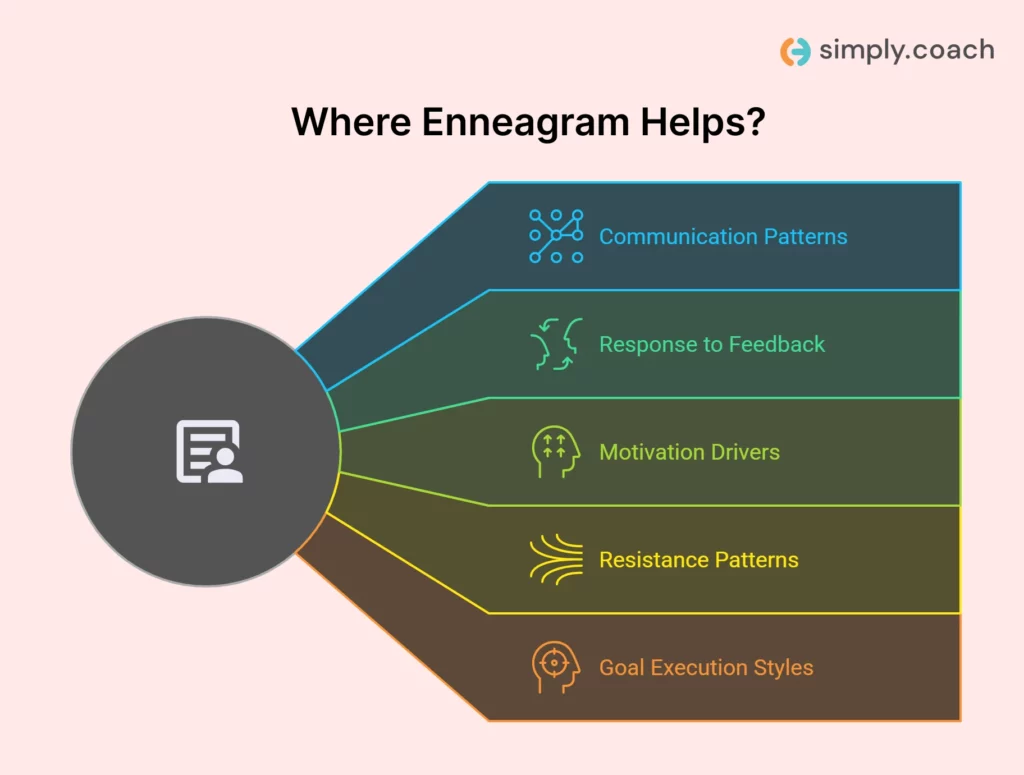
The enneagram becomes useful when it is applied to day-to-day coaching decisions, not when it is treated as theory. You will see it show up in how clients communicate, make decisions, and respond under pressure.
In sessions, this typically appears as:
- Communication patterns: Some clients are direct and action-oriented, others process internally before responding. Your questioning style needs to match this, otherwise you either lose momentum or create resistance.
- Response to feedback: Some clients want challenge and speed. Others need context, reflection, or time to absorb. The same feedback can either create movement or disengagement depending on how it is delivered.
- Motivation drivers: Clients are not motivated by the same outcomes. Some optimize for achievement, others for security, control, recognition, or meaning. Misalignment here is a common reason goals stall.
- Resistance patterns: What looks like procrastination, overthinking, or inconsistency is often patterned. The enneagram helps you identify what is actually driving the resistance.
- Goal execution style: Some clients move quickly but lose depth. Others need clarity before action. Some avoid commitment altogether. Your role is to calibrate pace and structure accordingly.
When you start recognizing these patterns, your coaching becomes more precise. You are no longer applying a standard framework. You are adapting it in real time.
What the enneagram is not (and where coaches misuse it)
The enneagram is often misapplied when it is treated as a shortcut instead of a lens. It is not:
- Reducing a client to a type limit how you interpret their behavior and create confirmation bias.
- It should guide where you look, not replace listening or questioning.
- It is not designed to assess mental health or replace therapeutic frameworks.
- Patterns must be observed over time, not inferred from initial impressions.
Misuse usually shows up as overconfidence. Once a type is assumed, everything starts to be interpreted through that lens, which reduces accuracy rather than improving it.
Also Read: Top 10 Enneagram Tests in 2026 for Coaches to Recommend to Clients
How to Use the Enneagram in Real Coaching Sessions for Better Results?
The value of the coaching Enneagram is not in identifying personality traits. It is in helping coaches diagnose real session-level patterns such as resistance, overthinking, avoidance, misalignment, and stalled progress.
When used well, it helps coaches adapt their approach based on how different clients process pressure, motivation, and change.
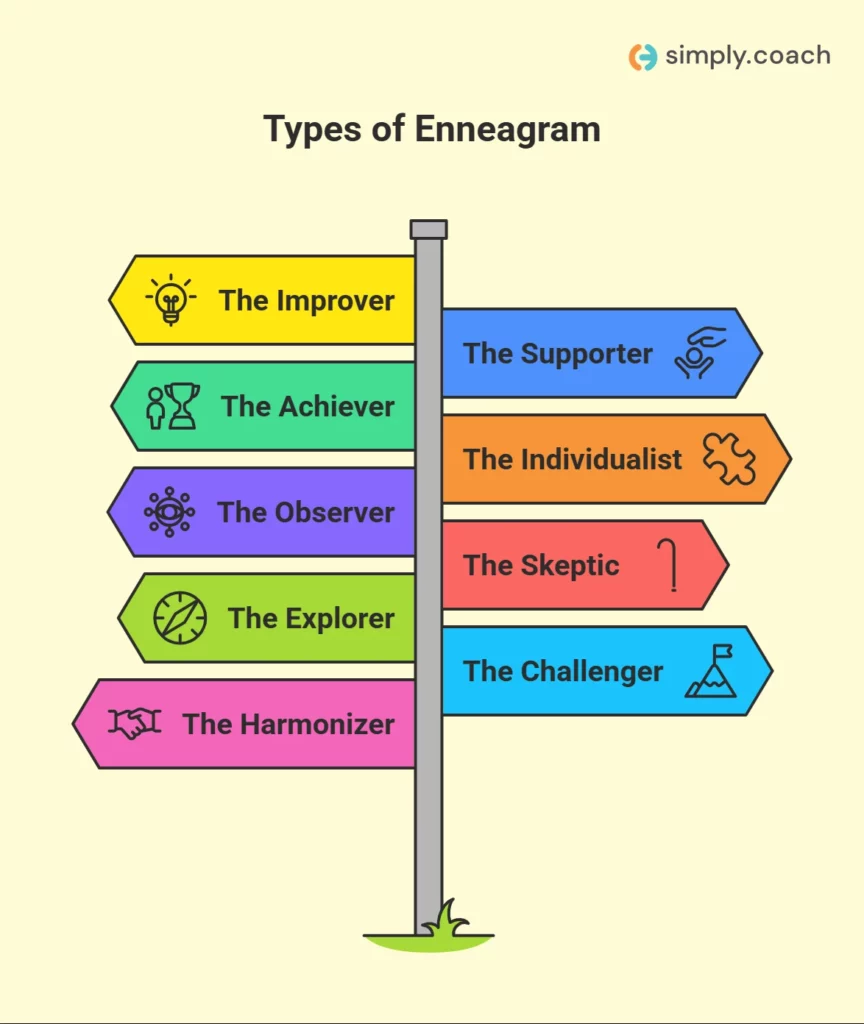
1. The Improver: With Type 1 clients, the Enneagram helps coaches identify when high standards are slowing progress. Instead of encouraging more refinement, the coaching shift is often toward execution, completion, and redefining what “good enough” looks like.
2. The Supporter: For Type 2 clients, it helps reveal when growth is being delayed by over-focus on other people’s needs. Coaching becomes more effective when personal progress is reframed as a way to create greater impact rather than self-prioritisation.
3. The Achiever: With Type 3 clients, the Enneagram helps surface the gap between external success and internal alignment. This allows coaches to move beyond performance and explore whether the client’s goals are actually meaningful to them.
4. The Individualist: For Type 4 clients, it helps coaches recognise when the client is waiting for emotional clarity before taking action. The coaching shift is often from reflection and identity exploration toward movement, experimentation, and clarity through action.
5. The Observer: With Type 5 clients, the Enneagram helps identify when thinking has become a substitute for doing. Coaches can then focus less on more input and more on helping the client convert understanding into visible action.
6. The Skeptic: For Type 6 clients, it helps reveal when hesitation is rooted in lack of self-trust rather than lack of clarity. This allows coaches to shift away from reassurance and toward strengthening decision ownership and internal authority.
7. The Explorer: With Type 7 clients, the Enneagram helps coaches spot when enthusiasm is being spread across too many directions. The coaching opportunity is usually to introduce structure, constraint, and commitment without shutting down momentum.
8. The Challenger: For Type 8 clients, it helps identify where strong action may be masking avoidance of vulnerability, internal tension, or relational friction. This gives coaches a way to expand range without diluting the client’s natural decisiveness.
9. The Harmonizer: With Type 9 clients, the Enneagram helps coaches recognise when inaction is being driven by avoidance of tension or disruption. Coaching becomes more effective when accountability, specificity, and follow-through are made more explicit.
The real value of the coaching enneagram is in structuring your coaching process around how clients think, decide, and act. At an advanced level, it becomes a framework for calibrating your approach across every stage of the coaching engagement.
Below is a practical, session-level framework you can apply consistently.
Intake: build pattern awareness, not type certainty
At intake, the objective is to understand how the client interprets problems, makes decisions, and frames goals.
Focus on three dimensions:
- Decision lens → outcome-driven, risk-aware, relationship-focused, meaning-driven
- Attention bias → what they naturally focus on (results, people, flaws, possibilities, threats)
- Default response under pressure → control, withdrawal, overthinking, avoidance, overaction
Instead of typing, document patterns. Over time, these signals become reliable indicators of how the client will behave in later stages of coaching.
Questioning: design questions to disrupt default patterns
The purpose of questioning is pattern interruption. Each client has a default way of thinking that limits progress.
Structure your questioning around:
- Reinforcing awareness → helping clients see their own patterns clearly
- Challenging bias → introducing perspectives they naturally avoid
- Driving movement → shifting from reflection to action
This requires adapting your questioning style:
- For overthinkers → reduce analysis, push toward decisions
- For action-driven clients → slow down, introduce reflection
- For avoidance patterns → increase specificity and commitment
Your questions should counterbalance the client’s default tendencies.
Goal setting: align goals with internal drivers, not just outcomes
Most goal-setting frameworks fail when they assume motivation is uniform. The enneagram allows you to align goals with what actually drives the client.
Structure goal-setting across three layers:
- External outcome → what the client wants to achieve
- Internal driver → why this matters to them
- Execution style → how they are most likely to follow through
If these three are not aligned, goals lose traction.
For example:
- Some clients need measurable progress to stay engaged
- Others need meaning or identity alignment
- Others need reduced uncertainty or clear structure
The enneagram helps ensure goals are not just defined, but sustainable based on how the client operates.
Feedback: deliver insight in a way that leads to action
Feedback is not just about accuracy, it is about absorption and application. The same insight can either create movement or resistance depending on how it is delivered.
Structure feedback around:
- Clarity → make the pattern visible
- Relevance → connect it to outcomes or goals
- Actionability → define what changes next
Adapt delivery based on client patterns:
- Some clients need direct, outcome-focused feedback
- Others need contextual framing to process it
- Others need time and space before responding
The key is to ensure feedback does not just create awareness, but leads to behavioral change.
Integration: use the enneagram as a calibration layer, not a system
The enneagram should sit on top of it as a calibration layer. Across all sessions, ask:
- Is my approach aligned with how this client thinks?
- Am I reinforcing their pattern or disrupting it?
- Are my interventions creating movement or maintaining comfort?
This ongoing calibration is what turns the enneagram from a conceptual tool into a practical advantage in coaching execution.
Use the enneagram to structure how you listen, question, set goals, and deliver feedback, so every part of your coaching adapts to how the client actually operates.
What to Avoid When Using an Enneagram?
The biggest mistakes coaches make with the Enneagram usually do not come from misunderstanding the model, but from over-applying it.
Problems tend to show up when coaches use type too quickly, too rigidly, or too literally, causing the framework to limit inquiry instead of improving coaching quality.
- Typing clients too early: Assigning a type too soon can lead to premature assumptions and narrow how the coach interprets the client from the start.
- Using type to explain everything: When every behaviour is filtered through type, coaches can miss context, contradictions, and situational patterns.
- Replacing inquiry with assumptions: Relying on what a type “typically” does can reduce curiosity and make sessions feel generic or overly interpretive.
- Focusing on type over outcomes: Too much emphasis on personality analysis can create insight without action and slow the client’s momentum.
- Treating the Enneagram as fixed: Clients evolve over time, and using the Enneagram too rigidly can lead to outdated assumptions and weaker interventions.
The Enneagram is most effective when it supports coaching rather than drives it. Used with flexibility and restraint, it helps coaches improve precision, deepen understanding, and guide clients toward more meaningful progress.
Also Read: Why Simply.Coach is the Best Life Coaching Platform for Your Business
How Simply.Coach Helps You Achieve Better Results From the Enneagram
Using the enneagram effectively requires more than understanding patterns. It requires tracking how those patterns show up across sessions, how clients respond over time, and how your interventions evolve based on that.
In practice, this becomes difficult when insights stay in your head or are scattered across notes. Patterns get missed, sessions become inconsistent, and it becomes harder to apply the enneagram in a structured way as your client load grows.
Simply.Coach helps you operationalize this. It gives you a system to capture patterns, track behavior over time, and apply personalized coaching consistently without relying on memory.
Where Simply.Coach supports enneagram-based coaching in practice:
- Client workspaces (track patterns across sessions): Capture session notes, behavioral patterns, triggers, and progress in one place. This allows you to identify recurring themes, such as resistance, overthinking, or avoidance, and adjust your coaching approach over time.
- Session notes and context tracking (from insight to application): Document not just what happened, but how the client responded, what patterns emerged, and what interventions worked. This makes it easier to refine your approach based on actual behavior, not assumptions.
- Journeys and coaching frameworks (consistent personalization at scale): Build structured coaching journeys that can be adapted for different client patterns. This helps you maintain consistency in your methodology while adjusting delivery based on how each client operates.
- Goals and action plans (align motivation with execution): Track goals alongside action steps and follow-through. This helps you connect client motivation patterns with actual execution, a key part of applying the enneagram effectively.
- Nudges and between-session engagement (reinforce behavior change): Support clients between sessions with reminders and actions tied to their patterns. This ensures insights translate into consistent behavior, not just in-session awareness.
- Reports and progress tracking (measure what actually changes): Track outcomes over time, making it easier to see how changes in your coaching approach impact client progress across different personality patterns.
What this changes in your coaching practice
When your coaching is structured:
- you can track patterns instead of relying on memory
- your interventions stay consistent across sessions
- personalization becomes repeatable, not reactive
- insights translate into measurable client progress
Simply.Coach does not replace frameworks like the enneagram. It helps you apply them consistently, so your coaching remains both personalized and scalable.
Conclusion
The coaching enneagram becomes useful when it changes how you coach, not just how you understand your client.
Most coaching challenges are not about lack of strategy. They come from misalignment, using the same questions, pacing, and feedback style with clients who think, decide, and respond differently. Over time, this shows up as resistance, inconsistent follow-through, or stalled progress.
As your coaching practice grows, the challenge is not personalization. It is maintaining that level of precision consistently across clients and sessions. The enneagram becomes a practical advantage when it is applied deliberately, not just understood conceptually.
However, applying the enneagram consistently requires structure behind your sessions.
Simply.Coach helps you track client patterns, session insights, and progress in one place, so your coaching stays personalized, consistent, and scalable without relying on memory or scattered notes.
See how Simply.Coach supports a more structured, pattern-driven coaching practice.
FAQs
1. Do coaches need formal certification to use the enneagram?
No, formal certification is not mandatory, but a structured understanding is important. Without proper grounding, coaches risk oversimplifying types or misapplying insights, which can reduce effectiveness.
2. Can clients accurately identify their own enneagram type?
Self-identification is possible, but often incomplete. Clients may relate to multiple types or choose based on surface traits, so coach-guided exploration tends to be more reliable.
3. How long does it take to accurately understand a client’s enneagram pattern?
It usually takes multiple sessions to identify consistent patterns. Early impressions can be misleading, so it is better to observe behavior over time rather than rushing to conclusions.
4. Should coaches explicitly share enneagram types with clients?
Not always. Some clients benefit from understanding their patterns through the model, while others respond better when insights are applied without introducing labels.
5. How is the enneagram different from other personality frameworks?
The enneagram focuses on underlying motivations and internal drivers, rather than just observable traits. This makes it particularly useful for addressing resistance, decision-making, and behavioral patterns.
6. Can the enneagram be used in team or group coaching?
Yes, it is often used to improve communication, conflict resolution, and role clarity within teams. However, it requires careful facilitation to avoid labeling or oversimplification.
7. Is the enneagram suitable for all coaching niches?
It can be applied across niches like leadership, life coaching, executive coaching, but its depth makes it more valuable in engagements focused on behavior change rather than purely tactical outcomes.