
When coaching neurodivergent clients, standard approaches often fall short. Attention may shift unpredictably, emotions can escalate rapidly, and gaps in executive function can slow progress. Without thoughtful adjustments, sessions risk losing structure, creating frustration, or increasing no-shows. Awareness of sensory processing, cognitive load, and emotional triggers is key to keeping clients engaged and moving forward.
Your goal is to help clients maintain focus, make confident decisions, and regulate emotions while respecting their unique processing styles. Rigid frameworks can overwhelm or disengage clients, eroding trust and slowing growth. By observing subtle cues and adapting methods in real time, you can design sessions that feel safe, structured, and productive while supporting autonomy.
In this article, you’ll discover actionable strategies, coaching types, and clinical decision points to implement coaching for neurodivergent people effectively.
Key Takeaways
- Misaligned coaching approaches increase no-shows and disengagement, especially when executive function and sensory needs are ignored.
- Structured, cognitively aligned strategies improve task initiation and follow-through, reducing client overwhelm during goal execution.
- Real-time adaptation of pacing, modality, and session structure is critical for maintaining emotional regulation and engagement.
- Strength-based and metacognitive approaches improve self-awareness and decision-making, leading to more sustainable behavior change.
- Simply.Coach supports neurodivergent coaching with tools like customizable forms and structured action plans, helping you reduce cognitive load, track patterns, and turn insights into manageable, consistent actions.
What Is Neurodivergent Coaching And How Does It Work?
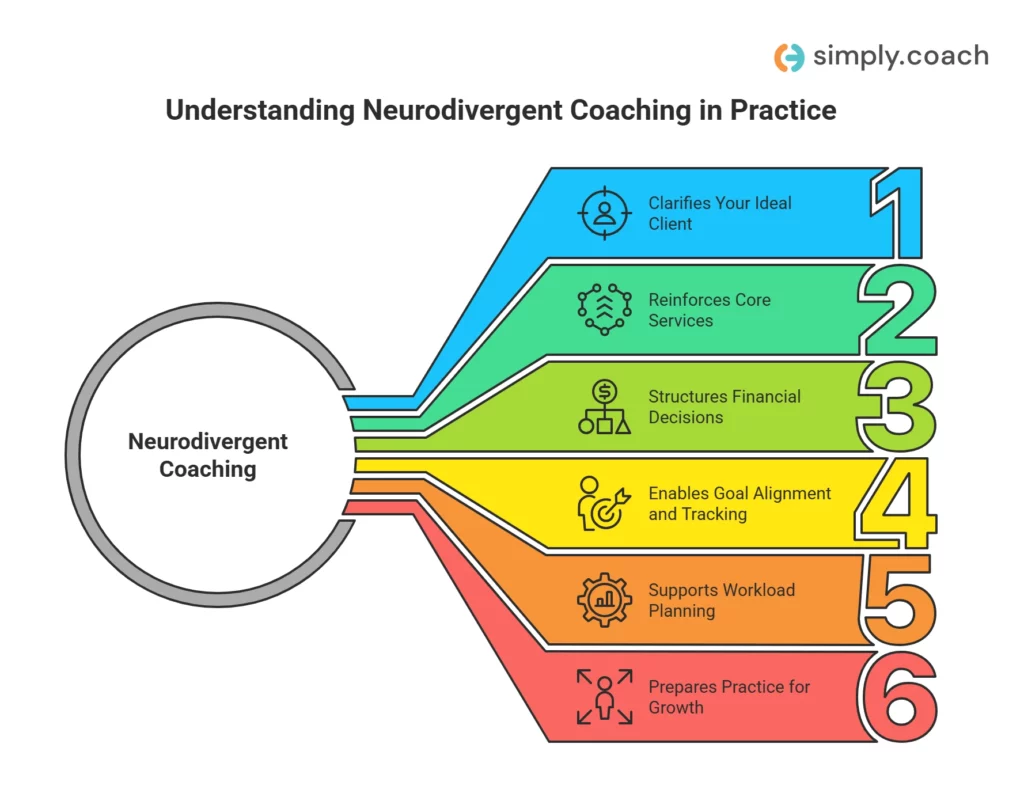
Neurodivergent coaching focuses on supporting clients whose thinking, attention, and processing styles differ from those of neurotypicals. Instead of forcing standard systems, coaching is adapted to how the client naturally operates, with an emphasis on strengths, clarity, and consistency.
As a coach, your role is to create a structured and supportive environment where clients can manage challenges in attention, planning, emotional regulation, and communication in ways that work for them.
How neurodivergent coaching works in practice:
- Creating a predictable and low-friction environment: Clear structure, simple workflows, and reduced overwhelm help clients stay engaged and consistent.
- Supporting executive function challenges: You help clients break down tasks, prioritise effectively, and follow through without cognitive overload.
- Adapting communication and session formats: Sessions may include visual aids, step-by-step guidance, or flexible pacing tailored to the client’s processing style.
- Building emotional and behavioural regulation: You provide strategies to manage stress, avoid burnout, and maintain momentum during challenges.
- Using a strength-based approach: Instead of focusing solely on difficulties, you leverage strengths such as creativity, pattern recognition, and deep focus to drive progress.
Neurodivergent coaching works best when it is flexible, structured, and tailored to how the client thinks, rather than forcing them into a fixed system.
Also read: 5 Traits of a Great ADHD Coach
With the coaching framework in place, clarifying your specific role ensures your approach aligns with client expectations and needs.
The Role of a Coach for Neurodivergent Clients
Coaching neurodivergent clients requires you to manage a wide spectrum of cognitive, emotional, and sensory profiles. These clients may experience differences in attention regulation, executive function, working memory, sensory sensitivity, and social cognition, which influence how they engage, process information, and implement strategies.
Your key responsibilities include:
- Creating a neuro-safe environment: Offer a structured, predictable, and non-judgmental space that reduces cognitive overload and sensory stress.
- Supporting executive function challenges: Assist clients with planning, prioritization, task sequencing, and overcoming working memory limitations.
- Facilitating emotional regulation: Recognize affective dysregulation, provide grounding strategies, and intervene early in escalation cycles.
- Managing social cognition differences: Help clients interpret social cues, manage relational dynamics, and communicate effectively in professional or personal contexts.
- Customizing session modalities: Adjust verbal, visual, or kinesthetic approaches according to sensory sensitivities or processing preferences.
- Strength-based facilitation: Highlight creative problem-solving, hyperfocus, analytical skills, or unique learning approaches to enhance engagement and outcomes.
- Translating insights to organizational contexts: Provide workshops or training that demonstrate how neurodivergent traits contribute to workplace innovation and collaboration.
Now that the role is clear, let’s explore the various coaching techniques for neurodivergent people.
8 Neurodiversity Coaching Techniques for Neurodivergent People
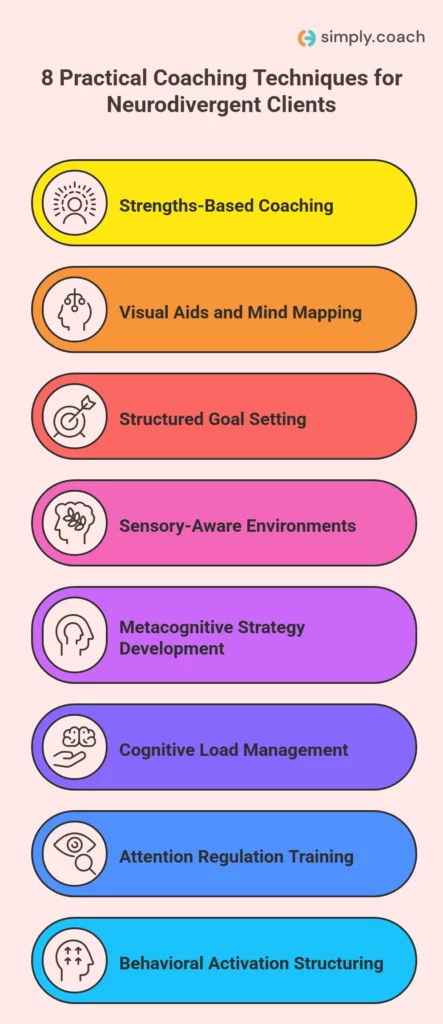
Neurodivergent clients require coaching strategies that align with how they process information, regulate emotions, and manage cognitive load. The following strategies are designed to help you intervene with precision while maintaining clarity, flexibility, and client autonomy.
1. Strengths-based coaching
Neurodivergent clients often display exceptional cognitive strengths, such as hyperfocus, advanced analytical reasoning, or creative problem-solving. You can incorporate techniques like mapping client strengths to goal-directed activities, designing tasks that align with cognitive profiles, and reinforcing self-efficacy through repeated skill application.
In-session application
- Identify strengths by analyzing past situations where the client performed with ease or high engagement.
- Translate strengths into specific, repeatable actions tied to current goals.
- Reframe challenges in context, showing how the same trait functions as a strength in different conditions.
- Reinforce patterns by linking strengths to consistent outcomes across sessions.
Guided prompts for implementation
- “Where does this feel easier for you, and what is different in that situation?”
- “How can you use your natural focus or thinking style to approach this task?”
- “What conditions help this strength show up more consistently?”
- “How would this task change if it matched how your brain prefers to work?”
- “Which part of this goal already aligns with your strengths?”
2. Visual aids and mind mapping
Visual structuring helps reduce working memory strain and linear processing demands, which often slow down decision-making for clients with ADHD, dyslexia, or processing variability. By externalizing thoughts into maps, diagrams, or spatial layouts, you can help clients organize information in a way that matches how they process it.
In-session application
- Convert verbal discussions into simple visual maps to show relationships between ideas.
- Group related tasks or concepts visually to improve prioritization and sequencing.
- Use color, spacing, or symbols to highlight importance and reduce cognitive clutter.
- Encourage clients to build or modify the map themselves to strengthen engagement.
- Revisit visuals across sessions to support memory and continuity.
Guided prompts for implementation
- “Can we map this out so you can see how everything connects?”
- “What stands out to you when you look at it this way?”
- “Which parts belong together, and which feel separate?”
- “Where does this fit within your bigger priorities?”
- “What becomes clearer when you see it visually?”
3. Structured goal-setting
Structured goal-setting helps you reduce executive function strain, decision fatigue, and task initiation barriers that many neurodivergent clients experience. Clients may struggle with translating abstract goals into actionable steps due to working memory limits or planning difficulties. You can introduce clear, externally structured pathways that break ambiguity and support follow-through.
In-session application
- Break goals into clearly defined micro-steps with one action per step to reduce cognitive load.
- Use time-bound anchors (e.g., specific days or durations) to support task initiation.
- Externalize plans using written or visual formats to compensate for working memory limitations.
- Limit options when decision paralysis is present by offering structured choices.
- Re-sequence tasks in real time if the client shows signs of overwhelm or disengagement.
Guided prompts for implementation
- “What is the smallest next step that feels doable right now?”
- “If this had to be completed in 15 minutes, what would you focus on first?”
- “Which part of this feels unclear or too open-ended?”
- “Would it help to choose between two clear options instead of generating new ones?”
- “What needs to happen before this step becomes easier to start?”
4. Sensory-aware environments
Sensory-aware coaching helps you manage sensory load, environmental distractions, and physiological overstimulation, which can directly impact attention and emotional regulation. Neurodivergent clients, particularly those with autism or sensory processing differences, may experience heightened sensitivity to noise, light, or visual clutter, affecting engagement.
In-session application
- Assess environmental factors such as noise, lighting, screen fatigue, and visual clutter at the start of sessions.
- Offer flexibility in session format, including camera use, pacing, and breaks.
- Reduce sensory load by simplifying visual inputs and limiting simultaneous stimuli.
- Introduce micro-pauses when signs of overstimulation or fatigue appear.
- Co-create a consistent session structure to provide predictability and safety.
Guided prompts for implementation
- “Is anything in your environment making it harder to focus right now?”
- “Would adjusting lighting, sound, or screen setup help you stay more present?”
- “Do you need a short pause to reset before we continue?”
- “What type of environment helps you think more clearly?”
- “How can we structure this session so it feels easier to stay engaged?”
5. Metacognitive strategy development
Metacognitive strategy development helps clients understand how they think, plan, and regulate their behavior, rather than only focusing on outcomes. Neurodivergent clients often struggle with self-monitoring, error detection, and strategy selection, especially under cognitive or emotional load. You can guide clients to build awareness of their internal processes, enabling more intentional decision-making and adaptive responses.
In-session application
- Pause after task discussions to explore what the client noticed about their thinking process.
- Help clients identify patterns in attention shifts, decision points, and breakdown moments.
- Externalize thinking using brief summaries or written reflections to improve clarity.
- Compare different strategies the client has used and evaluate which conditions supported success.
- Reinforce awareness by linking insights to specific adjustments for future tasks.
Guided prompts for implementation
- “What was happening in your thinking when you got stuck?”
- “How did you decide what to do next in that moment?”
- “What helped you stay on track, even briefly?”
- “What would you do differently next time based on this experience?”
- “Which strategy felt most natural or sustainable for you?”
6. Cognitive load management
Cognitive load management focuses on reducing mental overload caused by excessive information, task complexity, or competing demands. Neurodivergent clients often reach overload faster due to working memory limits, slower processing speed, or sensory interference, which can lead to avoidance or shutdown.
In-session application
- Limit the number of active topics and focus on one task or decision at a time.
- Break complex discussions into short, sequential segments with clear transitions.
- Use written or visual supports to offload memory demands during planning.
- Monitor signs of overload, such as slowed responses or disengagement, and adjust pacing immediately.
- Introduce brief pauses to allow processing and consolidation before moving forward.
Guided prompts for implementation
- “Is this too much to process at once, or should we simplify it?”
- “Which part feels most manageable to focus on right now?”
- “Would it help to pause and organize this before continuing?”
- “What is one piece we can complete before moving to the next?”
- “Do you need more time to process this, or should we break it down further?”
7. Attention regulation training
Attention regulation training helps clients manage fluctuating focus, distractibility, and inconsistent task engagement, which are common in ADHD and other neurodivergent profiles. Clients may experience cycles of hyperfocus followed by disengagement, making sustained progress difficult.
In-session application
- Identify when the client’s attention is most stable and align tasks to those periods.
- Introduce structured focus intervals with clear start and end points to reduce drift.
- Minimize task-switching by grouping similar activities together.
- Use external cues such as timers or checklists to support sustained attention.
- Redirect gently when attention shifts, without increasing cognitive pressure.
Guided prompts for implementation
- “When during your day does focusing feel easier or more natural?”
- “Would it help to work on this in a short, timed block?”
- “What usually pulls your attention away from this task?”
- “How can we make it easier to return to this after a distraction?”
- “What would help you stay with this for the next 10 minutes?”
8. Behavioral activation structuring
Behavioral activation structuring helps clients overcome task avoidance, inertia, and low initiation energy, which often result from executive dysfunction or emotional overwhelm. Neurodivergent clients may delay tasks not due to lack of motivation, but because starting feels cognitively or emotionally heavy.
In-session application
- Identify tasks the client is avoiding and analyze what makes them difficult to start.
- Reduce the entry barrier by defining a 2–5 minute starting action.
- Pair tasks with existing routines or environmental cues to trigger initiation.
- Reinforce action over perfection to prevent cognitive overload.
- Track small completions to build behavioral momentum across sessions.
Guided prompts for implementation
- “What is the easiest possible way to begin this?”
- “Can you commit to just 2 minutes of this task to get started?”
- “What usually makes starting this feel difficult?”
- “What can you do to make the first step feel lighter?”
- “What would count as a small win here today?”
Once these techniques are integrated, using Simply.Coach ensures your operations are structured, efficient, and client-focused.
7 Types of Coaching for Neurodivergent Clients
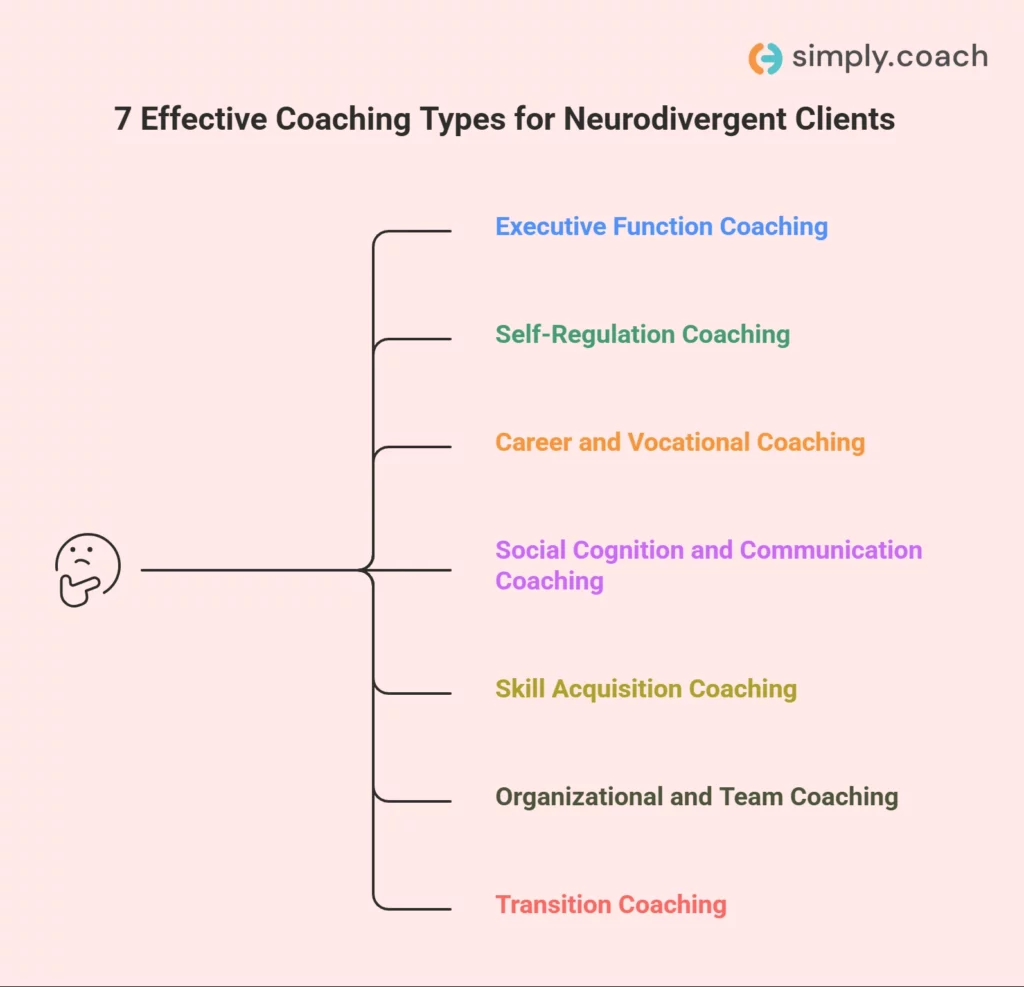
Neurodivergent clients present heterogeneous cognitive, emotional, and sensory profiles, which influence attention, executive functioning, emotional regulation, and social engagement. Different coaching approaches are tailored to address these unique processing patterns, helping clients manage daily, professional, and social challenges while using their cognitive strengths.
1. Executive function coaching
This type focuses on planning, organization, task initiation, time management, and working memory. Clients with ADHD, dyspraxia, or other executive function differences often struggle to sequence tasks or follow multi-step instructions. Strategies like “chunking” tasks, prioritization matrices, and real-time accountability help clients progress toward complex goals without overwhelm.
2. Self-regulation coaching
Neurodivergent clients often experience affective dysregulation, heightened emotional reactivity, or difficulty recovering from stress. Coaching supports emotional awareness, impulse control, and self-soothing techniques. You can guide clients to identify triggers, recognize early signs of escalation, and implement regulation strategies before overwhelm compromises decision-making or engagement.
3. Career and vocational coaching
Many neurodivergent clients encounter workplace challenges such as sensory overload, social misinterpretation, or executive function demands. Techniques include structured job-task mapping, communication scripts, and adaptive routines that mitigate environmental stressors while enhancing performance.
4. Social cognition and communication coaching
Clients on the autism spectrum or with social-pragmatic differences may struggle with interpreting nonverbal cues, conversational reciprocity, or relational nuance. You can support clients in building social confidence, managing professional or personal interactions, and practicing adaptive strategies that respect individual comfort zones and sensory sensitivities.
5. Skill acquisition coaching
Many clients benefit from breaking complex tasks into scaffolded, sequential steps, especially when executive function or learning differences are present. You can provide visual aids, checklists, or multimodal instructions to reduce cognitive load and reinforce mastery, ensuring clients gain independence in both professional and personal domains.
6. Organizational and team coaching
Neurodivergent clients in group settings often face communication barriers, sensory stress, or social ambiguity. Coaching techniques include structured check-ins, role clarity, and cognitive load-friendly task allocation to maximize participation and reduce stress in professional teams.
7. Transition coaching
Life transitions, such as career changes, higher education, or independent living, can overwhelm neurodivergent clients due to executive function demands, sensory sensitivities, or emotional regulation challenges. You’ll work with clients to predict stressors, scaffold tasks, and develop self-advocacy skills, ensuring smoother adaptation to new roles or environments.
Also read: ADHD Coach Salary Guide: U.S. Rates, Factors & Strategies to Boost Income in 2026
After selecting the right coaching methods, applying targeted in-session techniques brings strategy into measurable practice
Build Neurodivergent-Affirming Coaching Workflows With Simply.Coach
To provide coaching for neurodivergent people, you need systems that reinforce executive function, reduce cognitive load, and maintain engagement without adding friction. Simply.Coach, a leading digital coaching platform, enables you to operationalize these principles seamlessly, so your clients experience consistency, clarity, and regulated progress between sessions.
- Forms: Capture pre-session cognitive states, sensory sensitivities, and reflection inputs in a structured way, reducing the need for clients to process and articulate everything in-session.
- Action plans: Break down session insights into clear, low-friction steps, supporting execution without overwhelming neurodivergent clients who may struggle with initiation or sequencing.
- Notes: Structure the session capture in a way that reinforces memory, then convert key insights into actions, supporting continuity for neurodivergent clients with working memory challenges.
- Client workspaces: Provide a predictable, low-clutter environment where clients can access goals, notes, and resources without navigating multiple tools or distractions.
- Embedded video conferencing: Prepare clients ahead of sessions, reduce last-minute cognitive load, and maintain consistency in attendance and readiness.
- Journeys: Design structured yet flexible coaching pathways with clear progression, supporting neurodivergent clients who benefit from routine, predictability, and less ambiguity.
- Reports: Track neurodivergent behavioral patterns such as consistency, engagement, and follow-through, helping you adjust interventions based on observable trends rather than assumptions.
- Stakeholder integration: Incorporate structured feedback in workplace contexts, supporting neurodivergent clients navigating communication, expectations, and social dynamics.
Simply.Coach allows you to extend your coaching approach beyond sessions, reinforcing structure, regulation, and accountability without increasing manual effort.
Conclusion
Coaching for neurodivergent clients requires you to move beyond standard frameworks and work with how your clients actually process information, regulate emotions, and initiate action. The strategies outlined, ranging from cognitive load management to metacognitive development, enable you to design interventions that are structured, adaptive, and aligned with each client’s neurocognitive profile, improving engagement and sustained progress.
To implement this effectively, your role extends into continuous observation, real-time adaptation, and precise structuring of both sessions and between-session work. Neurodivergent clients benefit when coaching is predictable, low-friction, and cognitively aligned, rather than overly abstract or rigid.
To support this level of structured, adaptive coaching at scale, coaching platforms like Simply.Coach enable you to operationalize your coaching approach, turning session insights into structured action plans, automated nudges, and repeatable workflows. This reduces manual follow-ups, minimizes administrative load, and gives you greater visibility into client progress without constant tracking
FAQs
1. What is coaching for neurodivergent clients?
Coaching for neurodivergent clients adapts methods to align with executive function, attention, and sensory processing differences. You use structured, flexible approaches to improve engagement and follow-through.
2. How is coaching neurodivergent clients different from traditional coaching?
In neurodivergent coaching, you must adjust pacing, structure, and communication to match nonlinear thinking and variable attention patterns. Standard frameworks often fail without these adaptations.
3. What challenges do neurodivergent clients face in coaching?
Clients may struggle with task initiation, working memory, sensory overload, and emotional regulation. These factors can disrupt consistency and goal execution.
4. Which coaching strategies work best for neurodivergent clients?
Strategies like cognitive load management, structured goal-setting, and strengths-based coaching improve clarity and reduce overwhelm. They support sustained engagement and execution.
5. How do you improve focus in neurodivergent clients?
Use attention regulation techniques, timed work blocks, and reduced task switching. Align tasks with natural focus patterns to improve consistency.
6. Why is structure important in coaching neurodivergent clients?
Structure reduces decision fatigue and cognitive overload, making it easier to initiate and complete tasks. It provides predictability and stability in sessions.
7. Can neurodivergent clients benefit from coaching?
Yes, when coaching aligns with their cognitive and emotional processing styles, outcomes improve significantly. Misaligned approaches often limit progress.
8. How do you reduce overwhelm in neurodivergent clients?
Break tasks into micro-steps, limit information load, and adjust pacing in real time. This helps maintain engagement and prevents shutdown or avoidance.