
When people hear “wealth coach,” they often assume it involves managing investments, but that’s not your role. You are not a financial advisor or planner, and you do not tell clients where to invest their money. Instead, you focus on something far more foundational, their relationship with money.
As a wealth coach, you help clients uncover the beliefs they formed about money early in life, understand the emotions those beliefs trigger, and recognize the habits and patterns that shape their financial decisions. You also work within the context of family dynamics, where money often carries unspoken expectations, tension, and meaning.
This distinction is what makes your work valuable. Financial strategies can only go so far without clarity, alignment, and trust behind them. You help clients build that clarity so their decisions are not just financially sound, but also intentional and sustainable.
In this article, you will gain a clear understanding of what your role as a wealth coach truly involves, how your work differs from other financial professionals, who you can create the most impact for, and how to build a credible and effective wealth coaching practice.
Key Takeaways
- A wealth coach helps you improve your relationship with money, focusing on beliefs, habits, emotions, and family dynamics rather than managing investments.
- Coaching supports clarity, purpose, and intentional financial decisions across individuals, families, founders, and next-generation heirs.
- Wealth coaches guide family conversations, succession planning, governance frameworks, and legacy alignment for long-term wealth sustainability.
- Your role requires emotional intelligence, systems thinking, facilitation, strategic decision-making, financial literacy, and ethical awareness.
- Becoming a wealth coach involves education in finance and behavior, professional credentials, practical experience, and a structured coaching practice.
- Simply.Coach provides tools for client workspaces, repeatable program frameworks, multi-stakeholder sessions, and secure practice management.
- Wealth coaching adds value beyond money, it protects relationships, strengthens communication, and aligns wealth with purpose and values.
Who Is a Wealth Coach?
As a wealth coach, you help individuals and families improve their relationship with money. Your role is not to manage or invest money, but to help clients understand how they think, feel, and behave around it.
Money is deeply emotional and personal. It is shaped by early experiences, beliefs, habits, and family dynamics. You guide your clients in identifying these patterns, challenging limiting beliefs, and making more intentional and aligned financial decisions.
You also help clients redefine what wealth truly means in their lives. It goes beyond net worth to include well-being, purpose, impact, and relationships. More money does not automatically create fulfillment. You help clients close that gap.
Your work often sits in the space most financial professionals do not address. You help clients build self-awareness, clarity, and confidence so that their financial choices reflect who they are and what they truly value.
How wealth coaching differs from other financial professionals
Not everyone with “financial” or “wealth” in their title plays the same role. As a wealth coach, your work is distinct in both scope and impact.
Here’s how your role compares:
| Key aspects | Wealth coach | Financial advisor | Financial planner | Financial coach | Wealth manager |
| Scope of advice | Emotional, behavioral, relational, and legacy dimensions of wealth | Investment recommendations and asset growth | Goal-specific financial planning such as retirement, tax, estate, and education | Foundational money management such as budgeting, debt, and savings | Comprehensive financial services across investments, tax, and estate |
| Investment authority | None | Yes | Sometimes | No | Yes |
| Typical role scope | No mandatory licensing required | Requires licensure such as Series 65 or RIA registration | Licensing is required | Certifications are available but not mandatory | Requires licensure and registration |
| Fiduciary obligation | No, though ethical practice is expected | Usually yes | Usually yes | No | Usually yes |
| Who hires them | Affluent families, founders, next-generation heirs, and individuals navigating wealth transitions or emotional money patterns | Individuals and families seeking investment guidance and asset growth | Individuals planning for specific financial milestones | Individuals building foundational financial skills and habits | High-net-worth individuals and families needing full-service financial management |
Also read: Financial Coach vs Financial Advisor: Key Differences Explained
What Does a Wealth Coach Actually Do?
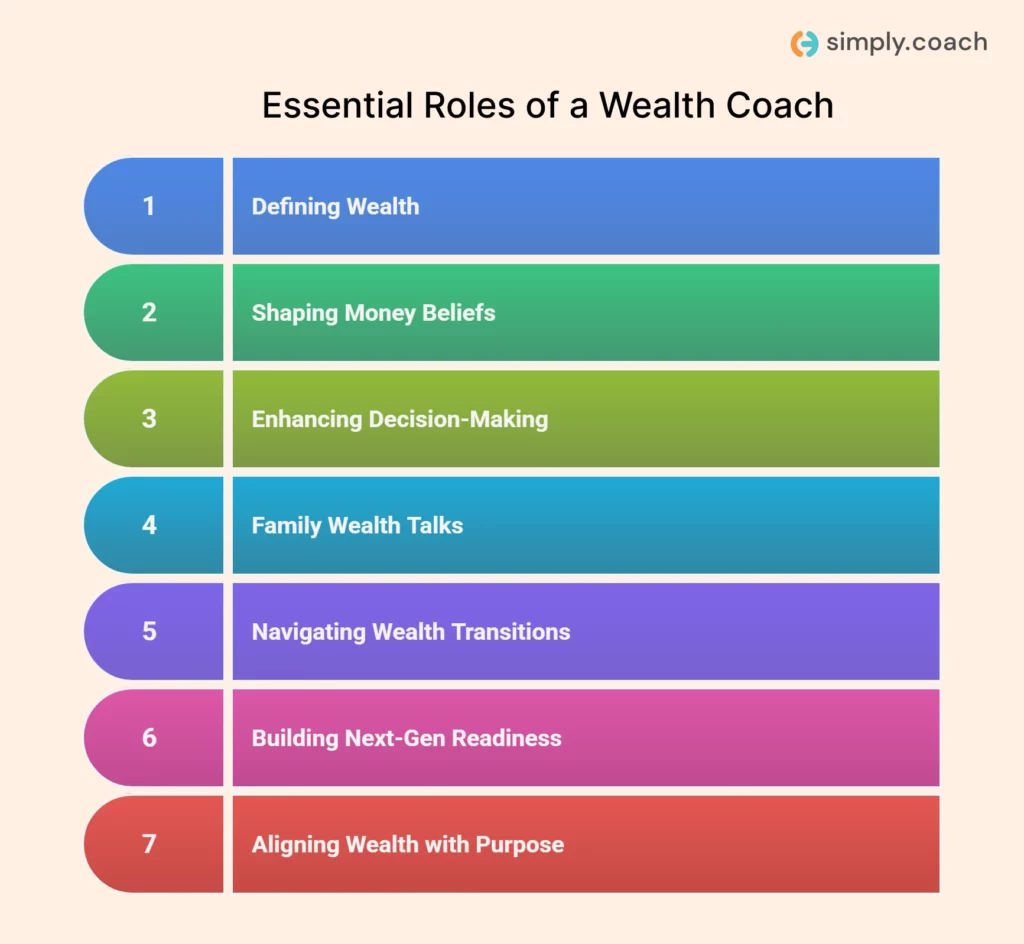
As a wealth coach, your role is to help clients navigate the human side of wealth. You do not manage money. You help clients think clearly about it, relate to it intentionally, and make decisions that align with their values and long-term vision.
Your work typically includes:
- Clarify your client’s definition of wealth: You help clients move beyond net worth and define what wealth means in their life, including purpose, lifestyle, relationships, and impact. This becomes the foundation for all future decisions.
- Identify and reshape money beliefs: You uncover unconscious money scripts formed through early experiences and help clients challenge limiting beliefs that drive unhelpful financial behaviors.
- Improve financial decision-making: You guide clients to slow down reactive choices, evaluate trade-offs, and make decisions that align with both financial realities and personal values.
- Facilitate family wealth conversations: You create structure for discussions around inheritance, expectations, roles, and responsibilities, reducing ambiguity and preventing long-term conflict.
- Prepare clients for wealth transitions: You support clients through events such as business exits, inheritance, or sudden wealth by helping them manage the emotional, relational, and identity shifts involved.
- Develop next-generation readiness: You work with heirs to build financial confidence, decision-making ability, and a sense of stewardship so they are prepared, not just entitled.
- Align wealth with purpose and legacy: You help clients connect their financial resources to meaningful outcomes, including lifestyle choices, long-term impact, and philanthropic intent.
Ultimately, your role is to ensure that wealth is not just accumulated, but understood, aligned, and sustained across decisions, relationships, and generations.
Common Myths About Wealth Coaches
As a wealth coach, you will often need to clarify what your role is and what it is not. Misconceptions can create confusion for potential clients and undervalue the depth of your work.
Here are some of the most common myths you will encounter and how to reframe them.
Myth 1: You manage your clients’ investments
You do not manage portfolios, recommend stocks, or create financial plans. That is the role of a financial advisor. Your work focuses on how clients think about money, make decisions, and navigate the emotional and relational aspects of wealth.
Myth 2: Wealth coaching is only for the ultra-wealthy
Your work is not defined by net worth. It is defined by complexity. Clients at different income levels face challenges with money beliefs, communication, and decision-making. The patterns exist regardless of how much wealth someone has.
Myth 3: You help clients get rich
You do not promise financial gains. You help clients define what wealth actually means to them and align their decisions accordingly. For many clients, the real shift is moving from chasing more to making intentional choices.
Myth 4: You create budgets and financial plans
That is financial coaching. Your work goes deeper by addressing why clients behave the way they do with money. When beliefs and patterns change, financial behavior becomes more consistent and sustainable.
Myth 5: Talking about wealth creates conflict
In reality, avoiding these conversations creates more tension over time. You bring structure and neutrality to discussions, helping clients and families communicate clearly and reduce misunderstandings.
Myth 6: Clients only need you during a crisis
While you often support clients during major transitions, your greatest impact comes from proactive work. You help clients build clarity, communication frameworks, and alignment before problems escalate.
Myth 7: Having money means having clarity
Financial success does not automatically create direction or purpose. Many of your clients may reach their financial goals and still feel uncertain about what comes next. Money can answer what is possible, but it cannot define what is meaningful. You help clients navigate those deeper questions so their wealth supports a clear sense of purpose, not confusion or drift.
Who Needs a Wealth Coach?
You deliver the most impact when financial stakes are high, relationships are complex, or the emotional weight of money feels heavier than it should. Your ideal clients often fall into these categories:
1. Affluent families managing complexity
You help families navigate challenges such as:
- Generational transitions, including passing wealth, leadership, or property without damaging relationships
- Succession confusion, clarifying who leads, decides, or inherits
- Governance gaps, establishing structure and shared agreement for major decisions
2. Business owners and founders
You support founders through transitions where business and identity are deeply intertwined. Your work includes:
- Preparing clients for life after a business exit or leadership transfer
- Managing identity shifts and emotional impact that financial planning alone cannot address
- Resolving tension caused by heirs’ lack of clarity or leadership conflicts
3. Individuals experiencing wealth anxiety
You help clients manage the emotional challenges of wealth, including:
- Wealth guilt from inheritance, earning more than peers, or family expectations
- Imposter syndrome when financial success outpaces internal confidence
- Lingering financial trauma from childhood scarcity, sudden loss, or exploitation
- You guide clients to identify, rework, and overcome patterns that quietly undermine decisions.
4. Next-generation heirs
You prepare heirs to carry wealth forward responsibly by:
- Building financial literacy and decision-making confidence
- Supporting autonomy and identity development separate from family wealth
- Cultivating a stewardship mindset, helping heirs view wealth as responsibility, not entitlement
By working with these clients, you ensure that wealth is not only preserved, but also aligned with values, purpose, and long-term impact.
Skills and Qualities to Become a Wealth Coach
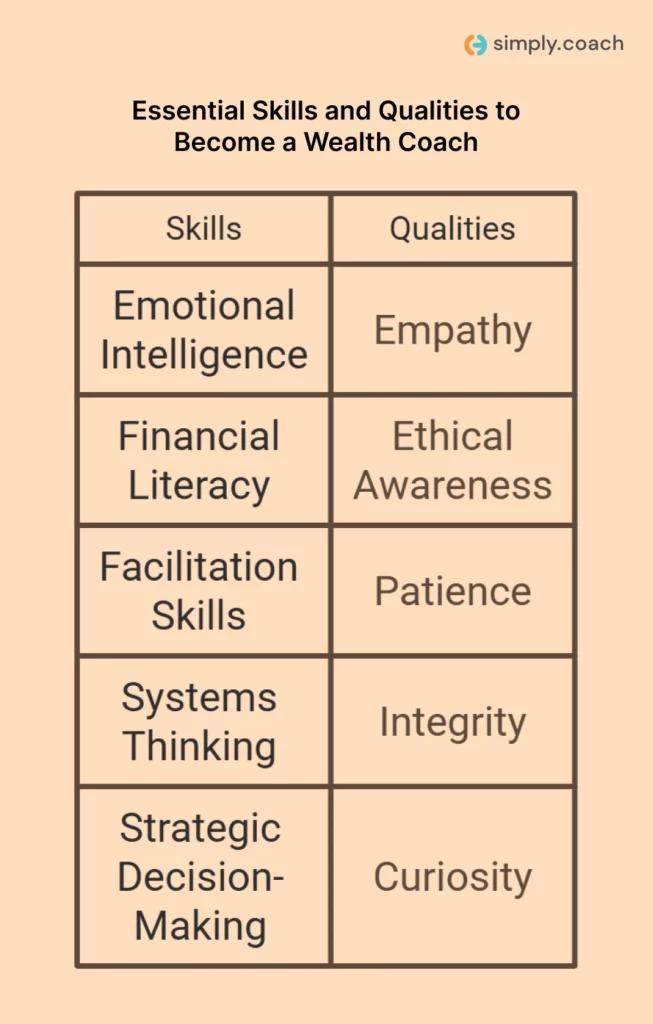
To succeed as a wealth coach, you need a combination of practical skills and personal qualities. These help you guide clients effectively, manage complex conversations, and provide meaningful insight into the human side of wealth.
| Skills | Qualities |
| Emotional intelligence: You can recognize and manage both your own emotions and your clients’ emotional responses to money. | Empathy: You naturally understand and resonate with clients’ feelings, which helps build trust and safety during sensitive conversations. |
| Financial literacy: You understand basic financial concepts like trusts, cash flow, and taxes to provide informed guidance without giving investment advice. | Ethical awareness: You maintain clear boundaries, ensuring clients receive coaching without crossing into regulated financial advice. |
| Facilitation skills: You can guide family meetings and multi-stakeholder conversations, helping clients communicate effectively and reduce conflict. | Patience: You stay composed during challenging or slow-moving discussions, allowing clients the space to process and reflect on decisions. |
| Systems thinking: You see wealth in the context of family, business, and generational structures, which helps design long-term frameworks. | Integrity: You act consistently with your values, building credibility and ensuring clients trust your guidance. |
| Strategic decision-making: You can help clients weigh options, assess trade-offs, and make choices that align with their goals, values, and legacy. | Curiosity: You stay open to learning about clients’ unique situations, continuously exploring patterns, behaviors, and solutions. |
By mastering these skills and embodying these qualities, you can deliver transformative guidance that helps clients not only manage wealth but also build clarity, purpose, and long-term alignment across generations.
Steps to Become a Wealth Coach
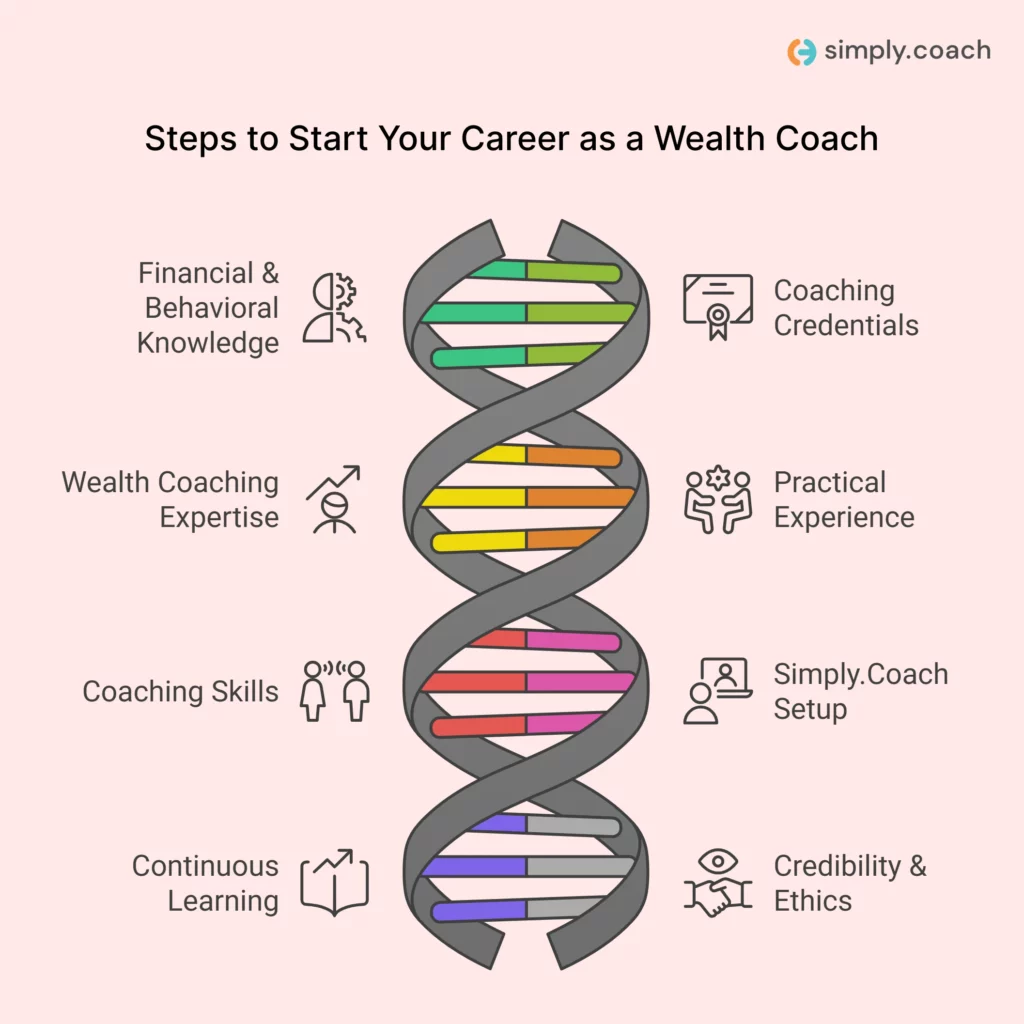
Becoming a wealth coach requires a combination of education, skills development, practical experience, and professional credibility. Following these steps ensures you are prepared to guide clients effectively through the human side of wealth.
Step 1: Gain foundational knowledge in finance and behavior
You should understand key financial concepts, including cash flow, estate planning, trusts, taxes, and wealth transition mechanics. Pair this with study in behavioral finance, psychology, or family systems to grasp how beliefs, emotions, and patterns influence financial decisions. This foundation allows you to confidently guide clients without stepping into investment management.
Step 2: Obtain professional coaching credentials
Enroll in accredited coaching programs such as those offered by the International Coaching Federation (ICF). Credentials validate your methodology, demonstrate professional commitment, and teach core coaching competencies. These certifications help clients trust your guidance and show that you follow structured, ethical practices.
Step 3: Develop specialized wealth coaching expertise
Seek training or certifications focused on money psychology, behavioral finance, or wealth transitions. Programs like the Accredited Financial Counselor (AFC), or courses from the Money Coaching Institute provide frameworks to address emotional, relational, and practical aspects of wealth. This specialization allows you to differentiate yourself in a growing field.
Step 4: Build practical experience
Start working with clients, friends, or pro bono cases to practice applying your skills in real situations. Focus on uncovering money beliefs, facilitating family discussions, and guiding clients through transitions such as inheritances or business exits. Practical experience helps you develop intuition, confidence, and credibility as a wealth coach.
Step 5: Cultivate core coaching skills
Hone skills such as emotional intelligence, active listening, facilitation, systems thinking, strategic decision-making, and ethical boundary management. These skills allow you to help clients navigate complex emotional and relational dynamics, ensuring they make intentional choices that align with their values and long-term goals.
Step 6: Establish a professional practice with Simply.Coach
Set up your coaching business with a clear structure for your services, contracts, and operational processes. Simply.Coach provides an all-in-one platform where you can:
- Create contracts and agreements easily, ensuring clarity on your scope of services
- Onboard clients and manage schedules, sessions, and progress tracking
- Structure repeatable programs for individuals, families, or next-generation clients
- Run multi-stakeholder sessions while collecting feedback and tracking behavioral shifts
- Maintain enterprise-level security for sensitive client data, including SOC2, HIPAA, and GDPR compliance
Using all in one coaching platform like Simply.Coach lets you focus on client relationships and coaching impact while the platform handles administrative, legal, and operational tasks efficiently.
Step 7: Network and continuously learn
Join professional communities, attend workshops, and stay updated on trends in wealth, psychology, and coaching practices. Networking helps you gain referrals, learn from peers, and continually improve the value you provide to clients. It also keeps you aware of emerging challenges in wealth transitions and client behavior.
Step 8: Maintain credibility and ethical standards
Clearly communicate your role and boundaries to clients. Never provide investment advice without proper licensure, and always act with integrity, confidentiality, and professionalism. Consistently demonstrating these standards builds trust and ensures your clients feel secure in your guidance.
Following these steps positions you to provide meaningful, long-term guidance that helps clients align their wealth with their purpose, relationships, and legacy, while running a professional, efficient practice with the support of Simply.Coach.
Conclusion
As a wealth coach, your role is not to tell clients what to do with their money. Your value lies in helping them decode their financial behaviors, uncover hidden beliefs, and understand the habits and family dynamics that shape their relationship with wealth. This work goes beyond numbers, it strengthens relationships, improves communication, and aligns shared values, ensuring that wealth truly lasts across generations.
With Simply.Coach, you can deliver this work efficiently and at scale. The platform provides structured client workspaces, repeatable program frameworks, and tools for managing multi-stakeholder sessions securely. By handling the operational side of your practice, Simply.Coach allows you to focus fully on guiding clients, building trust, and creating meaningful impact. It keeps your practice organized, compliant, and positioned for long-term growth.
FAQs
1. What is a wealth coach?
A wealth coach helps you improve your relationship with money, including beliefs, habits, and decision-making patterns rather than managing investments. They guide you to make intentional financial choices aligned with your values. It’s a behavioural and relational role, not a financial planner.
2. How does a wealth coach differ from a financial advisor?
A wealth coach focuses on mindset, habits, and the emotional side of money rather than investment strategies. A financial advisor is licensed to manage portfolios and products. Coaches do not give regulated investment recommendations.
3. Who can benefit from wealth coaching
Individuals, families, and business owners who feel overwhelmed, stuck, or misaligned with money can benefit. You also benefit if you face transitions like inheritances, exits, or intergenerational wealth decisions. Wealth coaching supports clarity, purpose, and sustainable financial behaviour.
4. What happens in a wealth coaching session?
A coach will explore your money beliefs, patterns, and goals to uncover underlying drivers of financial behaviour. They facilitate structured conversations and offer frameworks for alignment and clarity. The process is reflective and goal-oriented rather than directive.
5. Is a wealth coach only for wealthy people?
No. Wealth coaching is about behaviour, clarity, and intentional choices, not net worth alone. People at all income levels can struggle with money beliefs and money-related stress. The value comes from improving your financial mindset and decisions.
6. Do wealth coaches give investment advice?
No. Wealth coaches do not provide investment recommendations, manage assets, or sell financial products. Their focus is on your money patterns, communication, and financial clarity. Investment decisions should be made with a licensed advisor.