
Even if you’re the most experienced therapist, you hit moments where client engagement feels like walking a tightrope. You’re managing layered emotional states, tracking subtle shifts in regulation, and working to reduce no-shows, all while protecting the depth and integrity of your clinical work.
Over time, you start to notice patterns: clients revisiting the same themes, uneven follow-through between sessions, or progress slowing despite technically sound interventions. Many practitioners begin to question which strategies truly move the needle and what actually improves emotional regulation, strengthens rupture repair, and supports steady progress without increasing cognitive load or risking burnout.
In this article, we’ll break down session strategies, administrative optimizations, and clinical decision-making techniques designed to help you reduce no-shows, improve goal adherence, and navigate complex emotional dynamics with confidence.
Key Takeaways
- Consistency outside sessions determines whether insight translates into sustained behavioral and emotional change across time.
- Poorly structured systems, like scattered notes and inconsistent follow-ups, often disrupt progress more than a lack of clinical skill.
- Reducing no-shows requires both operational structure and in-session awareness of avoidance, resistance, and engagement patterns.
- The timing of interventions matters more than the intervention itself, especially during dysregulation or low-readiness phases.
- Overcomplicating tools, frameworks, or workflows increases cognitive load and weakens clarity in both sessions and planning.
Where Therapy Breaks Down in Practice
Expert therapists and those earlier in their careers encounter phases where progress slows despite consistent effort. These moments rarely stem from a lack of skill; they emerge from how clinical decisions, client readiness, and session structure intersect over time.
Before moving into structured tips for therapists, it helps to surface where therapy most commonly breaks down in real practice:
- Inconsistent follow-through between sessions: New therapists may over-prescribe tasks, while experienced therapists may under-structure them, leading to weak goal adherence.
- Untracked or loosely defined therapeutic goals: Early-career practitioners may set broad goals, while seasoned therapists may rely on memory instead of measurable shifts.
- Manual administrative load affecting clinical presence: Across all levels, time spent coordinating, scheduling, facilitating payments, and following up reduces cognitive bandwidth for attuned listening.
Also read: How to Prevent Coaching Burnout: 12 Strategies Every Coach Need (2026)
Understanding where therapy breaks down sets the foundation for applying the right tips with precision.
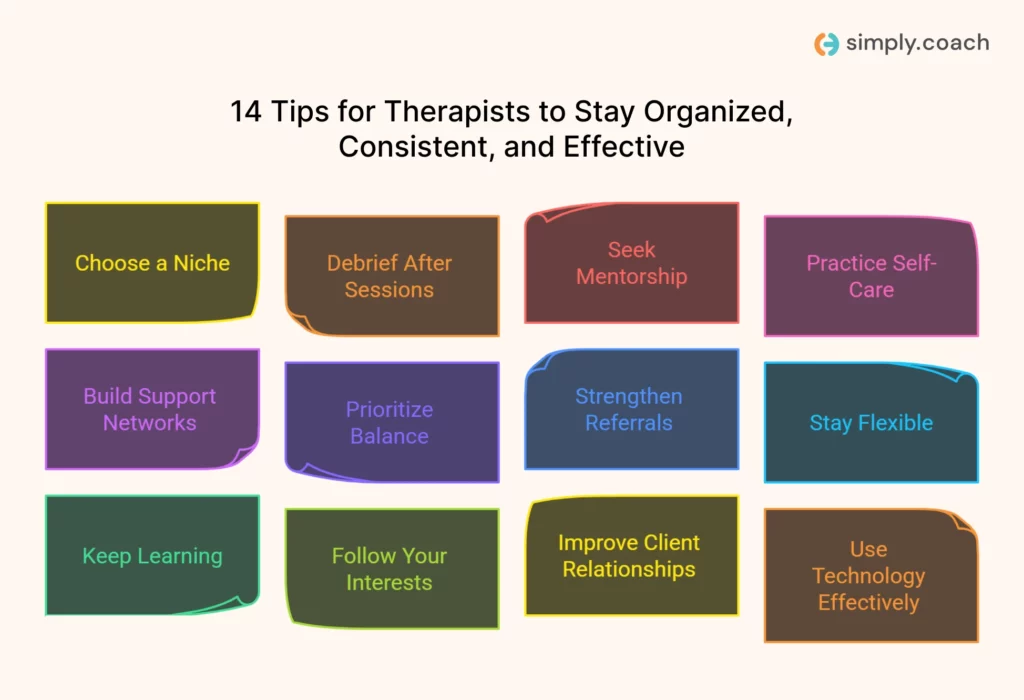
14 Tips For Therapists to Maintain Consistency in Practice
Before adding new techniques, it helps to recalibrate how you make decisions inside and between sessions. The following tips for therapists focus on improving clinical judgment, reducing no-shows, and strengthening follow-through where progress often stalls.
1. Choose a niche to establish yourself
Choosing a niche is all about clinical precision developed through repeated exposure. This directly impacts outcomes like emotional regulation, rupture repair, and adherence to therapeutic goals.
How to implement this
- Audit your last 20 sessions for pattern clustering: Identify recurring client concerns, rupture points, and intervention types where outcomes felt most stable and replicable.
- Introduce structured between-session tracking for 1–2 client segments: Use pre-session forms and brief check-ins to monitor emotional regulation and goal adherence within your emerging niche.
- Standardize your intake prompts for preferred client types: Refine questions to quickly assess readiness, risk factors, and communication patterns aligned with your focus area.
- Test niche alignment before fully committing: Block specific time slots for similar client profiles and evaluate consistency in engagement, no-shows, and session depth over 6–8 weeks.
2. Take time to debrief after each session
If you rely on memory to carry insights forward, note that recall alone often distorts clinical judgment over time. Debriefing creates a structured pause to examine what actually shifted in-session: emotional regulation, resistance, or subtle rupture signals.
How to implement this
- Block 5 structured minutes immediately after each session: Capture intervention timing, client response, and any missed cues before moving to the next client.
- Use a consistent 3-point debrief framework: What shifted, what resisted, and what needs to be tracked before the next session.
- Utilize pre-session forms for continuity: Compare client-reported emotional states with your last session notes to validate or challenge your assumptions.
- Tag patterns across 8–10 sessions: Identify recurring rupture points, emotional triggers, or communication breakdowns that inform future interventions.
3. Seek out mentorship and be open to feedback
At different stages, you may develop blind spots, not from lack of skill, but from repeated exposure to similar patterns without external challenge. Mentorship and feedback create a structured way to examine those patterns, especially in cases involving subtle resistance, stalled progress, or recurring ruptures.
How to implement this
- Schedule structured peer consultations for complex cases: Focus on cases with stalled progress, repeated no-shows, or unclear emotional shifts rather than routine check-ins.
- Bring session recordings or detailed process notes: Review exact intervention points, tone shifts, and missed cues instead of relying on retrospective summaries.
- Use feedback frameworks, not open-ended discussions: Ask specifically: Was the intervention timed correctly? Was emotional readiness accurately assessed?
- Rotate perspectives across disciplines when needed
Consult with professionals using different modalities to challenge habitual thinking patterns.
4. Practice self-compassion and prioritize self-care
You might often extend regulation and compassion outward while operating in a state of internal depletion. Over time, this shows up subtly as reduced tolerance for ambiguity, premature interventions, or difficulty holding emotional intensity without directing it.
How to implement this
- Build a pre-session regulation reset between clients: Use 2–3 minutes to downshift your nervous system before entering the next emotional context.
- Track your own activation patterns across sessions: Note when certain client themes trigger urgency, frustration, or withdrawal in your responses.
- Schedule recovery blocks after high-intensity sessions: Avoid stacking emotionally demanding clients without space to recalibrate your attention.
- Use brief post-session discharge practices: Physically or cognitively release residual emotional load to prevent carryover into subsequent sessions.
5. Build a support network and set boundaries to prevent burnout
Build a support system you actually use, not just one you “have.” Stay in regular consultation with peers who understand your case complexity. Set clear limits on availability, session extensions, and between-session communication. When emotional residue from sessions builds up, process it deliberately instead of carrying it forward.
How to implement this
- Define clear caseload boundaries based on intensity: Limit the number of high-acuity or emotionally demanding clients per day to maintain clinical sharpness.
- Establish structured peer support touchpoints: Create consistent spaces for case reflection when challenges arise, and also as an ongoing practice.
- Set communication expectations with clients early: Clarify response times, boundaries outside sessions, and what constitutes urgent vs non-urgent contact.
- Segment your schedule to reduce emotional carryover: Avoid placing similar high-intensity cases back-to-back without a transition space.
6. Prioritize balance in your personal & professional life
Structure your week based on your cognitive and emotional capacity, not just availability. Place high-intensity sessions where your attention is strongest. Protect recovery time as seriously as client time. Notice early signs of fatigue, shorter patience, and quicker interpretations, and adjust before it affects your work.
How to implement this
- Design your weekly schedule around cognitive and emotional load: Place high-intensity sessions during your peak attention windows and avoid overloading those periods.
- Create non-negotiable personal recovery blocks: Treat time for rest, movement, or reflection as fixed commitments, not flexible gaps.
- Limit context-switching between roles: Avoid shifting directly from emotionally demanding sessions into unrelated high-focus tasks without transition time.
- Audit your energy patterns monthly: Identify when your clinical presence drops and adjust scheduling accordingly.
7. Take advantage of the power of networking
Treat your referral network as part of your clinical system. Build relationships with professionals who understand your approach and send clients who are ready for your level of work. Be clear about who you accept and who you refer out. Strong networks improve client fit, reduce early drop-offs, and make your caseload more clinically aligned.
How to implement this
- Audit your current referral sources: Identify which channels consistently send clients aligned with your niche and which lead to mismatched expectations or frequent no-shows.
- Build relationships with adjacent professionals: Connect with psychiatrists, coaches, and specialists whose work complements yours for smoother client transitions.
- Close the loop after referrals: Share non-confidential feedback on client fit and progress patterns to strengthen long-term referral quality.
- Create a clear referral filter: Define the client profiles you accept, defer, or redirect to avoid misalignment early.
8. Be open-minded and flexible
Adapt your approach based on client readiness, not preference for a modality. Shift between structure and exploration depending on regulation capacity and session phase. Make small adjustments and observe the response instead of changing direction too quickly.
How to implement this
- Define your “non-negotiables”: Identify which parts of your approach must remain consistent to maintain safety and structure.
- Adjust based on client readiness: Shift between exploratory, directive, or stabilizing approaches depending on emotional regulation capacity.
- Test small deviations, not full shifts: Introduce minor changes in intervention style and observe client response before changing direction entirely.
- Use session feedback as calibration: Track when flexibility improves engagement versus when it creates uncertainty or resistance.
Also read: How to Manage Client Shutdowns in Therapy: Strategies & Causes (2026)
9. Never stop learning
Apply what you learn directly to active cases instead of collecting frameworks. Test one approach across multiple sessions and observe its impact on regulation, engagement, and follow-through.
How to implement this
- Integrate one concept at a time: Apply a single technique or framework across multiple sessions instead of introducing several at once.
- Link learning to active cases: Identify where a new approach directly applies to current clients rather than abstract scenarios.
- Review outcomes after application: Track whether the new intervention improved emotional regulation, engagement, or goal adherence.
- Revisit and refine: Return to the same material after applying it to deepen understanding through practice.
10. Lean into your passions
Pay attention to the cases that hold your attention longer and deepen your thinking. Gradually shape your caseload around those areas. When your work aligns with your curiosity, your pattern recognition sharpens, and your sessions gain depth.
How to implement this
- Track which cases hold your attention longer: Notice where you feel more engaged, curious, and mentally present during and after sessions.
- Gradually rebalance your caseload: Increase the proportion of clients aligned with your interests without abrupt shifts.
- Deepen expertise in selected areas: Pursue focused learning and supervision tied to the types of cases you want to handle more often.
- Align session structure with your strengths
Lean into approaches that feel natural while still meeting client needs effectively.
11. Develop strong client-therapist relationships and enhance communication skills
Go beyond active listening. Use reflection to deepen insight, not repeat content. Introduce a challenge when the client is ready, and hold back when regulation drops. Track subtle shifts, withdrawal, over-compliance, and tone changes, and respond in real time.
How to implement this
- Track rupture signals in real time: Notice shifts in tone, withdrawal, or over-compliance as early indicators of misattunement.
- Vary communication based on session phase: Use more structure during early stabilization and increase exploration as emotional safety builds.
- Balance reflection with direction: Pair validation with a gentle challenge to prevent sessions from becoming repetitive.
- Use between-session check-ins: Reinforce continuity through brief prompts or pre-session forms to track emotional and behavioral shifts.
12. Invest in technology to improve client experience and continuity
Use systems that support your clinical work, not complicate it. Track goals, session themes, and progress in one place instead of relying on memory. Use automated reminders with pre-session forms to reduce no-shows and gather context.
How to implement this
- Set up automated reminders with pre-session forms: Use email and text nudges to reduce no-shows and gather emotional state data before sessions.
- Track goals and progress in one system: Monitor shifts in emotional regulation, behavior, and communication patterns across sessions.
- Use video conferencing integration for consistency: Maintain session continuity, especially for clients with scheduling or location constraints.
- Facilitate payments within your workflow: Reduce friction post-session so administrative tasks don’t interrupt clinical focus.
13. Streamline administrative tasks
Reduce decision fatigue by standardizing routine processes. Batch scheduling, follow-ups, and facilitating payments into fixed time blocks. Avoid handling admin between sessions; it disrupts your mental reset. The less energy you spend on coordination, the more you preserve for clinical work.
How to implement this
- Centralize scheduling and reminders: Use automated reminders (email & text) with pre-session forms to reduce back-and-forth and prevent no-shows.
- Batch administrative tasks into fixed windows: Handle scheduling, facilitating payments, and follow-ups at specific times instead of between sessions.
- Standardize recurring workflows: Create consistent processes for intake, cancellations, and rescheduling to reduce decision fatigue.
- Limit real-time admin during clinical hours: Avoid responding to non-urgent coordination messages between sessions.
14. Use templates for efficient clinical notes and letters
Templates are often treated as administrative shortcuts, but in practice, they influence how clearly you think about a case over time. Without structure, notes become either overly detailed without synthesis or too brief to track meaningful shifts. One of the most high-impact tips for therapists is that well-designed templates support continuity, sharper formulation, and more accurate follow-up between sessions.
How to implement this
- Create a structured note template with fixed fields: Include sections for presenting concern, intervention used, client response, and next-session focus.
- Use consistent language for tracking progress: Standardize how you describe emotional regulation, resistance, and behavioral shifts across sessions.
- Build templates for recurring documents: Prepare formats for intake summaries, progress updates, and referral notes to reduce variability.
- Review and refine templates quarterly: Adjust the structure based on what information you actually use in future sessions or consultations.
Also read: 7 Strategies to Attract More Therapy Clients in Private Practice
Once these practices are in place, the next challenge is sustaining them consistently across sessions and clients.
Turn Your Clinical Work Into Consistent Client Progress With Simply.Coach
Most therapists don’t struggle with what to do in-session; they struggle with maintaining continuity between sessions without adding administrative strain. This is where a leading digital coaching platform like Simply.Coach becomes clinically useful, not as a business tool, but as an extension of your therapeutic process.
Instead of relying on memory, scattered notes, or manual follow-ups, you can create a structured environment where client progress, communication, and engagement stay aligned across sessions.
Here’s how Simply.Coach supports better therapy outcomes:
- Nudges: Reinforce between-session follow-through with automated, non-intrusive reminders that support behavioral consistency without manual effort.
- Forms: Use pre-session forms to capture emotional state, resistance, and context before sessions begin, improving intervention timing.
- Action plans: Translate session insights into clear, trackable actions so clients don’t leave with awareness alone but with direction.
- Scheduling: Reduce no-shows through self-scheduling and automated reminders (email & text) with pre-session forms, improving session consistency.
- Notes: Use template-based notes to track interventions, responses, and patterns, turning documentation into a clinical thinking tool.
- Reports: Generate structured insights into client progress, helping you identify plateaus, improvements, or missed patterns over time.
- Client workspaces: Give clients a central place to access notes, goals, and shared resources, improving engagement between sessions.
- Embedded video conferencing: Maintain continuity with integrated sessions, ensuring notes, communication, and session data stay in one place.
- Goal & development planning: Set structured, trackable goals and monitor shifts in emotional regulation and behavior across sessions.
- Team engagements: Run structured therapy or coaching programs across groups while maintaining consistency in communication and tracking.
When applied thoughtfully, Simply.Coach helps you refine advanced practices by reducing cognitive load, improving follow-through, and making client progress more visible.
Conclusion
Effective therapy focuses on refining how and when you apply them. Each choice has an impact on clinical outcomes over time, such as selecting a niche and holding debriefing sessions to lower no-shows and improve between-session follow-through.
These tips are most useful when applied with judgment, considering client readiness, emotional regulation capacity, and the context in which interventions are introduced. Without clear goal tracking, consistent follow-ups, and organized session data, even strong interventions lose continuity.
If you are looking to implement these tips for therapists without adding administrative strain, Simply.Coach, through their all-in-one HIPAA-compliant therapy practice management software, offers a structured way to support your clinical workflow. From goal tracking and automated reminders (email & text) with pre-session forms to video conferencing integration and facilitating payments, it helps you maintain consistency across sessions while keeping your focus where it belongs, on client outcomes.
FAQs
1. What are the most effective tips for therapists to improve client outcomes?
The most effective tips for therapists focus on consistency between sessions and in-session technique. This includes structured goal tracking, timely follow-ups, and reducing no-shows through automated reminders (email & text) with pre-session forms. These practices improve emotional regulation, adherence, and continuity of care when applied at the right phase of therapy.
2. What advice for new therapists helps avoid early clinical mistakes?
Strong advice for new therapists centers on pacing, avoiding premature interpretation, over-structuring sessions, or pushing insight before emotional safety is established. Early-stage work should prioritize stabilization, rapport, and accurate assessment of client readiness before introducing deeper interventions.
3. How can therapists reduce no-shows in their practice?
Reducing no-shows requires both structural and relational adjustments. Use consistent scheduling patterns, automated reminders (email & text) with pre-session forms, and review attendance patterns during sessions when avoidance signals emerge. Avoid over-accommodating inconsistent attendance, as it can reinforce disengagement.
4. How do therapists improve client engagement between sessions?
Between-session engagement improves when tasks are specific, emotionally tolerable, and clearly linked to session work. Assign structured actions, use light check-ins, and avoid overwhelming clients during periods of dysregulation or resistance. Consistency matters more than volume.
5. What are common mistakes therapists make in ongoing practice?
Common errors include inconsistent follow-ups, fragmented note-taking, unclear goal tracking, and pushing interventions before clients are regulated. Another frequent issue is relying on memory instead of structured systems, which weakens continuity across sessions.
6. How do experienced therapists continue improving their skills?
Experienced therapists improve by refining judgment and learning new models. This includes reviewing session decisions, identifying missed rupture signals, and adjusting intervention timing. Mentorship, peer consultation, and structured feedback loops remain critical even at advanced stages.
7. When should therapists avoid introducing structured interventions?
Structured interventions should be avoided during high emotional dysregulation, trauma activation, or when power imbalances exist. In these cases, focus on stabilization, containment, and safety before moving into goal-oriented or directive work.
8. How can therapists track progress without overcomplicating their workflow?
Progress tracking should be simple, visible, and consistent. Use clear goals, periodic check-ins, and structured notes that capture behavioral and emotional shifts. Avoid over-documentation that adds cognitive load without improving clinical clarity.