
You work with clients who set clear goals, yet struggle to follow through consistently between sessions and commitments. Progress often slows, and conversations start repeating without meaningful behavioral change or forward movement. Many coaching engagements fail not because goals lack clarity, but because clients continue patterns they never identified as risks or boundaries.
Even when you use structured goal-setting frameworks, something still feels incomplete in how your clients execute and sustain progress. Without clear boundaries, clients default to familiar habits, which quietly undermine even the most well-defined goals.
This is where anti-goals add a critical layer to your coaching approach by helping clients define what they must avoid. They bring clarity to decision-making, strengthen accountability, and prevent common failure patterns before they take hold. In this blog, you will learn what anti-goals are, why they work, and how to apply them in your sessions to improve client outcomes and long-term success.
Key Takeaways
- Anti-goals are clearly defined outcomes or behaviors clients commit to avoiding, not just negative thoughts.
- They highlight recurring patterns and risks that undermine client progress, creating actionable behavioral boundaries.
- Anti-goals work by leveraging avoidance motivation, loss aversion, and clarity through contrast to prevent setbacks.
- They complement traditional goals, acting as guardrails that improve decision-making, accountability, and focus.
- Setting anti-goals involves defining worst-case scenarios, identifying friction points, flipping them into specific boundaries, and using “If-Then” strategies.
- Reviewing and linking anti-goals to measurable outcomes ensures sustainable progress and strengthens client ownership.
- Common mistakes include vague statements, too many anti-goals, ignoring triggers, or failing to review regularly.
- Tools like Simply.Coach help track, document, and reinforce anti-goals alongside traditional goals for measurable results.
What Are Anti-Goals?
Anti-goals are specific, clearly defined outcomes or behaviors that you and your clients commit to avoiding during a coaching engagement. They are not vague fears or negative thoughts, but concrete patterns such as missed commitments, poor boundaries, or recurring unproductive habits. In your coaching practice, anti-goals help you identify what has consistently blocked progress based on your client’s past decisions and behaviors. This gives you a structured way to address risks early and prevent setbacks before they affect momentum.
As a coach, you use anti-goals to create clear behavioral boundaries that guide everyday decisions and actions. They bring focus to what should not happen, which helps your clients stay aligned with their priorities and long-term direction. This approach allows you to design more precise action plans, reduce recurring friction, and strengthen accountability throughout the coaching process. Anti-goals ensure that progress remains consistent, intentional, and grounded in real behavioral change.
How Do Anti-Goals Work?
Anti-goals work by shifting your client’s focus from chasing outcomes to actively avoiding behaviors that create setbacks. This approach strengthens awareness, improves decision-making, and helps you guide clients with more precision during coaching engagements.
- Loss aversion drives stronger commitment: People naturally work harder to avoid losses than to achieve gains, which increases follow-through on behavioral changes.
- Avoidance motivation highlights hidden risks: Clients become more aware of patterns that lead to failure, allowing you to intervene before problems escalate.
- Clarity through contrast sharpens decision-making: Defining what to avoid makes desired outcomes clearer, helping clients make faster and more confident choices.
- Pattern interruption prevents repeated mistakes: Anti-goals expose recurring behaviors, enabling you to break cycles that traditional goal-setting often overlooks.
- Complements traditional goal-setting frameworks: Anti-goals act as guardrails, ensuring your clients stay aligned while working toward their primary goals.
- Psychological simplicity: Concentrating on avoiding specific outcomes reduces mental clutter and keeps clients’ focus manageable during coaching.
When you consistently apply these principles in your coaching practice, anti-goals become a practical tool for driving sustained and measurable client progress.
Also read: Goal Setting in Coaching: Helping Clients Set Goals They Can Achieve
Key Benefits of Anti-Goals in Coaching
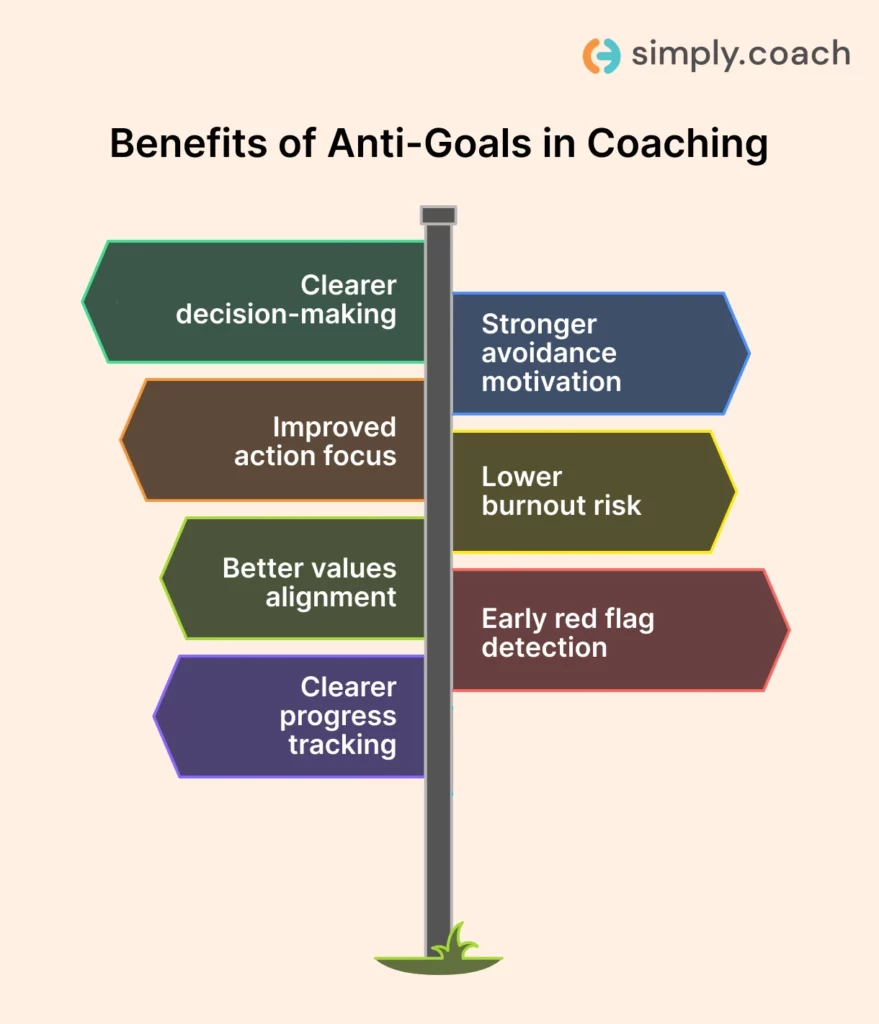
Anti‑goals offer coaches and clients insights beyond traditional goal‑setting by focusing attention on what to avoid, not just what to pursue. They help you create behavior patterns that reduce risk and improve decision quality, strengthening the coaching process and outcomes.
- Greater clarity in decision‑making: Anti‑goals sharpen your client’s awareness of unwanted outcomes, making choices more intentional and aligned with true priorities.
- Stronger motivation through avoidance cues: The brain’s natural bias toward avoiding losses can increase commitment when clients clearly see what they want to prevent.
- Improved focus on meaningful actions: Defining what to avoid helps eliminate distractions and keeps your clients centered on behaviors that matter most.
- Reduced risk of burnout: By intentionally avoiding behaviors and patterns that deplete energy, clients maintain balance and safeguard long‑term engagement.
- Better alignment of values and outcomes: Anti‑goals help clients name what drains their satisfaction, which strengthens clarity about the life and work they truly want.
- Easier identification of red flags: When clients name what they want to avoid, you can work together to spot warning signs earlier and prevent setbacks.
- Enhanced behavioral tracking: Avoidance targets create clear markers to monitor progress, making it simpler for you to assess changes over time.
Together, these benefits make anti‑goals a powerful complement to traditional goals, giving your clients a practical and psychologically grounded framework for real progress.
How Anti-Goals Differ from Traditional Goals
In coaching, understanding the difference between anti-goals and traditional goals helps you design strategies that both prevent setbacks and drive progress. Anti-goals focus on behaviors or outcomes clients want to avoid, while traditional goals focus on what clients aim to achieve.
| Aspect | Anti-goals | Traditional goals |
| Focus | Defines behaviors or outcomes to avoid, preventing recurring mistakes and unproductive patterns. | Defines desired outcomes or achievements to pursue, providing clear direction and targets. |
| Motivation | Driven by avoidance and loss aversion, encouraging clients to prevent negative consequences. | Driven by aspiration and reward, motivating clients to achieve specific results. |
| Clarity | Makes risks and problem areas visible, helping clients recognize what to prevent. | Makes success targets visible, helping clients focus on progress and measurable achievements. |
| Behavioral impact | Encourages reflection on choices to avoid repeated mistakes and poor decisions. | Encourages proactive actions toward achievement but may overlook recurring negative behaviors. |
| Best use in coaching | Works as a complementary tool to guide clients away from pitfalls and maintain accountability. | Works best for setting vision, tracking progress, and achieving measurable outcomes. |
Using anti-goals alongside traditional goals ensures clients not only pursue meaningful results but also avoid patterns that could undermine long-term success.
How to Set Anti-Goals in Coaching Practice
Setting anti-goals is a powerful inversion technique, originally popularized by investor Andrew Wilkinson. It helps your clients find clarity by defining what they don’t want, instead of only chasing aspirational goals. Many clients struggle to imagine a “perfect life” because it feels abstract, but they can vividly describe a “worst nightmare” with little effort.
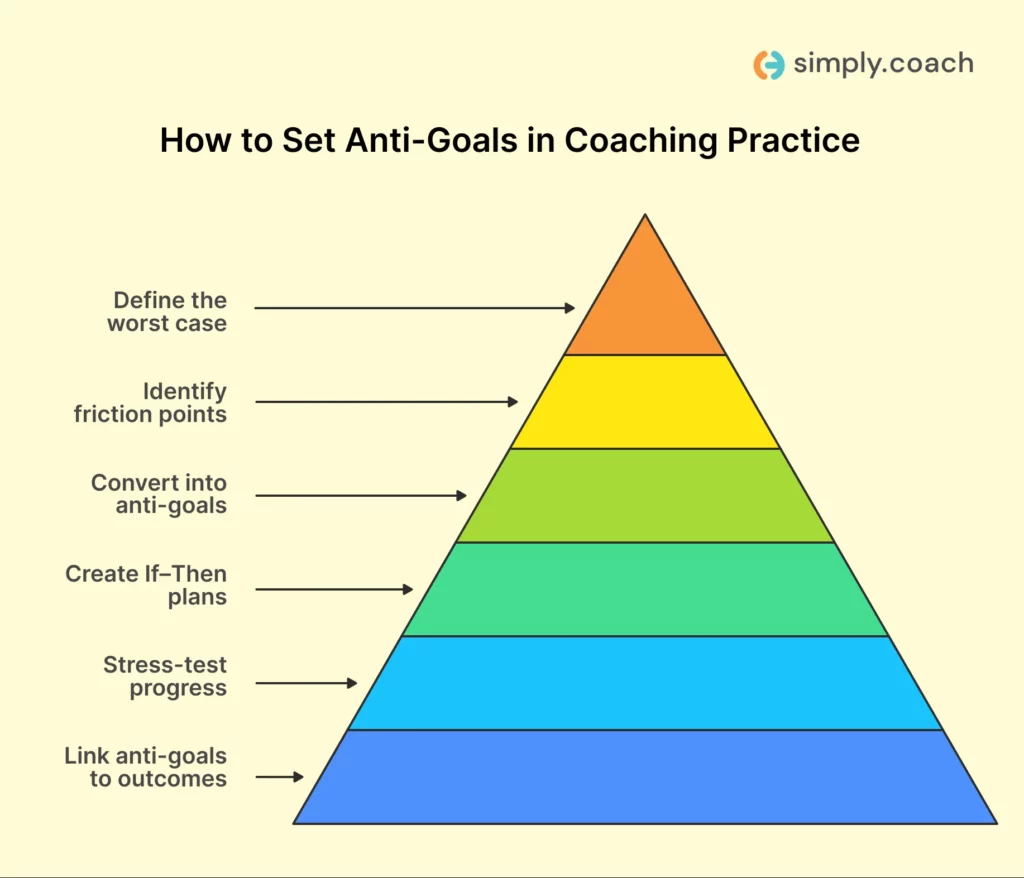
As a coach, using anti-goals gives you the ability to create guardrails that protect your client’s well-being, reduce overwhelm, and maintain focus while they pursue high-performance targets. Anti-goals are not just theoretical; they give you tangible behavioral levers that drive sustainable client progress.
1. The Inversion Exercise – Define the “worst case”
Start by asking your client to temporarily set aside aspirations. Encourage them to describe their “Worst Possible Day” or a “Project Failure.”
Coaching prompts:
- “If this coaching engagement completely failed six months from now, what would your day look like?”
- “Which people, habits, or tasks would drain your energy and block your progress?”
Objective: Identify the specific stressors, recurring mistakes, and triggers that clients instinctively fear. These insights allow you to translate abstract anxieties into actionable anti-goals.
Additional tip: Encourage clients to visualize worst-case scenarios in detail, including emotional responses. Emotional clarity strengthens motivation to avoid these outcomes.
Also read: Effective Mindset Coaching Questions to Unlock Client Breakthroughs
2. Identify the friction points
Once the worst-case scenario is clear, categorize each item to pinpoint actionable focus areas. Friction points help clients see patterns that repeatedly disrupt progress.
Common categories:
- Schedule: Back-to-back meetings, no time for focused work.
- Boundaries: Answering emails late at night or over weekends.
- People: Working with disrespectful, uncooperative, or disorganized colleagues or clients.
- Health: Skipping workouts, irregular meals, or neglecting sleep.
Tips for coaches:
- Prioritize the friction points that create the biggest energy drain or stress.
- Encourage journaling or reflection exercises to uncover hidden patterns.
- Focus on high-impact areas first to ensure clients experience early wins.
3. Flip the script into anti-goals
Translate each negative outcome into a specific anti-goal, a clear rule or boundary designed to prevent that outcome.
| Worst case scenario | Resulting anti-goal |
| Constant interruptions prevent deep work | I will not have my phone in the office during deep-work blocks |
| Resentment from tasks outside expertise | I will not accept tasks outside my Zone of Genius |
| Burnout limits family time | I will not take meetings after 5:00 PM, no exceptions |
Tips for coaches:
- Ensure each anti-goal is measurable and enforceable.
- Limit to 3–5 anti-goals per domain to prevent overwhelm.
- Encourage clients to reframe anti-goals in actionable behaviors, not vague restrictions.
Additional value: Framing anti-goals this way helps clients take ownership of their boundaries, strengthening self-regulation and confidence.
4. Create “If-Then” implementation intentions
Anti-goals are tested in real-world scenarios. Preparing your client for these challenges increases adherence.
Example of If-Then logic:
- “If a client requests a meeting after 5:00 PM, then I will offer them two slots the next morning.”
Coaching tips:
- Use this method to remove decision fatigue in the moment.
- Encourage clients to role-play scenarios where anti-goals might be challenged.
- Reinforce that testing boundaries is expected and provides data for refinement.
Additional value: This step strengthens resilience, making anti-goals practical and realistic rather than theoretical.
5. Review and “Stress-Test” success
In sessions, ask not only “What did you achieve?” but also “What did you successfully avoid?”
Coaching questions:
- Which anti-goals were consistently maintained this week?
- Did any boundaries get tested, and how did you respond?
- What triggers or patterns emerged that need adjustments?
Tips for coaches:
- Celebrate avoidance wins to reinforce behavior change.
- Treat broken anti-goals as data points, not failures.
- Adjust boundaries or systems if needed to make adherence sustainable.
Additional value: Reviewing anti-goals builds accountability and creates measurable progress, which increases client motivation and engagement.
6. Anchor anti-goals to measurable outcomes
Anti-goals become more effective when clients can clearly see how avoiding certain behaviors improves their results. Without this connection, clients may follow boundaries inconsistently because the impact feels indirect.
As a coach, help your clients link each anti-goal to a specific outcome they care about, such as improved focus, better energy levels, or stronger professional relationships. This makes anti-goals feel purposeful rather than restrictive, increasing long-term commitment.
Coaching questions:
- “What improves in your work or life when you successfully avoid this behavior?”
- “How does this anti-goal support your larger goals or priorities?”
Tips for coaches:
- Track before-and-after changes to show the impact of avoided behaviors.
- Connect anti-goals to measurable indicators like time saved, reduced stress, or improved output quality.
- Reinforce this connection during reviews to strengthen client motivation.
Additional value: When clients see clear outcomes tied to anti-goals, they shift from compliance to ownership, making behavior change more sustainable.
Implemented thoughtfully, anti-goals give you a structured, psychologically grounded system to help clients protect their energy, make better decisions, and sustain meaningful progress over time.
Master the Art of Planning and Goal Setting for Yourself as a Coach
This guide helps coaches apply the same clarity and structure they give clients to their own practice. Learn how to plan effectively, set actionable goals, and avoid common coaching pitfalls. Gain practical tools to stay focused, accountable, and consistent in growing your coaching business.

Best Practices for Using Anti-Goals Effectively in Coaching
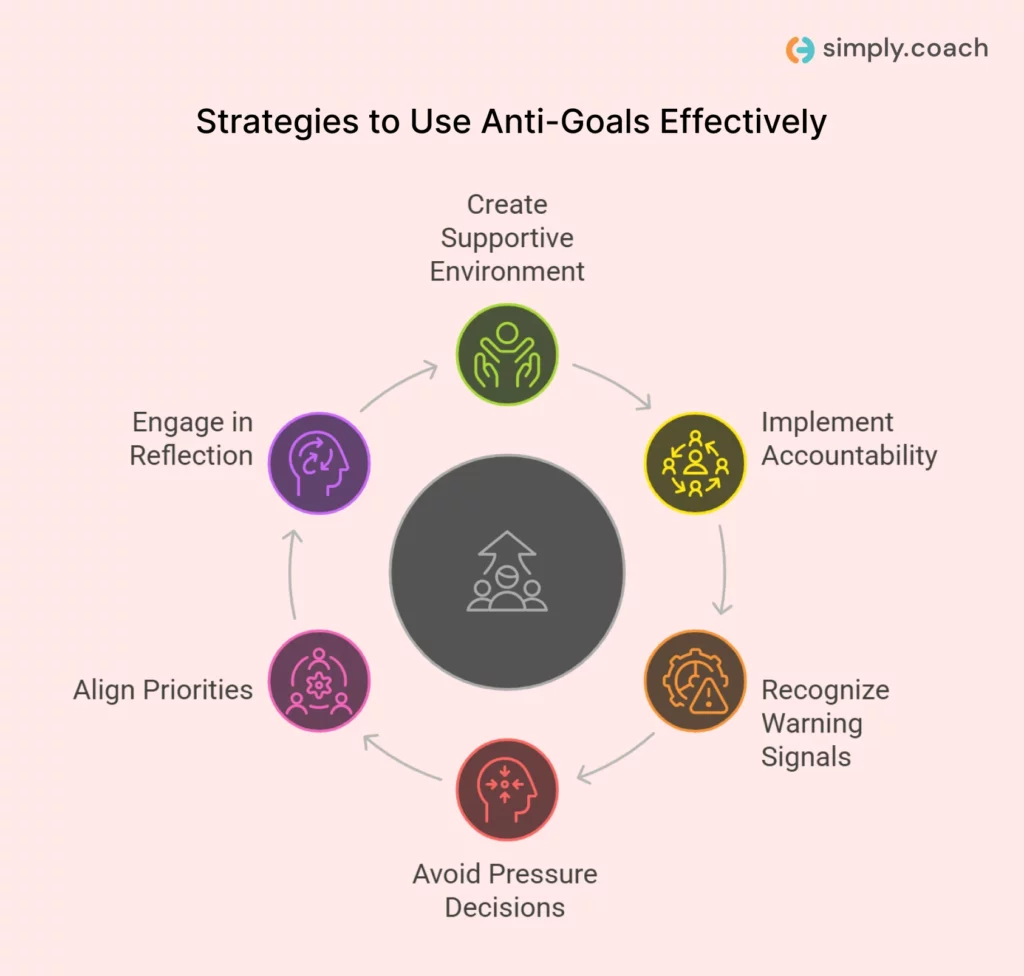
Once anti-goals are defined, the challenge is helping your clients apply them consistently in real situations. Many clients understand their boundaries during sessions but struggle to maintain them when pressure, urgency, or emotions take over. As a coach, your role is to ensure anti-goals are not just defined but actively practiced, reinforced, and sustained over time.
1. Design the environment to support anti-goals
Your client’s environment plays a direct role in whether anti-goals are followed or ignored. Instead of relying only on discipline, help clients reduce exposure to triggers that lead to unwanted behaviors.
For example, if a client struggles with constant interruptions, removing notifications or blocking focus time creates immediate relief. If late-night work is a problem, setting clear device cut-off times can reinforce boundaries. These changes make it easier for clients to stay aligned without constant effort.
2. Build simple accountability systems
Anti-goals become more effective when clients know they will review them regularly. Without accountability, most boundaries weaken over time, especially when short-term pressures arise.
Encourage your clients to track what they successfully avoided each week, not just what they achieved. You can also introduce simple systems like weekly check-ins, shared trackers, or peer accountability. This keeps anti-goals visible and reinforces commitment beyond the coaching session.
3. Help clients recognize early warning signals
Most clients don’t break boundaries suddenly; there are early signs that appear before the behavior happens. Helping clients identify these signals allows them to act before the situation escalates.
Ask your clients to reflect on moments when they almost ignored an anti-goal. These situations often reveal triggers such as urgency, guilt, or external pressure. Once identified, clients can pause and make more intentional decisions instead of reacting automatically.
4. Strengthen decision-making during high-pressure situations
Anti-goals are most likely to fail when clients feel pressured to respond quickly. In these moments, they tend to fall back into old habits. Preparing for these situations improves consistency.
You can guide clients to slow down their response process, even in urgent scenarios. Encouraging a short pause before committing to requests can help them evaluate whether the decision aligns with their anti-goals. This creates space for better judgment under pressure.
5. Connect anti-goals to what matters most
Clients are more likely to follow anti-goals when they understand why those boundaries exist. If anti-goals feel restrictive, they are often ignored or bypassed.
Help your clients connect each anti-goal to something meaningful, such as protecting their time, health, or relationships. When clients see anti-goals as safeguards rather than limitations, their commitment becomes stronger and more consistent.
6. Reinforce progress through reflection
Regular reflection helps clients recognize the impact of following anti-goals. Without this, they may overlook progress because avoidance is less visible than achievement.
During sessions, ask your clients what improved because they maintained their boundaries. This could include better focus, reduced stress, or improved work quality. Highlighting these outcomes reinforces the value of anti-goals and encourages long-term adherence.
When you apply these best practices consistently, anti-goals become more than defined boundaries, they turn into a reliable system that helps your clients protect their energy, make better decisions, and sustain meaningful progress.
Also read: How to Set SMART and Stretch Goals for Your Coaching Business
Common Mistakes to Avoid When Using Anti-Goals in Coaching
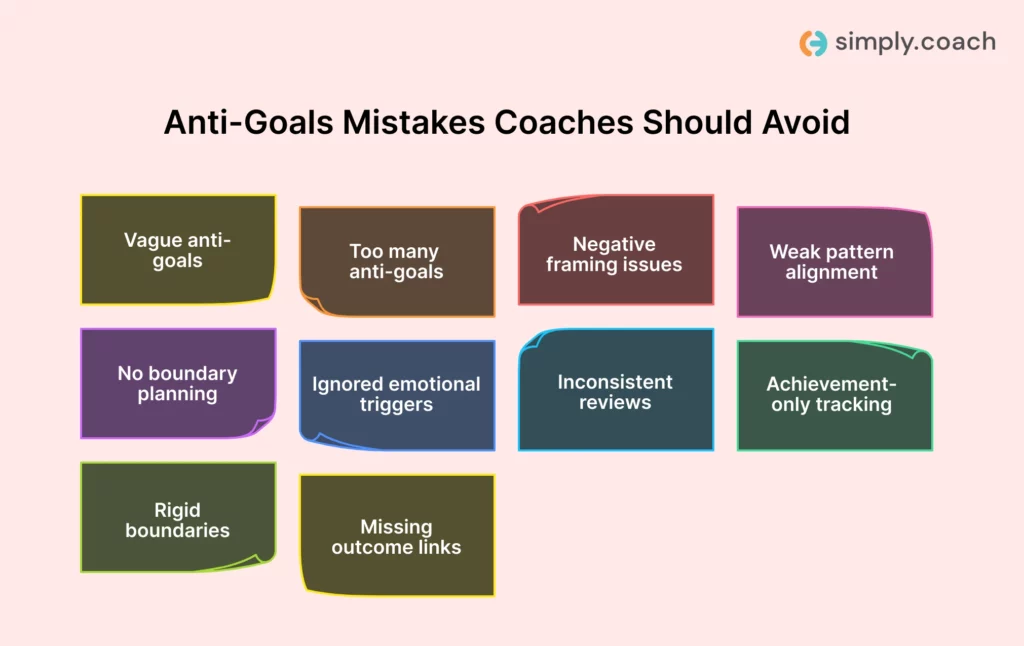
Anti-goals are powerful when applied correctly, but many coaches and clients misuse them in ways that reduce their effectiveness. Avoiding these specific mistakes will help you ensure anti-goals drive consistent and measurable behavior change.
- Defining anti-goals too vaguely: Statements like “avoid burnout” or “don’t overwork” lack clarity and cannot guide daily decisions. Always translate anti-goals into specific, observable behaviors that clients can act on immediately.
- Focusing on too many anti-goals at once: Overloading clients with multiple restrictions creates confusion and reduces adherence. Limit anti-goals to a small number of high-impact areas to maintain focus and consistency.
- Treating anti-goals as negative thinking: Some clients resist anti-goals because they feel restrictive or pessimistic. Clarify that anti-goals are practical boundaries designed to protect energy and improve outcomes, not limit growth.
- Not linking anti-goals to real client patterns: Creating anti-goals without grounding them in past behaviors leads to irrelevant or ineffective boundaries. Always base anti-goals on recurring mistakes, triggers, and real-life experiences.
- Failing to prepare for boundary challenges: Clients often break anti-goals when situations become urgent or uncomfortable. Without pre-defined responses, they default to old habits instead of maintaining boundaries.
- Ignoring emotional triggers behind behaviors: Many boundary violations are driven by emotions like guilt, fear, or the need to please others. If these triggers are not addressed, anti-goals will not hold under pressure.
- Not reviewing anti-goals consistently: Anti-goals lose relevance when they are not revisited regularly. Without review, clients forget, ignore, or outgrow them without proper adjustment.
- Measuring only achievements, not avoidance: Coaches often track what clients accomplish but ignore what they successfully avoided. This misses a key indicator of progress and reduces reinforcement of positive behavior change.
- Setting unrealistic or rigid boundaries: Anti-goals that do not fit the client’s context are often broken quickly. Boundaries should be practical, flexible, and aligned with the client’s actual responsibilities.
- Failing to connect anti-goals to outcomes: When clients do not see how avoiding certain behaviors improves their results, motivation drops. Always link anti-goals to tangible outcomes like improved focus, reduced stress, or better performance.
Avoiding these mistakes ensures that anti-goals remain practical, relevant, and effective, helping your clients build consistent habits and achieve sustainable progress.
When to Use Anti-Goals in Coaching (and When Not to)
Knowing when to use anti-goals is just as important as knowing how to set them. While anti-goals are highly effective in many coaching scenarios, they are not suitable for every client or situation.
| Situation | When anti-goals work best | When anti-goals may not be effective |
| Client clarity level | When clients feel stuck, overwhelmed, or unclear about what they want but can easily identify what they want to avoid. | When clients already have strong clarity and need direction toward specific outcomes rather than avoidance. |
| Behavior patterns | When clients repeat the same mistakes, habits, or decisions that consistently block progress. | When clients are experimenting or exploring new areas without established negative patterns yet. |
| Emotional state | When clients experience stress, burnout, or frustration caused by recurring situations or poor boundaries. | When clients are highly anxious or overly negative, where focusing on avoidance may reinforce limiting thinking. |
| Coaching goals | When the focus is on improving behavior, decision-making, and boundary-setting in daily routines. | When the focus is purely on achieving measurable outcomes such as revenue targets or performance metrics. |
| Decision-making challenges | When clients struggle to say no, overcommit, or make reactive decisions under pressure. | When clients already have strong discipline and need strategies to scale performance rather than avoid risks. |
| Stage of coaching | Early stages, where understanding patterns and risks helps build a strong foundation for future progress. | Later stages, where clients need optimization, growth strategies, or advanced performance systems. |
Using anti-goals at the right time helps you address root causes of setbacks, while using them in the wrong context can limit progress or create unnecessary constraints.
How Simply.Coach Helps You Set and Track Anti-Goals Effectively
Setting anti-goals requires consistent tracking, structured reflection, and clear accountability. Simply.Coach helps you integrate all of this into your coaching workflow, so anti-goals are not just defined but actively followed and measured.
- Centralized goal planning: You can document anti-goals alongside traditional goals in one place, ensuring they remain visible and part of every coaching conversation.
- Structured session notes for reflection: Capture what clients avoided, identify patterns, and track behavioral changes over time without relying on scattered notes.
- Action plans with built-in accountability: Assign anti-goals as clear commitments within action plans, making it easier to track whether clients follow through consistently.
- Progress tracking with measurable outcomes: Link anti-goals to results such as improved focus, reduced stress, or better time management, making progress tangible for clients.
- Dedicated client workspace: Clients can revisit their anti-goals, session insights, and commitments anytime, helping them stay aligned between sessions.
- Reminders and follow-ups: Automated prompts help clients stay consistent with their boundaries, especially during high-pressure situations where they might revert to old habits.
Using Simply.Coach, you can turn anti-goals into a structured, trackable system that improves accountability, strengthens client consistency, and delivers measurable coaching outcomes.
Conclusion
Anti-goals give you a practical way to help clients avoid patterns that consistently block progress and create setbacks. They shift focus from abstract outcomes to clear behavioral boundaries that guide daily decisions. When used alongside traditional goals, they create a balanced system that improves clarity, consistency, and accountability. As a coach, this approach allows you to deliver more structured, measurable, and sustainable client outcomes.
If you want to implement anti-goals with consistency and clarity, Simply.Coach provides the structure you need. From tracking client progress to managing action plans and session insights, it keeps everything organized in one place. You can reinforce anti-goals through regular reviews, accountability systems, and measurable outcomes without added complexity. This allows you to focus more on coaching while ensuring your clients stay aligned and consistent.
FAQs
1. What are anti‑goals and why are they useful in coaching?
Anti‑goals are clearly defined behaviors, outcomes, or states your client wants to avoid. They help surface negative patterns and stressors by framing what worst‑case scenarios look like, making boundaries easier to enforce. This approach increases clarity and reduces unintended behaviours that block progress.
2. How do anti‑goals work differently from traditional goals?
Traditional goals describe where you want to go, while anti‑goals describe what you want to avoid. Anti‑goals use avoidance motivation and loss aversion to strengthen focus and reduce distraction, helping clients stay on path by preventing mistakes rather than just chasing outcomes.
3. When should a coach use anti‑goals with a client?
Use anti‑goals when a client feels stuck, lacks clarity, or repeatedly experiences the same setbacks. They are especially useful if your client struggles to articulate what they want but can easily describe what they want to avoid.
4. Can anti‑goals improve productivity and work‑life balance?
Yes, anti‑goals help clients eliminate energy drains, reduce stress, and protect personal time by setting strict boundaries. For example, avoiding late‑night emails or unnecessary meetings can increase focus and reduce burnout.
5. How do I turn a worst‑case scenario into an actionable anti‑goal?
Start by having clients describe vivid negative outcomes, then identify the behaviours that contribute to them. Translate those behaviours into specific rules or boundaries that prevent those outcomes from happening.
6. Do anti‑goals work better for certain types of goals?
Anti‑goals are most impactful when used alongside traditional goals, as they prevent pitfalls that often derail progress toward desired outcomes. They work well in behaviour‑change, boundary setting, habit formation, and stress reduction.
7. Is setting anti‑goals only about avoiding negatives?
No, it’s about defining what holds your client back so you can design proactive strategies for growth. Understanding what clients want to avoid can reveal values and priorities that shape their positive ambitions.
8. How often should anti‑goals be reviewed or updated?
Review anti‑goals regularly, ideally during session check‑ins, to ensure they remain relevant as client circumstances change. This helps refine boundaries and maintain alignment with evolving goals.