
Therapy is no longer something people see as a luxury. It’s become a necessity. In 2026, almost 25% of Americans are seeing a therapist, while nearly half (48%) plan to start within the next year. That’s a significant number, showing considerable demand for highly effective therapeutic support.
You’re likely making a real impact with your clients, but running a practice can still feel overwhelming. You’re dealing with endless admin, unpredictable referrals, no-shows, and growth that seems just out of reach no matter what you do.
Does that sound like you?
This guide is designed for therapists like you, those doing important work but struggling to scale without feeling burnt out. We’ll go over some practical strategies to help you grow your therapy practice in 2026, using systems and tools that let you focus on your clients instead of the paperwork.
Audit Your Current Practice: Where Are the Gaps?
Before diving into strategies for growth, it’s crucial to take a step back and assess how things are running now.
Ask yourself:
- Are you still tracking sessions with a notebook or scattered Google Docs?
- Do no-shows happen more often than you’d like, costing you both time and energy?
- Are you spending five or more hours a week just handling administrative tasks?
- Do you find yourself re-writing intake forms or repeating onboarding steps for each new client?
- Can you easily show progress data if a client or their sponsor asks for it?
If even one of these questions made you pause, you’re not alone. Many therapists build their practices on word of mouth and organic growth, not necessarily on streamlined systems. And that’s where the gaps begin to show.
Let’s explore some key strategies that will help you scale your therapy practice while delivering impactful outcomes for your clients.
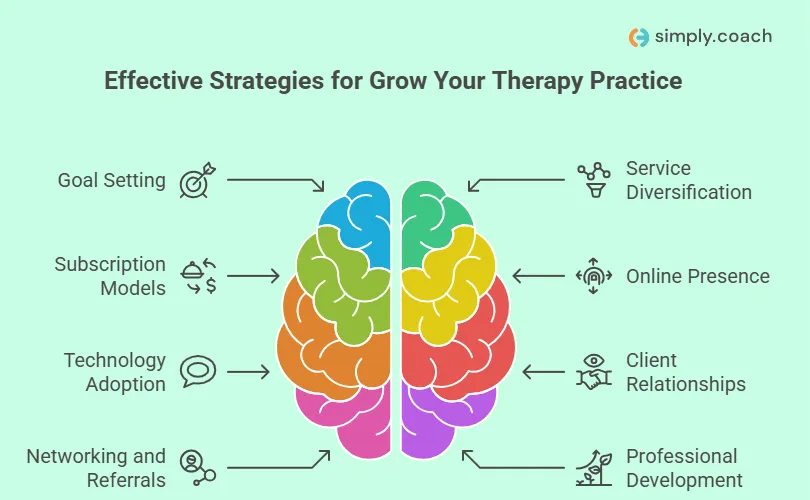
1. Set Clear and Achievable Goals with Your Clients
As a therapist, you know that helping clients set and achieve goals is at the core of effective therapy. But how do you ensure those goals are clear, realistic, and achievable?
Let’s explore into two powerful strategies that can help you guide your clients toward real progress.
A. SMART goal-setting
Setting goals is an essential part of therapy, but not all goals are created equal. The SMART method helps you break down goals in a way that makes them clear, achievable, and motivating.
- Specific: The goal needs to be clear and focused. Instead of “I want to feel better,” it might be “I want to reduce my anxiety levels by practicing relaxation techniques three times a week.”
- Measurable: You should be able to track progress. How will you know when the goal has been achieved? In the example above, measuring anxiety levels can be done through regular self-assessments or feedback.
- Achievable: Make sure the goal is within reach. It should challenge your client but still be attainable with effort.
- Relevant: The goal should matter to your client. It must align with their personal values and motivations.
- Time-bound: Set a clear deadline for when the goal should be accomplished. A goal like “reduce anxiety in the next three months” is more actionable than a vague “reduce anxiety sometime.”
Using SMART goals helps your clients see exactly what they’re working toward, keeps them focused, and makes it easier to track progress along the way.
Read: How to Set and Use SMART Therapy Goals (with Examples)
B. Action plans and nudges
Once a goal is set, the next step is to break it down into actionable steps and build in regular nudges to keep your clients on track.
- Action plans: Action plans help your clients take small, manageable steps toward their bigger goal. For example, if the goal is to improve anxiety management, an action plan might include daily relaxation exercises, weekly reflection on progress, and regular check-ins with you.
- Nudges: Sometimes clients need a little extra push to stay motivated. Nudges, gentle reminders, encouragements, or prompts are key to maintaining momentum. These could be weekly check-ins, automated reminders to complete specific tasks, or simply encouraging clients to stay consistent with their action plans.
Together, action plans and nudges help clients stay focused, on track, and empowered to take control of their progress.
2. Diversify Your Services to Attract a Broader Client Base
As a therapist, you may already be offering valuable one-on-one sessions, but what if you could expand your services and attract more clients?
Diversifying your offerings not only opens up new revenue streams but also helps you reach a broader audience. Here are some effective ways to do just that:
A. Online courses and workshops
- The rise of online learning has opened up countless opportunities for therapists. Many clients are now looking for flexible, accessible ways to improve their mental health, whether it’s through self-paced courses or live workshops.
- Offering online courses or workshops allows you to extend your expertise beyond your one-on-one sessions. For example, you could create a course on managing stress, improving relationships, or boosting self-confidence.
- If you’re wondering how to set this up, tools like Simply.Coach’s Journey Builder allow you to easily create structured programs that can be replicated for multiple clients. These programs can be tailored to fit various client needs, giving you a new way to serve more people with less effort.
B. Specialized coaching programs
- With so many therapists offering general services, it’s important to specialize in order to
tostand out against the competition. Consider offering life coaching, career coaching, or stress management therapy to carve out a niche. - By focusing on a specific area, you not only attract clients looking for those services but also position yourself as an expert in that field. Specializing can help you connect with a particular group of people who need your help, whether that’s professionals in high-stress industries or individuals navigating career changes.
- Example: If you specialize in stress management therapy, you could offer services tailored to healthcare professionals dealing with burnout. By providing coping strategies, relaxation techniques, and tools for maintaining work-life balance, you can help them manage stress and improve their overall well-being in high-pressure environments.
C. Subscription & package models
- Subscription models or session packages are a great way to keep clients engaged long-term. Rather than offering individual sessions, you can create pricing models that encourage ongoing commitment.
- Offering flexible packages also allows you to cater to different client needs. Some clients may prefer a few intensive sessions, while others might benefit from a longer, continuous commitment.
- What to charge:
- Monthly: $200-$500 per month for weekly 50-minute sessions, plus email support.
- Yearly: $2,000-$5,000 annually, with a discount for long-term commitment.
- Weekly sessions: 50-minute one-on-one therapy.
- Progress tracking: Tools for tracking goals and assessments.
- Personalized action plans: Tailored plans for clients to work on between sessions.
- Email support: Access to you for questions between sessions.
- Exclusive resources: Worksheets, journaling prompts, and guided meditations.
- Group sessions: Discounted access to workshops or online group therapy.
- If you’re looking to offer these kinds of options, Simply.Coach’s subscription and session packages make it easy to create and manage packages or subscription models, helping you track payments and client engagement while keeping things organized.
3. Build and Use Your Online Presence
In today’s digital world, having a strong online presence is crucial for growing your practice. It’s not enough to rely on word-of-mouth alone. Here’s how you can use your online presence to attract new clients, build trust, and expand your reach.
A. Social proof: Testimonials and reviews
- Client success stories, testimonials, and reviews are powerful tools for building trust. Potential clients want to know that you’ve helped others achieve results, and positive feedback can convince them that you can do the same for them.
- Encourage satisfied clients to leave reviews on your website, Google, or trusted platforms like G2 and Capterra. These reviews act as social proof and help potential clients feel confident in choosing your services. It’s one of the easiest ways to establish trust before clients even step into your office or start a session.
Why reviews matter:
- Trust and credibility: 74% of consumers say that reviews increase trust in a company.
- Informed decision-making: 68% of consumers form opinions after reading 1–6 reviews.
- Revenue impact: Increasing a business’s Yelp rating by one star can increase revenue by 5–9%.
- Consumer behavior: 95% of consumers read online reviews before making a purchasing decision.
Incorporating authentic testimonials into your marketing strategy can significantly enhance your practice’s reputation and attract new clients.
B. Optimize your website
- A professional website is essential for showcasing your expertise and services. It should highlight your credentials, certifications, and experience, as well as provide a clear call to action (CTA) if that’s booking a consultation or signing up for a newsletter.
- If you don’t have a website yet or want to improve your current one, Simply.Coach’s showcase page makes it easy to build a personal website that reflects your practice and converts visitors into clients. Your website is often the first impression potential clients will have, so make sure it’s polished and professional.
C. Content marketing and SEO
- Blogging and SEO are key for driving traffic to your website and helping potential clients find you. Regularly posting valuable content related to your niche, if that’s tips for managing anxiety or strategies for career development, helps you rank on search engines and establish authority in your field.
- Social media is another powerful tool for staying connected with your current clients and reaching new ones. Sharing relevant articles, or even behind-the-scenes content, can help build engagement and keep your therapy practice top of mind.
4. Embrace Technology to Streamline Your Practice
As a therapist, you’re juggling client sessions, paperwork, scheduling, and everything else that comes with running a practice. It’s easy to feel overwhelmed by all the administrative tasks, especially when you want to focus on helping your clients. But with the right technology, you can streamline these tasks and create more time for what matters most to your clients.
A. Video conferencing integration
- Remote sessions are now the norm: Many clients prefer the convenience of virtual sessions, and it’s likely to stay this way. Offering remote therapy can help you expand your reach and make sessions more accessible.
- Integrating tools like Zoom or Microsoft Teams into your practice allows you to keep everything in one place, from scheduling to video calls. This saves you from switching between different platforms and apps.
- No-shows are a hassle: Automated reminders (via email or text) can help ensure clients show up for their sessions and complete any necessary forms ahead of time, making your workflow smoother.
B. Automation tools
- Admin work eating up your time? Scheduling, billing, and client intake can quickly take up hours each week. Automation tools can handle these tasks for you.
- With the right tools, you can automate everything from appointment scheduling to payment processing. This gives you
backthe vital time you need to focus on your clients.
C. Client relationship management
- Tracking client progress shouldn’t be a chore: Managing goals, progress, and notes manually can get messy and time-consuming. Using digital tools helps keep everything organized.
- Platforms that offer customizable client workspaces allow you to track goals, share resources, and easily update progress, keeping clients engaged and on track.
| Simply.Coach provides all these features in one platform, designed specifically for therapy practices. Their all-in-one therapy practice management software saves you time and helps you grow. Learn more and schedule a demo today. |
5. Strengthen Client Relationships with Effective Communication
Effective communication is at the heart of building lasting, impactful relationships with your clients. It’s not just about what you say, but how you listen and engage.
Here’s how you can improve your communication with clients to strengthen those relationships and support their progress.
A. Active listening and client-centered approach
- Building rapport is key to creating trust with your clients. When clients feel heard and understood, they’re more likely to engage in the therapeutic process and make meaningful progress.
- Active listening means fully focusing on the client, acknowledging their feelings, and asking thoughtful questions that help them explore their concerns. This builds a connection that helps them feel safe and supported.
B. Regular check-ins and feedback
- To keep clients engaged and motivated, it’s essential to have regular check-ins throughout the course of therapy. These check-ins provide an opportunity to discuss progress, adjust goals, and address any concerns before they become bigger issues.
- Feedback is a valuable tool for continuous improvement. Actively seeking feedback from your clients helps you understand what’s working and what isn’t, allowing you to fine-tune your therapy approach.
6. Expand Your Reach through Networking and Referrals
Growing your practice isn’t just about what you can do within the four walls of your office. Expanding your reach through networking and referrals can help bring in new clients and create long-term, mutually beneficial relationships. Here’s how you can leverage these strategies to grow your therapy practice.
A. Build strategic partnerships
- Networking with other professionals is one of the most effective ways to expand your reach. Partner with doctors, life coaches, or other mental health professionals who can refer clients to you. A trusted referral from a colleague can be a strong recommendation for potential clients seeking help.
- Corporate wellness programs are another great avenue. Reach out to health institutions, schools, or businesses to offer wellness programs or employee support services. These partnerships can be a steady stream of referrals and help you build a reputation as an expert in your field.
B. Referral Programs
- A referral program incentivizes your current clients to recommend your services to others. Offering a small discount, free session, or other benefits for each successful referral encourages clients to spread the word about your practice.
- The key is to make it easy for clients to refer others. Create a simple system for them to pass along your information, whether through a referral card, a personalized email, or a referral link on your website.
Join Simply.Coach’s Affiliate Program
Join Simply.Coach’s Affiliate Program and earn up to $199 USD for every successful Referral. Sign up, share your unique referral link, and start earning a commission as soon as someone you refer subscribes to Simply.Coach.

7. Stay Updated and Invest in Continuous Professional Development
The therapy field is constantly evolving. To stay competitive and continue delivering the best care to your clients, it’s essential to invest in your own growth.
Here’s how you can stay on top of industry trends and expand your skills to ensure continuous improvement in your practice.
A. Attend conferences, webinars, and podcasts
- Staying updated with the latest industry trends is crucial for keeping your skills sharp and relevant. Attending conferences, webinars, and listening to podcasts are excellent ways to stay informed and learn from experts in your field.
- They provide valuable insights, new techniques, and fresh perspectives that can be applied to your practice.Join the Growth Dialogues CommunityTune in to the Growth Dialogues Podcast and gain actionable insights for growing your therapy practice. Each episode features expert guests sharing strategies and tips to help you thrive. As a listener, you can implement these powerful approaches directly into your practice.Listen now!
B. Professional development logs
- Track your growth to ensure you’re continuously developing as a professional. Keeping a professional development log allows you to track your certifications, hours, and any additional training or workshops you’ve completed.
- This helps you stay on top of your goals and ensures that you meet any continuing education requirements.
8. Use AI to Grow Your Therapy Practice
In 2026, AI is revolutionizing the way businesses operate, and therapy practices are no exception. By integrating AI into your workflow, you can save time, improve client engagement, and enhance the overall client experience. Here are a couple of strategies to consider:
A. AI-powered client management
- Streamline administrative tasks such as appointment scheduling, client follow-ups, and reminders.
- AI-driven platforms can automatically schedule sessions based on availability.
- Send reminder emails or text messages to clients.
- Reschedule appointments if a client misses a session, reducing no-shows.
- Keep your calendar organized, allowing you to focus more on your clients.
B. AI for personalized client insights
- AI tools can track goals, emotional responses, and behaviors to analyze client data.
- Gain deeper insights into your clients’ progress and needs.
- Offer more tailored and effective therapy based on data-driven insights.
- Identify areas that may need more focus to enhance the therapeutic process.
- Use AI to generate progress reports and provide clients with data-backed updates, making therapy more transparent and results-driven.
Common Mistakes to Avoid When Growing Your Therapy Practice
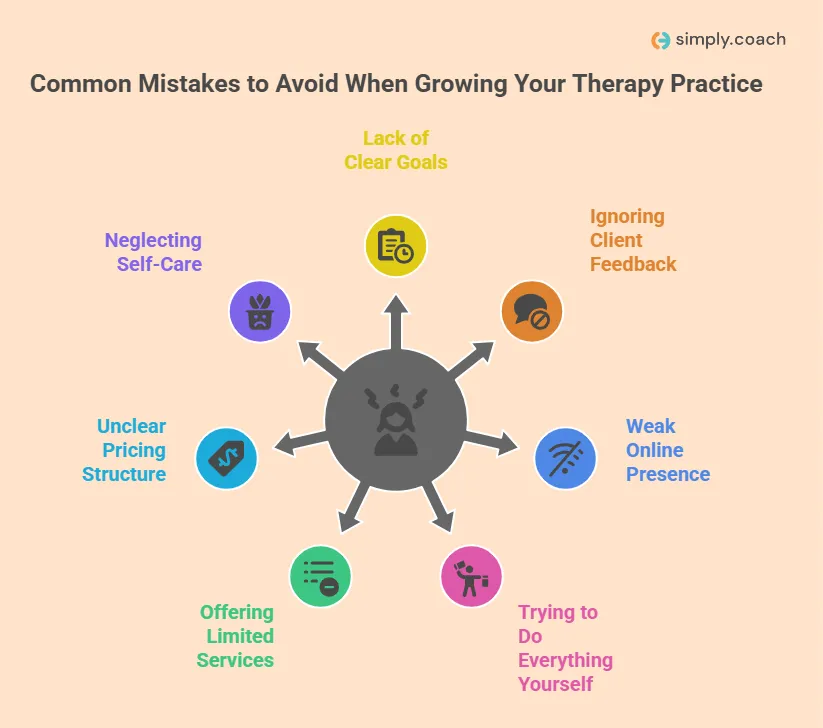
Growing your therapy practice can be challenging, but avoiding these common mistakes will set you on the right path toward success and sustainability.
- Lack of clear goals: Without clear goals, you risk wasting time and energy. Set specific, measurable, achievable, relevant, and time-bound (SMART) goals to keep your growth focused and trackable.
- Ignoring client feedback: Neglecting to listen to your clients can cause stagnation. Regularly seek feedback to adjust your services and ensure you’re meeting their needs effectively.
- Weak online presence: A limited online presence can restrict your reach. Build a professional website and maintain an active presence on social media to attract new clients and showcase your expertise.
- Trying to do everything yourself: Overloading yourself with tasks outside of therapy leads to burnout. Automate administrative tasks and consider delegating marketing or other functions to keep your focus on client care.
- Offering limited services: Limiting your services can restrict client growth. Offer specialized programs or therapy options to address diverse client needs and expand your client base.
- Unclear pricing structure: Ambiguity in pricing can create confusion and mistrust. Be transparent about your pricing, ensuring clients know exactly what to expect and can plan accordingly.
- Neglecting self-care: Ignoring your own well-being will eventually affect your ability to help others. Prioritize self-care and set boundaries to ensure you stay healthy and effective as a therapist.
Conclusion
Growing your therapy practice requires intentional effort, the right tools, and a clear strategy. By setting achievable goals, diversifying your services, and leveraging effective communication, you can create a practice that thrives. Avoiding common mistakes will help you stay focused, organized, and on track for long-term success.
Simply.Coach is a powerful therapy practice management software designed to streamline your practice, automate administrative tasks, and improve client engagement. With everything in one platform, it saves you time and helps you focus on what really matters to your clients.
| Watch this review by Eva Martin, a coach and therapist, on how Simply.Coach can help streamline your practice: Simply.Coach Review: Eva Martin, Coach and Therapist |